
# The Ultimate Fall & Winter Car Maintenance Checklist in America: How to Prepare Your Vehicle for Cold Weather & Avoid Breakdowns
It is the single most dreaded sound on a freezing winter morning: you hurry out into the bitter cold, turn the ignition key or press the start button, and instead of a confident, roaring engine, you hear a sluggish, agonizing click... click... wheeze... silence.
Your car battery is dead. You are late for work, your kids are shivering in the backseat, and the local roadside assistance service is quoting a four-hour wait time due to a surge in emergency calls.
According to automotive breakdown statistics from AAA, roadside assistance crews respond to more than 32 million calls per year across the United States—with the vast majority of preventable battery failures, tire blowouts, and engine overheating occurring during severe temperature transitions in late autumn and winter.
Cold weather is brutally unforgiving to mechanical components. Low temperatures thicken engine fluids, reduce chemical battery output by up to 50%, cause tire pressure to plummet overnight, and turn worn windshield wipers into useless streaks of ice.
The good news? Spending just 45 minutes in your driveway or garage in late September or October can save you hundreds of dollars in towing fees, prevent catastrophic engine damage, and ensure your vehicle starts reliably every single morning.
Here is your comprehensive, step-by-step autumn and winter car care checklist.
1. The #1 Winter Killer: Test Your 12V Car Battery Before the First Freeze
If there is one maintenance item you inspect this week, make it your 12-volt battery.
Why do batteries fail so dramatically in winter? It is a cruel double-whammy of chemistry and physics:
- Reduced Chemical Capacity: When temperatures drop to 32°F (0°C), a lead-acid battery loses approximately 35% of its cranking power. At 0°F (-18°C), battery strength drops by more than 50%.
- Increased Engine Resistance: At the exact same time your battery is at its weakest, cold engine oil thickens like molasses, requiring nearly twice as much electrical energy from the starter motor to turn the engine over.
If your battery was already weakened during summer heat waves (which evaporate internal electrolyte fluid), the first autumn frost will finish it off.
How to Inspect and Test Your Battery:
- Check the Age Stamp: Look at the date sticker on top of the battery casing (e.g., "09/23" means September 2023). Most car batteries in the US have a reliable lifespan of 3 to 5 years. If your battery is over 3 years old, treat it with caution.
- Inspect the Terminals for Corrosion: White, powdery crust (lead sulfate or copper corrosion) around the positive and negative terminals acts as an electrical resistor, choking off current. Disconnect the negative terminal first, scrub the terminals clean with a wire brush dipped in a baking soda and warm water mixture, dry thoroughly, and apply a thin coat of dielectric grease or petroleum jelly.
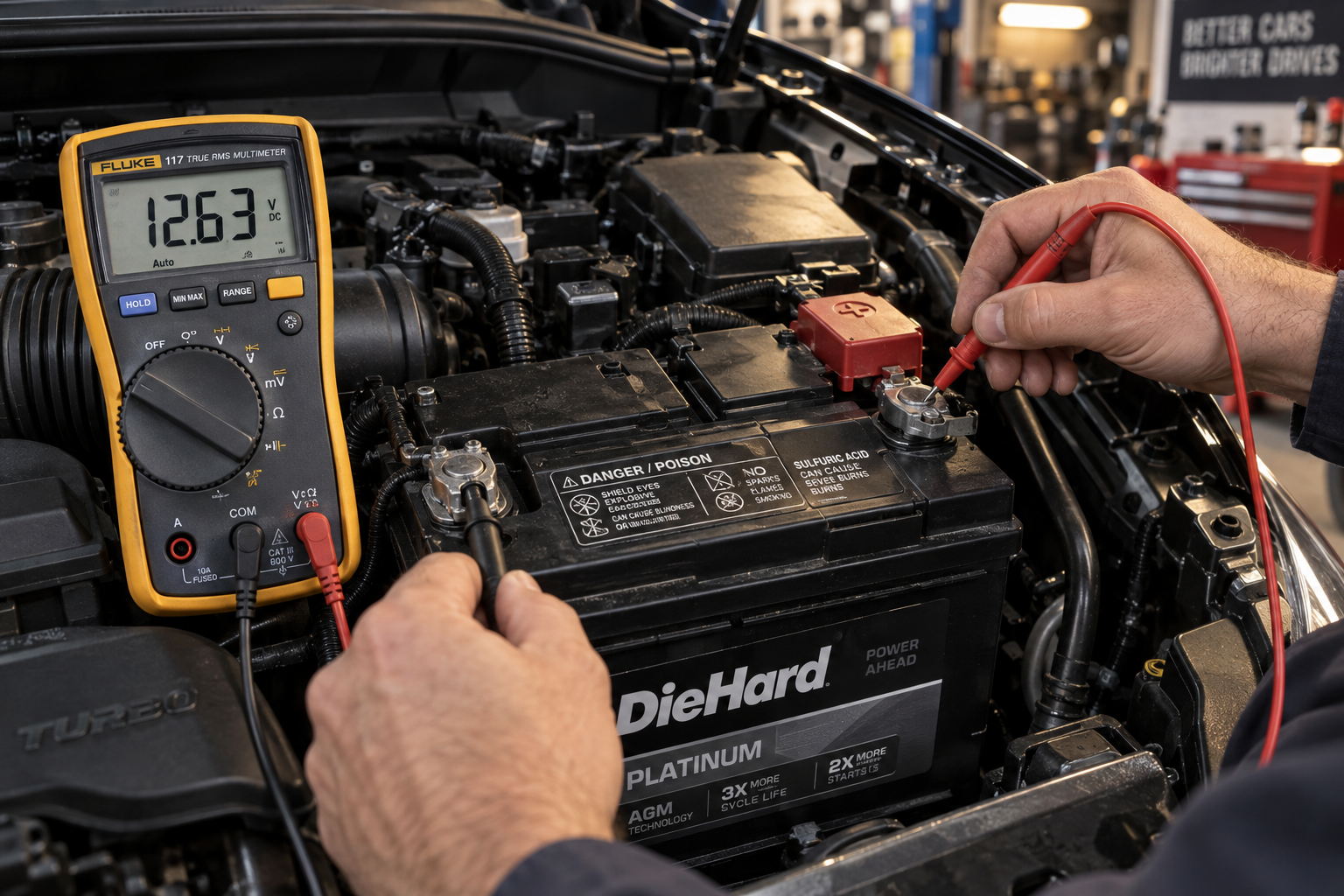
- Check Voltage with a Digital Multimeter:
- Turn off the engine and headlights. - Set your multimeter to DC Volts (20V scale). - Touch the red probe to the positive (+) terminal and the black probe to the negative (-) terminal. - 12.6V or higher: Fully charged and healthy (100%). - 12.4V: Acceptable, roughly 75% charged. - 12.2V or below: Discharged or dying (50% or less)—charge immediately or replace before winter.
2. Tires: Tread Depth, the "Penny Test," and the 1 PSI Rule
Your tires are the only four contact patches connecting your 3,500-pound vehicle to the road surface. In rain, slush, black ice, and snow, worn tread turns your car into a sled on greased rails.
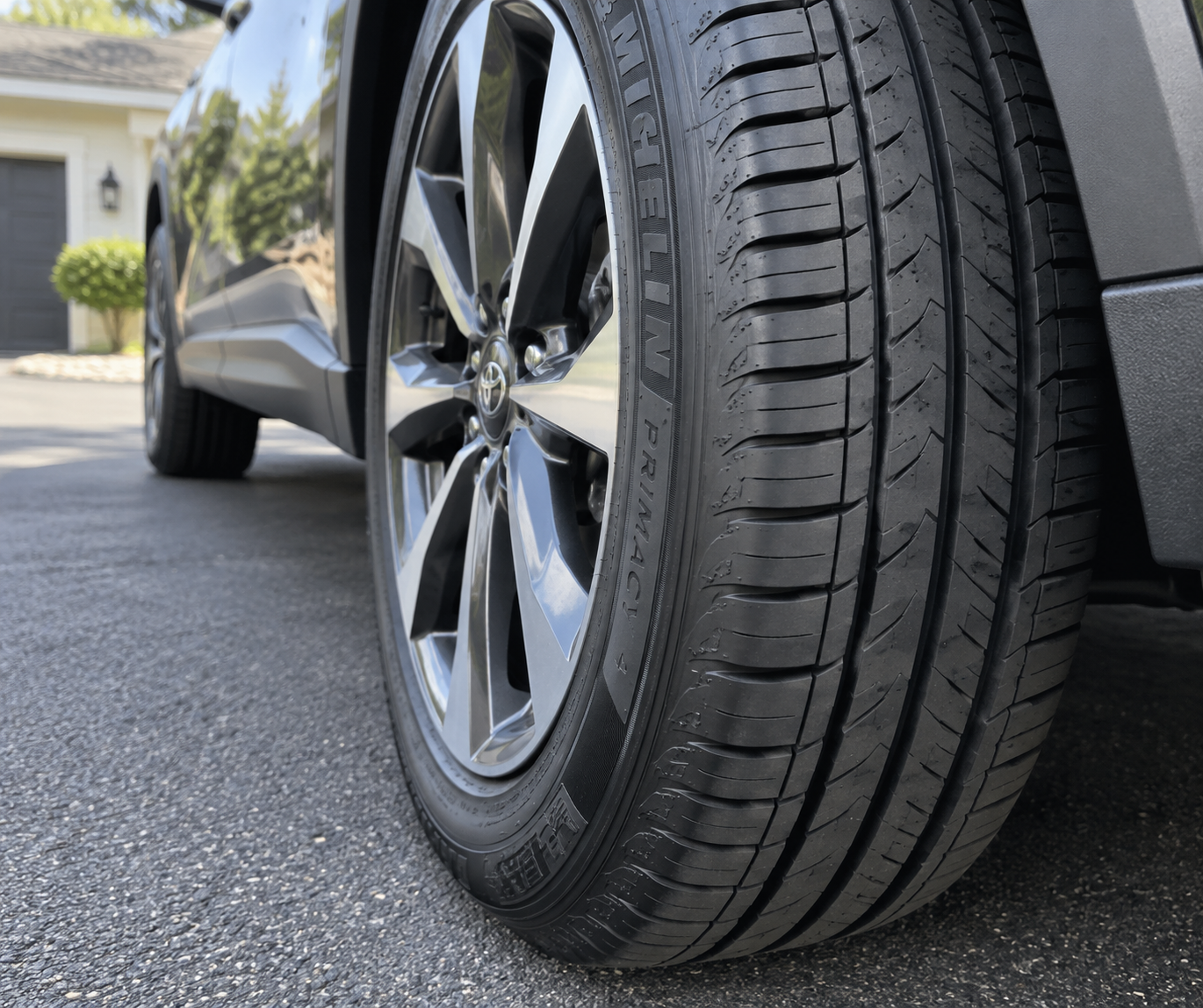
The "Lincoln Penny Test" for Tread Depth
You do not need specialized tools to check whether your tires are legally safe and winter-ready:
- Take an ordinary copper US penny and turn Abraham Lincoln's head upside down, facing you.
- Insert the coin into several deep grooves across the tire tread (center, inner edge, outer edge).
- If you can see the top of Lincoln's entire head: Your tread depth is less than 2/32 of an inch. Your tire is legally bald, dangerously unsafe on wet roads, and must be replaced immediately.
- If Lincoln's hair is partially covered: Your tread is around 4/32 of an inch. While legally acceptable for dry summer highway driving, it has lost significant hydroplaning resistance in slush and heavy rain.
- For safe winter driving: Automotive safety experts recommend a minimum of 5/32 to 6/32 of an inch to effectively channel water, slush, and packed snow away from the tire footprint.
The 1 PSI per 10°F Rule: Why Your TPMS Light Flashes
Have you ever walked out on the first chilly autumn morning to find the horseshoe-shaped Tire Pressure Monitoring System (TPMS) warning light glowing on your dashboard?
Tires do not necessarily have a leak. It is basic thermodynamics: for every 10°F (-12°C) drop in ambient temperature, tire pressure drops by approximately 1 to 2 PSI (pounds per square inch).
If your tires were filled to 32 PSI on an 85°F August afternoon, a sudden cold snap down to 35°F will drop your pressure down to 27 PSI—triggering the low-pressure sensor.
- Action: Check tire pressure when the tires are \"cold\" (before driving, or at least 3 hours after parked).
- Fill all four tires (and your spare!) to the exact PSI listed on the yellow-and-white sticker inside the driver-side door jamb—never to the maximum PSI printed on the tire sidewall.
3. Critical Fluid Swaps: Don't Let Your Wiper Reservoir Freeze & Crack
One of the most common and costly autumn oversights is leaving summer-formula windshield washer fluid in your car.
Swap Out Summer Washer Fluid
- The Problem: Inexpensive blue washer fluid sold during summer is essentially tinted water with mild soap. It freezes solid at 32°F (0°C). When it freezes, it expands, cracking your plastic washer reservoir tank, splitting rubber delivery hoses, and burning out the electric washer pump motor ($200 to $400 repair). Worse, spraying it onto a cold windshield on the highway will instantly create an opaque sheet of ice across your glass, blinding you at 65 mph.
- The Solution: Run your washer reservoir down or siphon it, then refill with winter-grade de-icer fluid rated to -20°F (-29°C) or -30°F (-34°C) containing methanol. These formulas melt frost on contact and will never freeze inside the lines.
Verify Engine Coolant / Antifreeze
Engine coolant does not just prevent summer overheating—its primary winter duty is preventing engine block cracking. Pure water expands by 9% when frozen, with enough hydraulic force to crack an iron engine block or rupture your radiator.
- Use a cheap $5 antifreeze hydrometer tester to check your coolant's freeze point.
- A standard 50/50 mix of ethylene glycol antifreeze and distilled water protects your engine down to -34°F (-37°C) and raises the boiling point to 265°F.
Engine Oil Viscosity: Switch to Winter-Weight
Modern synthetic oils labeled 0W-20, 0W-16, or 5W-30 are multi-grade oils engineered for all seasons. The number before the "W" (which stands for Winter, not weight!) indicates the oil's flow rate at low temperatures. A 0W or 5W oil circulates through your engine within seconds of a cold start, protecting sensitive camshafts and bearings from metal-on-metal friction.
If your vehicle manufacturer allows multiple viscosities (check your owner's manual), ensure your autumn oil change uses the recommended lighter winter viscosity.
4. Wipers, Lights & Brakes: Visibility and Stopping Power
Beam Blades vs. Traditional Frame Wipers
Traditional metal-frame wiper blades have multiple hinge joints that trap falling snow, sleet, and freezing rain, freezing into rigid lumps that skip across your windshield.
Before winter, upgrade to frameless beam-style wiper blades (such as Bosch Icon or Rain-X Latitude). Beam blades feature a single piece of spring steel enclosed in an aerodynamic rubber spoiler, preventing ice buildup and applying uniform pressure across curved windshields.
Clean and Polish Cloudy Headlight Lenses
Autumn and winter bring significantly shorter daylight hours, meaning you spend far more time driving in darkness and fog. Cloudy, oxidized yellow plastic headlight lenses reduce illumination by up to 80%. Use an inexpensive $15 headlight restoration kit or have your local mechanic polish them crystal clear.
Inspect Brake Pads and Rotors
In wet, icy conditions, stopping distances can multiply by three to five times.
- Have your mechanic measure brake pad thickness: minimum safe thickness is 3mm to 4mm (new pads are typically 10mm to 12mm).
- Check for deep grooves or rust pitting on the brake rotors that could cause uneven braking or ABS pulsation.
5. Build Your Winter Roadside Emergency Trunk Kit
No matter how well-maintained your vehicle is, sudden snowstorms, multi-vehicle pileups, or unexpected flat tires can leave you stranded on an interstate for hours.
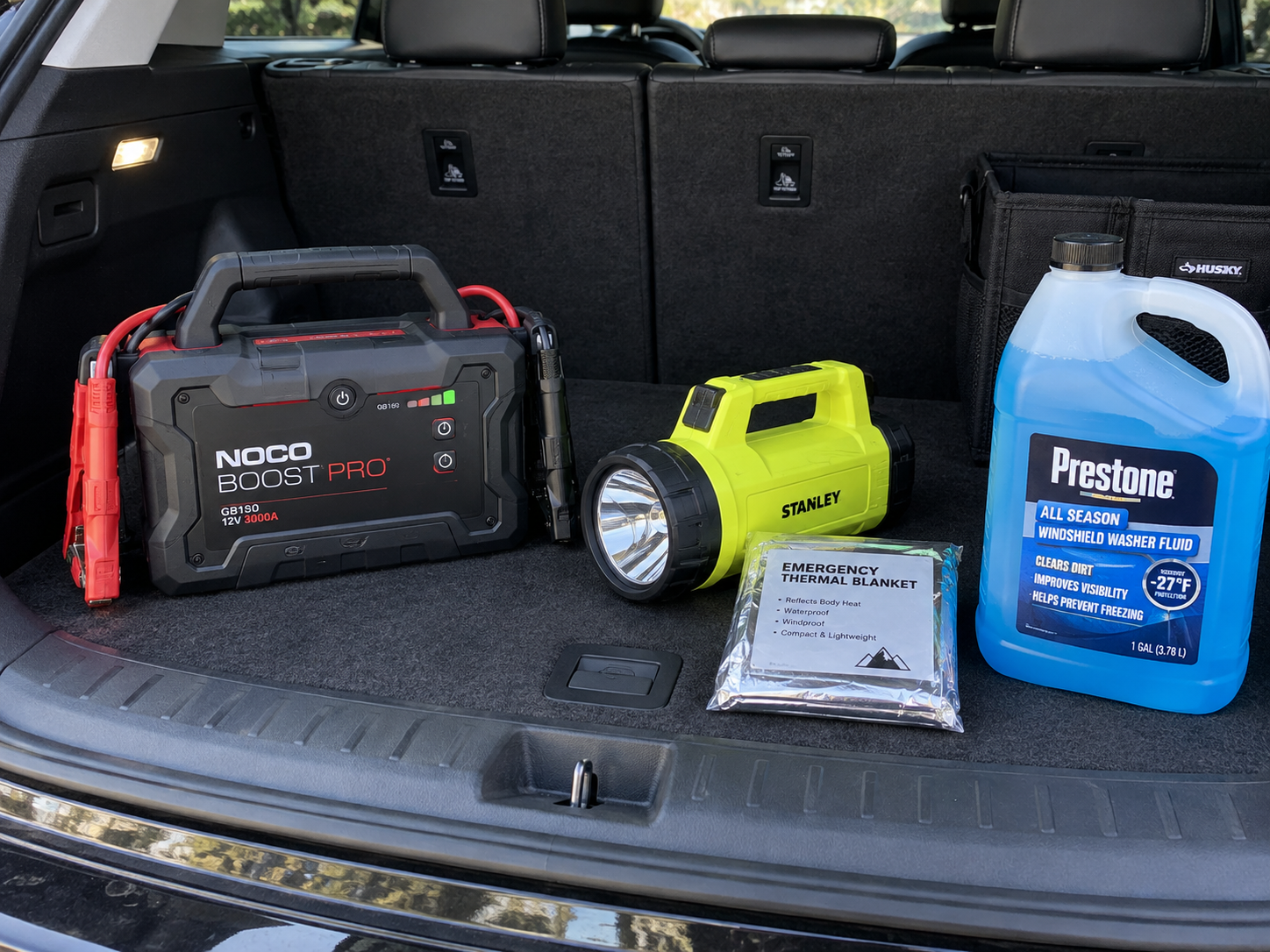
Keep a compact plastic tote bin in your trunk stocked with these lifesaving items:
- Heavy-Duty Jumper Cables (or a Lithium Jump-Starter Pack): A self-contained portable lithium jump-starter pack ($50 to $80) is worth its weight in gold—it lets you jump-start your own car in 60 seconds without waiting for a stranger or a tow truck.
- High-Lumen LED Flashlight & Extra Batteries: Changing a tire on a dark shoulder in freezing wind is impossible without reliable hands-free lighting (a headlamp is ideal).
- Traction Aid: A small bag of non-clumping clay cat litter or coarse sand, placed behind drive wheels, provides instant traction if you get stuck on slick ice.
- Heavy-Duty Ice Scraper with Snow Brush: Never use hot water to melt ice off your windshield—the thermal shock will instantly shatter the laminated glass.
- Warm Emergency Supplies: Thermal Mylar space blankets, a pair of insulated waterproof work gloves, warm wool socks, and a few high-protein energy bars.
- Tire Inflator & Pressure Gauge: A 12-volt portable air compressor that plugs into your cigarette lighter ensures you can top off tires anywhere.
6. Finding a Trustworthy Mechanic & Avoiding Unnecessary Upsells
While DIY checks empower you to catch 80% of potential issues, certain tasks—like brake pad replacements, serpentine belt tensioning, and suspension alignments—are best handled by certified professional automotive technicians.
How to Protect Yourself at the Repair Shop:
- Ask for the Old Parts Back: Reputable shops have zero hesitation showing you the worn brake pads or leaking water pump they replaced.
- Get a Written Estimate: Never authorize repairs over the phone without receiving a detailed itemized breakdown of parts vs. labor costs.
- Look for ASE Certification: Mechanics certified by the National Institute for Automotive Service Excellence (ASE) adhere to rigorous industry standards.
Need a reliable local auto repair shop, body shop, mobile mechanic, or tire center in your neighborhood? Discover top-rated, community-verified automotive experts on FindALoco Automotive & Repair Directory.
Preparing your vehicle ahead of time gives you total peace of mind, ensuring that when the temperature plummets and the snow begins to fall, your car starts effortlessly, grips the road securely, and brings you and your family home safe and warm every single day.