
# The Ultimate Tenant Guide to Renting an Apartment in America: Lease Red Flags, Move-In Inspections & Getting Your Full Deposit Back
For tens of millions of people across the United States—from young professionals and college students to recently arrived immigrant families and long-time residents—finding and leasing an apartment is one of the single largest financial commitments they make each year.
Yet, walking into the modern American rental market can feel like stepping into a legal minefield.
Between astronomical application fees, algorithmic background screening companies demanding near-perfect credit scores, complex 40-page legal lease contracts, and corporate property management companies notorious for nickel-and-diming tenants out of their \$2,000 security deposits, renting has never been more stressful or financially high-stakes.
Every year, American tenants lose hundreds of millions of dollars in wrongfully withheld security deposits simply because they did not know their legal rights or failed to document pre-existing damage during move-in.
Whether you are renting your very first apartment in California or Texas, relocating to a new city, or moving into a shared house with roommates, here is your definitive, battle-tested guide to protecting your wallet, mastering your lease, and getting every single dollar of your security deposit returned.
1. The Qualification Gauntlet: How to Qualify Without Perfect Credit
Before you even step foot inside an apartment, most landlords require prospective tenants to pass a rigid financial screening process.
The \"3x Gross Income Rule\"
The standard benchmark across the US rental industry is that your household gross monthly income (before taxes) must equal at least three times the monthly rent (or 2.5 times in ultra-high-cost metropolitan areas like New York or San Francisco).
- Example: If an apartment costs \$2,200 per month, your household must prove a combined monthly gross income of at least \$6,600 (\$79,200 annually).
Navigating Credit Checks (and What to Do With No Credit History)
Most conventional corporate property managers look for a FICO credit score of 650 or higher. But what if you are a newcomer to the country with no US credit history, a student, or someone rebuilding their credit?
- Find Independent \"Mom-and-Pop\" Landlords: Private landlords renting out individual condos, duplexes, or in-law units (ADUs) are far more flexible than corporate mega-complexes. They care more about stable employment and personal character than automated credit algorithms.
- Provide Alternative Proof of Solvency: Offer to show 3 to 6 months of bank statements proving healthy savings, a formal job offer letter detailing your salary, and positive letters of reference from previous employers or landlords.
- Use a Cosigner (Guarantor): A trusted family member or close friend with strong US credit (usually 700+) who legally agrees to cover your rent if you default.
- Institutional Guarantor Services: If you have no local cosigner, third-party companies (such as TheGuarantors, Rhino, or Insurent) act as your institutional guarantor for a modest upfront fee (typically 4% to 10% of annual rent).
2. 5 Dangerous Lease Traps & Hidden Fees to Watch Out For
Never sign a lease agreement on your phone while rushing between errands. Take the contract home, read every clause carefully, and watch out for these insidious hidden costs:
1. Mandatory \"Amenity\" & Valet Trash Fees
Look closely at the monthly line items. A listed base rent of \$1,900 might conceal a \$35 monthly \"valet trash\" fee, a \$50 \"smart home tech fee\", a \$25 \"package locker concierge fee\", and a \$100 reserved parking fee—secretly raising your true housing cost by over \$200 every month.
2. The Automatic Renewal (Rollover) Trap
Many standard US residential leases include an automatic renewal clause requiring 60 days of advance written notice before your lease ends if you plan to move out.
- If your lease ends on July 31 and you notify the landlord on July 1 (30 days notice), the landlord can legally penalize you with an extra full month of rent or automatically roll your lease into a significantly more expensive month-to-month rate.
- Pro-Tip: Set a calendar reminder on your smartphone exactly 75 days before your lease expiration date.
3. Blanket \"Professional Carpet Cleaning\" Clauses
Some landlords sneak in a mandatory clause stating that tenants must pay for professional steam carpet cleaning with a receipt upon move-out. In many states (including California, Washington, and Massachusetts), blanket mandatory cleaning deductions are legally void unless the carpet is excessively soiled beyond normal use.
4. Excessive Guest Restrictions
Be wary of clauses restricting visiting family members or significant others to fewer than 7 or 14 consecutive days. An overly restrictive guest clause can be weaponized by landlords looking for an excuse to issue lease violation notices.
3. The 48-Hour Move-In Inspection: Your Million-Dollar Defense
The single biggest mistake renters make happens within their first 48 hours in a new apartment: they unpack their boxes, go to sleep, and forget to document the apartment's existing condition.
A year later when moving out, the landlord charges \$800 for scratched baseboards, stained blinds, and chipped bathroom tiles that were already damaged before move-in!

The Step-by-Step Move-In Walkthrough Protocol:
- Take 100+ High-Resolution Timestamped Photos: Before moving a single piece of furniture inside, walk slowly through every room with your smartphone. Photograph:
- Film a Continuous 4K Video Walkthrough: Record a slow 5-minute video narrating what you see: turn on every faucet, flush every toilet, switch on every stove burner, and plug your phone charger into every electrical outlet to confirm they work.
- Upload to Cloud Storage: Save the photos and video into a dedicated Google Drive, iCloud, or Dropbox folder labeled '[Apartment Address] Move-In [Date]'.
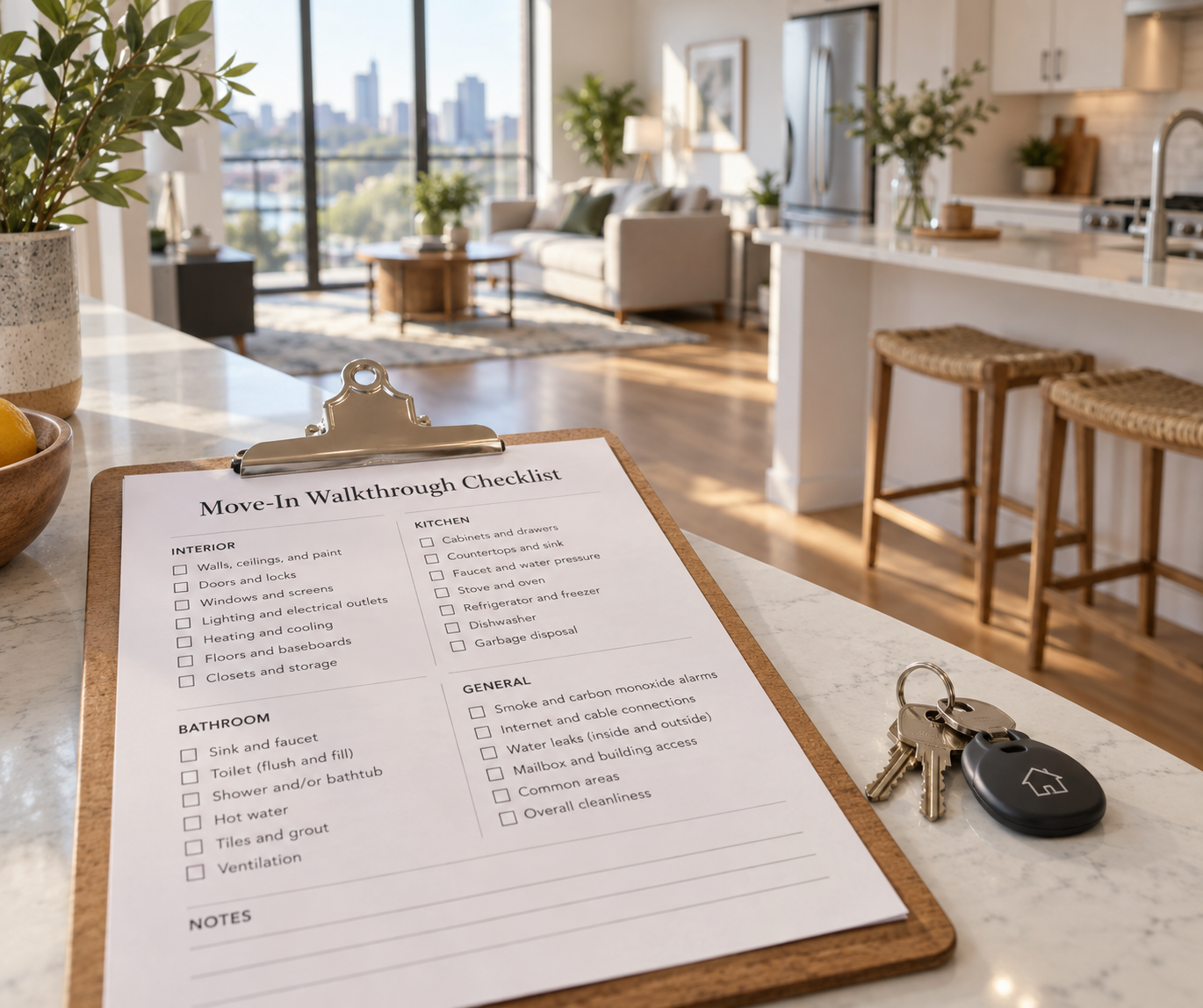
- Submit the Written Walkthrough Checklist to Management: Complete the landlord's move-in condition form, list every single tiny imperfection, sign it, keep a photocopy, and email a PDF copy to the leasing office so there is a permanent written paper trail with a timestamp.
- Baseboards, door frames, and window sills - Inside oven, microwave, dishwasher, and refrigerator drawers - Interior of all kitchen and bathroom cabinets (checking for leaks or water stains) - Every existing stain, tear, or snag in carpets and vinyl planks - Window screens (check for small tears) and window blinds (check for missing slats)
4. The Security Deposit Battlefield: Normal Wear & Tear vs. Damage
Under US landlord-tenant law, landlords are strictly prohibited from deducting ordinary \"normal wear and tear\" from your security deposit.
Understanding the difference between wear and tear versus actual tenant negligence is your most potent weapon in recovering your full deposit:
| Item Category | Normal Wear & Tear (Landlord Pays) | Actual Tenant Damage (Tenant Pays) |
|---|---|---|
| Walls & Paint | Minor scuffs from furniture, small pin/nail holes from hanging pictures, paint fading from sunlight | Large gaping drywall holes, crayon/marker drawings, unauthorized bold accent wall colors |
| Flooring | Carpet thinning in high-traffic hallways, minor surface scuffs on wood | Large carpet burn marks, pet urine stains/odors, deep gouges from dragging heavy furniture |
| Fixtures & Hardware | Loose door handles, faded cabinet pulls, mineral deposits on showerheads | Smashed bathroom mirrors, cracked toilet tanks, broken interior doors |
| Window Blinds | Blinds bent slightly from age or sun warping | Plastic slats chewed by pets or ripped completely off cords |
Statutory Deposit Return Deadlines by State:
Landlords cannot hold your money indefinitely. By law, landlords must return your security deposit—along with an itemized statement of any legitimate deductions and receipts—within strict state deadlines:
- California: 21 calendar days (Civil Code § 1950.5)
- New York: 14 calendar days (GOL § 7-108)
- Texas: 30 calendar days (Property Code § 92.103)
- Washington State: 30 calendar days (RCW 59.18.280)
- Florida: 15 to 30 days depending on whether deductions are claimed (FS § 83.49)
If your landlord fails to provide an itemized statement within the statutory timeframe, in many states they forfeit their legal right to keep any portion of your deposit, and you may be entitled to sue in Small Claims Court for bad-faith statutory damages up to two or three times the original deposit amount!

5. Roommate Agreements: Surviving Shared Living Without Drama
Moving in with roommates is the most practical way to afford urban living, but sharing an apartment with friends or strangers without ground rules can destroy relationships.
Under a standard \"Joint and Several Liability\" lease, every roommate is 100% legally responsible for the entire rent amount. If your roommate abruptly packs their bags and leaves, the landlord can legally demand the entire \$3,000 monthly rent from you alone.
Essential Clauses in a Roommate Agreement:
- Rent & Utility Allocation: Specify exact dollar splits for rent (often adjusted if one bedroom has an en-suite bathroom or walk-in closet) and utility bills (electric, gas, water, gigabit internet).
- Quiet Hours & Overnight Guests: Define agreed-upon quiet hours (e.g., 10 PM on weeknights) and limits on how many consecutive nights a partner or guest can stay over (e.g., no more than 3 consecutive nights per week).
- Cleaning & Chores Schedule: Establish clear weekly responsibilities for taking out trash, cleaning shared kitchen counters, and scrubbing bathrooms.
- Early Move-Out Protocol: Require any departing roommate to provide at least 60 days notice and assist in finding an approved replacement tenant before receiving their share of the deposit back.
6. How to Find Safe, Verified Rentals & Spot Craigslist Scams
When searching for apartments online, always maintain high vigilance against wire-transfer and fake-landlord scams:
- Red Flag #1: Refusal to Meet in Person or Show the Interior: Never send an application fee, deposit, or wire transfer via Zelle or Venmo before touring the actual interior of the unit with a verified property manager.
- Red Flag #2: Rent Significantly Below Market Value: If comparable two-bedroom apartments in the neighborhood rent for \$2,400, a listing offering the exact same unit for \$1,200 is virtually guaranteed to be a fraudulent bait-and-switch.
- Red Flag #3: Landlord Claims to Be Out of the Country on Mission/Military Duty: The classic scammer excuse for why they cannot meet you with keys.
Ready to explore verified, community-recommended rental apartments, rooms for rent, and local real estate listings in your city? Browse top-rated local housing opportunities on FindALoco’s Verified Real Estate & Rental Directory and connect with trusted local property managers today.