
# Living Trust vs. Will in America: How to Avoid Probate Court, Protect Your Real Estate, and Preserve Generational Wealth
For millions of hardworking families who built their lives in the United States, purchasing a home is the crowning symbol of security, sacrifice, and prosperity.
Behind every single-family home in suburban California, Texas, Washington, or Florida lies decades of relentless dedication—countless overtime shifts, small business ventures nurtured from scratch, and frugal living aimed at creating a brighter future for the next generation.
Yet, a heartbreaking reality catches tens of thousands of grieving families completely off guard every year.
When a homeowner passes away without comprehensive estate planning, the real estate they labored a lifetime to accumulate does not automatically transfer smoothly to their surviving children or spouse.
Instead, the property is dragged into the complex, expensive, and protracted bureaucratic machinery of Probate Court.
Navigating probate without an airtight estate plan can tie up family assets for eighteen months or longer, drain tens of thousands of dollars in statutory legal fees, expose private financial affairs to public record, and ignite bitter friction among surviving heirs.
Understanding the profound distinction between a Last Will and Testament and a Revocable Living Trust is the single most important legal step you can take to shield your family and ensure your legacy remains intact.
The Hidden Trap of American Probate Court
Probate is the state-supervised judicial procedure through which a deceased individual's assets are identified, debts and taxes are satisfied, and remaining property is distributed to heirs.
While the concept sounds orderly in theory, the practical experience of probate is a prolonged administrative ordeal.
In states with high property values such as California, statutory attorney and executor fees are mandated by state probate code rather than hourly billing.
These fees are calculated not on the owner's actual home equity, but on the gross fair market value of the estate:
- Four percent of the first one hundred thousand dollars
- Three percent of the next one hundred thousand dollars
- Two percent of the next eight hundred thousand dollars
- One percent of the next nine million dollars
Consider an average California suburban home appraised at one million dollars with an outstanding mortgage balance of six hundred thousand dollars.
Even though the owner's true equity is only four hundred thousand dollars, probate calculates fees against the full one-million-dollar gross value.
The statutory attorney fee alone is twenty-three thousand dollars, and the statutory executor fee is another twenty-three thousand dollars.
When added to court filing fees, mandatory publication costs, and probate referee appraisal fees, probate easily strips fifty thousand to sixty thousand dollars straight from your children's inheritance before they receive a single penny.
Beyond financial drain, probate is entirely public.
Anyone—including curious neighbors, aggressive real estate flippers, predatory debt collectors, and estranged relatives—can walk into the county courthouse or search online registries to inspect an itemized list of your family's assets, debts, home address, and heir identities.
Furthermore, during the twelve to twenty-four months the court case remains open, the title to the family home is effectively frozen, preventing your children from refinancing, renting, or selling the property while monthly mortgage and insurance payments continue to accrue.
The Common Myth: Why a Last Will Does Not Avoid Probate
One of the most persistent and costly misconceptions among American homeowners is the belief that executing a Last Will and Testament keeps their estate out of court.
In reality, a Will is literally an admission ticket to probate.
A Will is merely a legal letter of instruction addressed directly to the probate judge.
It informs the court who you wish to nominate as executor and how you prefer your assets divided.
However, a Will has zero independent legal authority until a probate judge officially validates the document, formally appoints the executor, and oversees the entire judicial process.
If your estate exceeds your state's small-estate statutory threshold—which in California is only around one hundred eighty-four thousand dollars, easily surpassed by any parcel of real estate—having a Will does not bypass court.
Your heirs must still file a probate petition, attend public hearings, publish legal notices in local newspapers, pay statutory probate fees, and wait months for judicial decrees.

The Ultimate Shield: The Revocable Living Trust
A Revocable Living Trust operates on a completely different legal foundation.
Rather than waiting until death to take effect, a Living Trust is an independent legal entity created during your lifetime to hold ownership of your assets for your own benefit.
When establishing a revocable trust, you typically serve in three simultaneous roles:
- The Grantor (or Trustor), the creator who contributes the assets
- The Initial Trustee, the manager who maintains absolute day-to-day control over all property inside the trust
- The Primary Beneficiary, the person entitled to use, spend, enjoy, and benefit from the trust assets during your life
Because the trust is fully revocable, you retain complete authority to sell properties, refinance home mortgages, buy new assets, withdraw funds, amend terms, or revoke the trust entirely whenever you see fit.
You file taxes exactly as you always have under your standard Social Security number, with zero separate tax returns or bureaucratic friction.
The transformative power of a Living Trust emerges upon your passing or incapacitation.
When you pass away, you do not own the property in your individual capacity; the Living Trust owns it.
Because legal ownership is held by the trust entity—which does not "die"—there is zero legal justification for court involvement.
Your handpicked Successor Trustee—typically an adult child, trusted sibling, or professional fiduciary—steps into your shoes immediately without filing court petitions, without waiting on court dockets, and without paying exorbitant statutory attorney fees.
The successor trustee quietly, privately, and seamlessly transfers the home deed and funds directly to your named beneficiaries according to your precise written instructions.
The Pillars of a Comprehensive Estate Planning Package
A sophisticated estate plan consists of more than just a trust agreement.
An experienced estate planning attorney prepares a unified suite of essential legal documents that function harmoniously:
The Pour-Over Will acts as a legal safety net.
If you inadvertently forget to title a newly acquired vehicle or personal asset into your trust before passing away, the Pour-Over Will catches that asset and directs it straight into your Living Trust upon your death.
The Durable Power of Attorney for Finances grants your trusted agent the legal authority to manage banking affairs, pay utility bills, interact with the IRS, and manage government benefits on your behalf if you become incapacitated due to illness, stroke, or injury.
The Advance Healthcare Directive (combining a Medical Power of Attorney and Living Will) designates who has the legal authority to make critical medical decisions for you if you cannot speak for yourself, and articulates your personal wishes regarding life support, pain management, and organ donation.
The HIPAA Medical Information Release authorizes healthcare providers to share your medical records and diagnosis with your designated loved ones without violating federal privacy laws.

The Fatal Mistake: The Unfunded Trust
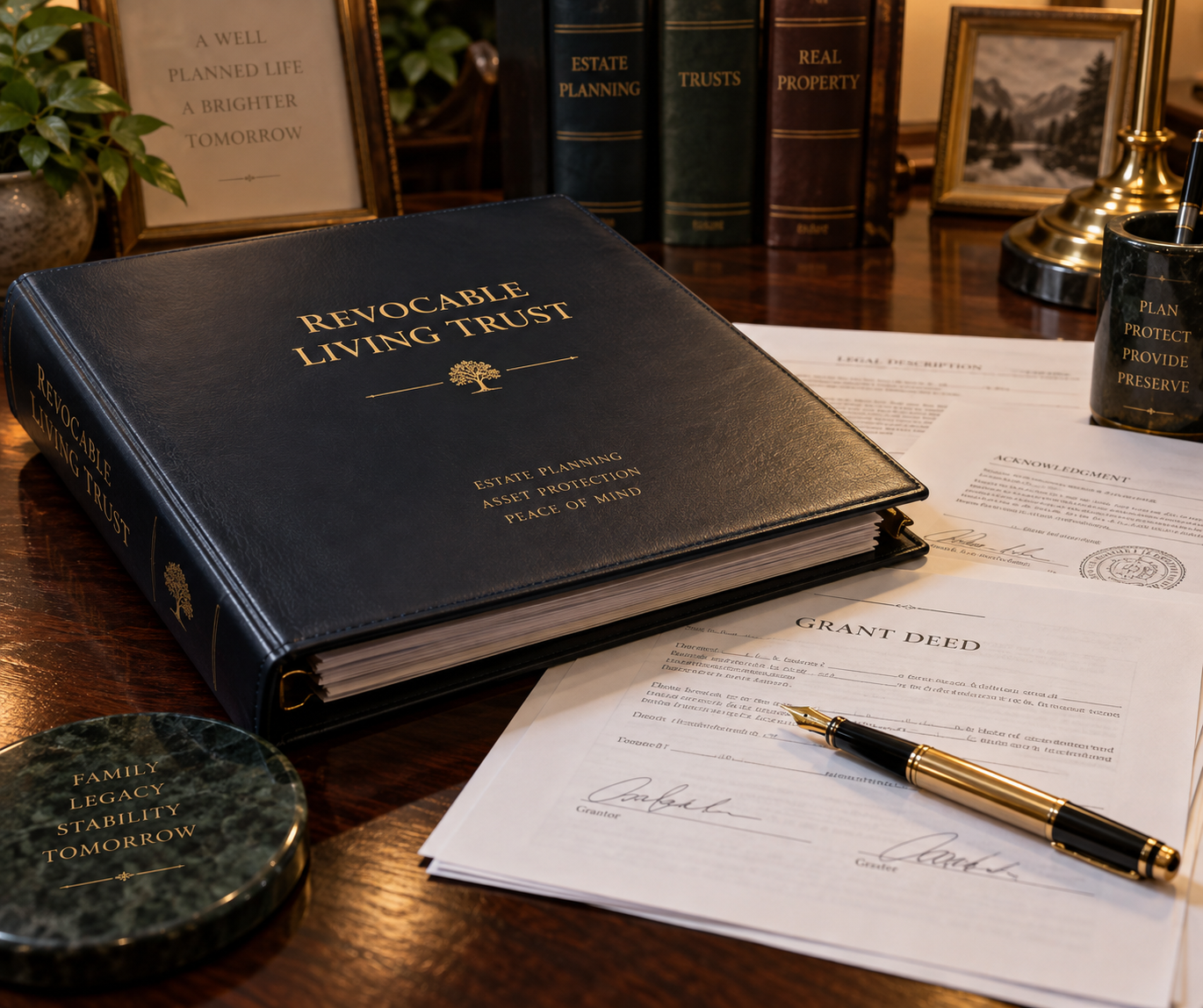
The single most heartbreaking scenario an estate attorney encounters is discovering that a deceased client paid thousands of dollars to establish a beautiful, leather-bound Living Trust, but never "funded" it.
A Living Trust is like an empty safe; unless you physically place the title of your assets inside that safe, the trust is powerless.
Drafting the trust document does not automatically transfer your real estate.
To fund your home into the trust, your attorney must prepare, execute, and record an official Grant Deed or Quitclaim Deed with the County Recorder's Office, formally transferring title from your individual name to your name as Trustee of your Revocable Living Trust.
Similarly, financial assets require intentional alignment:
- Primary bank checking and savings accounts should be retitled into the name of the trust
- Non-retirement brokerage accounts and mutual funds should be held under the trust name
- Real estate investment properties and vacation homes in other states must be deeded to avoid "ancillary probate" proceedings across multiple jurisdictions
Retirement accounts like 401(k)s, Traditional IRAs, and Roth IRAs are treated differently because of unique tax rules.
Rather than changing ownership of retirement accounts to the trust during your life—which would trigger catastrophic premature income tax penalties—you designate primary and contingent beneficiaries directly with the financial custodian, coordinating them with your overall estate plan.
Preserving Family Harmony and Protecting the Next Generation
Beyond bypassing probate costs, a Living Trust empowers you with nuanced control over how and when your children receive their inheritance.
If you pass away leaving a simple Will or no estate plan at all, California and most state laws mandate that an eighteen-year-old child receives their entire inheritance in one lump-sum cashier's check on their eighteenth birthday.
Handing a vulnerable eighteen-year-old hundreds of thousands of dollars in sudden cash often leads to impulsive spending, predatory relationships, and financial devastation.
Through your Living Trust, you can establish sensible distribution milestones:
- Providing funds for college tuition, trade school, and healthcare expenses throughout young adulthood
- Distributing one-third of the trust principal at age twenty-five, one-half of the remainder at age thirty, and the final balance at age thirty-five
- Incorporating protective spendthrift clauses that shield your children's inheritance from future divorce proceedings, business bankruptcies, or civil lawsuits
Estate planning is not merely a technical exercise in property law; it is the ultimate expression of parental love, foresight, and protective stewardship.
Taking the time to construct an airtight Living Trust today ensures that the fruits of your lifelong labor flow uninterrupted to the children you cherish most, sheltering their financial future for generations to come.
Looking for experienced, trusted Vietnamese-American estate planning attorneys, living trust specialists, and real estate legal counsel in your state? Connect with verified legal professionals on the FindALoco Vietnamese Legal & Estate Planning Directory, explore comprehensive financial and life insurance planning through the FindALoco Insurance Directory, and consult experienced CPAs on the FindALoco Tax & Accounting Directory.