
# What to Do After a Car Accident in the US: A Practical Guide to Medical Care, Insurance Traps, and Legal Rights
The sudden screech of tires, the violent jolt of metal crumpling against metal, and the explosive pop of white airbag powder filling the cabin.
In a fraction of a second, an ordinary morning commute along a busy interstate or a routine drive home from the grocery store transforms into total chaos.
Your heart hammers against your ribs, adrenaline floods your bloodstream, and your hands tremble on the steering wheel.
Every year, millions of motorists across the United States experience traffic collisions ranging from minor rear-end fender-benders at neighborhood stoplights to catastrophic multi-vehicle pileups on rain-slicked freeways.
Yet, despite how common vehicle accidents are, very few drivers truly understand what to do in the immediate aftermath—and even fewer are prepared for the labyrinth of insurance adjusters, medical bills, liability disputes, and legal complexities that follow.
The decisions you make in the first sixty minutes at the scene, and during the first fourteen days following the crash, will either protect your physical recovery and financial security or permanently damage your ability to receive fair compensation.
The First Sixty Seconds: Safety, Shock, and Staying Calm
The moments immediately following an impact are defined by shock and confusion. Before opening your car door or unbuckling your seatbelt, take a deliberate breath and assess your physical condition.
Check yourself and your passengers for obvious trauma, bleeding, numbness, or severe pain. If anyone is injured or unable to move, immediately dial 911 and request emergency medical services.
If your vehicle is still operational and the crash occurred in live traffic lanes, guide the car safely toward the right shoulder or a nearby parking lot to prevent secondary collisions, especially on high-speed freeways. Turn on your hazard flashers immediately.
If the vehicle is immobilized, remain inside with your seatbelt fastened until emergency personnel arrive, or carefully exit toward the sidewalk away from oncoming traffic if staying in the vehicle poses a fire or safety hazard.
Above all, maintain an attitude of calm composure. Even when the other driver behaved recklessly—running a red light, tailgating aggressively, or texting behind the wheel—confrontational arguments on the roadside accomplish nothing and can escalate into dangerous roadside confrontations.
The Golden Rule: Never Say "I'm Sorry" or Admit Fault
One of the most natural human instincts after an unsettling event is to apologize or express polite sympathy. Phrases like "I'm so sorry, I didn't see you coming" or "I was just checking my navigation map" might feel like polite social courtesy, but in American insurance and tort law, they are lethal.
Insurance claims adjusters and defense lawyers routinely scour police statements, witness accounts, and recorded calls for any casual apology, twisting it into a binding admission of legal liability.
Even if you privately suspect you might have braked late or glanced away momentarily, you rarely possess the complete objective picture of the crash.
The other motorist may have been speeding, driving under the influence, lacking functional brake lights, or distracted by a mobile screen.
When speaking with the other driver, exchange required information courteously:
- Full legal names and direct contact phone numbers
- Driver license numbers and issuing states
- Automobile insurance policy numbers and provider names
- Vehicle make, model, color, and license plate numbers
Limit your conversation strictly to this factual exchange. Do not debate who was right, do not negotiate roadside cash settlements, and never sign handwritten notes or informal agreements on the spot.
Documenting the Scene Before Evidence Disappears
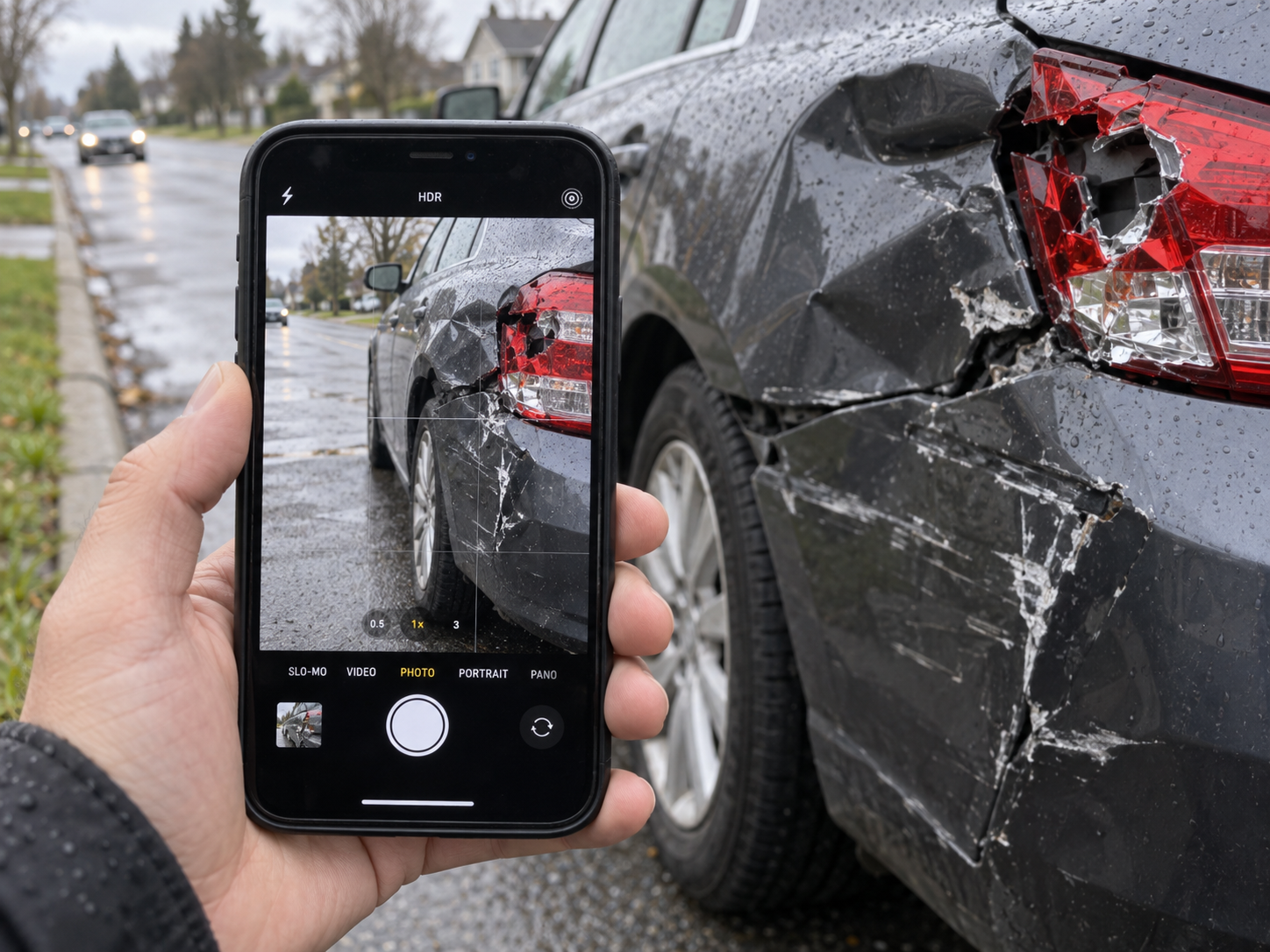
In the modern insurance landscape, photographic and digital evidence is your greatest shield against fabricated counterclaims and bad-faith liability denials. Before tow trucks haul away the wreckage and street sweepers clear the debris, capture comprehensive visual documentation using your smartphone camera.
Take wide-angle photographs showing the overall collision scene, including the positioning of both vehicles relative to the roadway, lane dividers, skid marks, curb lines, and traffic signals.
Capture detailed close-up shots of all vehicular damage, focusing not only on crumpled fenders and cracked bumper covers, but also on broken glass, deployed airbags, and tire scuff marks.
Document surrounding environmental context, such as rain pools, obscured street signs, construction cones, and visual obstructions.
If independent bystanders, nearby business employees, or other drivers stopped to assist, politely request their names and telephone numbers. A neutral third-party witness who confirms that the opposing vehicle blew through a red light is often the single most decisive piece of evidence in resolving liability disputes.
Always ensure that law enforcement responds to the scene to file an official police collision report. When the responding officer arrives, describe the sequence of events clearly, calmly, and truthfully without speculating.
Before departing, ask the officer for their name, badge number, and the official police report incident number so you can obtain a certified copy for your claim records.

The Invisible Injury: Adrenaline, Whiplash, and Medical Timelines
One of the most dangerous mistakes injured motorists make after an accident is telling the investigating police officer or insurance representative: "I feel fine, I don't need a doctor."
During a violent collision, the human endocrine system releases massive surges of adrenaline and endorphins—the body's primal survival mechanism designed to mask pain and keep you functional.
Severe soft tissue tears, cervical whiplash, lumbar disc herniations, subtle concussions, and internal micro-traumas often produce zero noticeable symptoms during the first twenty-four to forty-eight hours.
Only when the chemical rush subsides two or three days later do intense neck stiffness, radiating shooting pain down the arms, debilitating lower back spasms, and pounding headaches emerge.
Seeking a formal medical evaluation at an urgent care clinic, emergency room, or primary care facility within forty-eight to seventy-two hours of the collision is vital for two distinct reasons.
First and foremost, early clinical diagnosis and treatment prevent acute musculoskeletal injuries from deteriorating into chronic, lifelong degenerative pain.
Second, insurance adjusters look relentlessly for what they call a "gap in treatment." If you wait two or three weeks before visiting a physician, the opposing insurer will aggressively argue that your injuries were caused by an unrelated gym workout, a weekend chore, or a pre-existing health condition, using the delay to drastically slash or deny your medical settlement.
Be entirely candid with your examining physicians. Describe every physical symptom, however minor it may seem—dizziness, ear ringing, shoulder tenderness, or tingling in your fingers.
Follow all prescribed treatment plans diligently, attending every physical therapy, chiropractic, or orthopedic appointment without unexcused cancellations.
Decoding the Insurance Maze: Coverages That Actually Protect You
Auto insurance policies in the United States represent a complex patchwork of state-mandated minimums and optional protective riders. Understanding how these distinct layers interact is essential when navigating a collision claim.
Liability coverage pays for property damage and bodily injuries that you cause to other parties when you are legally at fault. However, minimum state liability limits are often shockingly low—in some jurisdictions, as meager as fifteen thousand dollars per injured person—which can be completely consumed by a single emergency room visit.
Collision and comprehensive coverages protect your own vehicle regardless of who caused the wreck. If liability is disputed by the other party's insurer, utilizing your own collision coverage gets your vehicle repaired or declared a total loss promptly, leaving your insurance carrier to subrogate and recover your deductible from the at-fault driver later.
Medical Payments (MedPay) and Personal Injury Protection (PIP) are invaluable coverages that pay for your initial hospital bills, diagnostic MRI scans, and necessary therapies immediately, irrespective of who was at fault for the crash. In "no-fault" insurance states, PIP is your primary source of immediate medical coverage.
Uninsured and Underinsured Motorist (UM/UIM) coverage is arguably the single most critical investment on any auto policy. An estimated one in eight drivers across the country operates a motor vehicle without any insurance whatsoever, and tens of millions carry only bare-bones minimum policies.
If a negligent driver causes you severe spinal injuries or fractures and possesses only minimal coverage or flees the scene in a hit-and-run, your own UM/UIM policy steps into the shoes of the at-fault driver, providing hundreds of thousands of dollars in vital bodily injury compensation.

The Adjuster Playbook: Beware of Lowball Offers and Recorded Statements
Within twenty-four to seventy-two hours of reporting an accident, you will inevitably receive a friendly, polite telephone call from an insurance claims adjuster representing the other driver.
The adjuster will sound warm, sympathetic, and reassuring, asking how you are feeling and offering to "take care of everything quickly so you can put this behind you."
Do not be deceived by this cordial bedside manner. Insurance adjusters are trained corporate negotiators whose primary metric of job performance is minimizing the payout dollars departing their company's reserve funds.
The adjuster will frequently request a "quick recorded statement" to confirm the details of the crash. Politely but firmly decline.
You have zero legal obligation under state law to provide a recorded interview to the opposing party's insurance company.
Adjusters are masters at framing leading, ambiguous questions designed to get you on tape minimizing your injuries or inadvertently accepting fractional fault for the collision.
Equally treacherous is the "quick settlement check." In the days following a crash, before you have received a comprehensive MRI or completed diagnostic orthopedic evaluations, the adjuster may offer to send you an immediate check for five hundred or one thousand dollars, plus payment of your initial emergency room bill.
In exchange, you will be required to sign a comprehensive "Release of All Claims."
The moment your pen touches that release, your claim is permanently extinguished.
If an MRI scan three weeks later reveals a herniated cervical disc requiring twenty thousand dollars in spine surgery and months of rehabilitation, you will be legally barred from seeking another penny from the at-fault driver or their insurer.
When to Seek Professional Legal Representation
Not every automotive collision requires hiring a licensed attorney. A purely property-damage fender-bender where nobody suffered physical discomfort, both vehicles were repaired smoothly, and rental cars were provided can generally be handled directly between the drivers and insurance carriers.
However, whenever an accident involves physical injuries, ambulance transport, ongoing physical therapy, lost wages from missed work, or contested liability where the other driver fabricates an alternative story, attempting to negotiate alone is like wandering into an unfamiliar courtroom without a defense.
Reputable personal injury attorneys operate under a contingency fee agreement. Under this model:
- You pay zero upfront retainers or out-of-pocket legal fees
- The attorney advances all case investigation costs, police reconstruction fees, and expert witness expenses
- The legal fee is collected strictly as an agreed percentage only after a successful financial settlement or trial verdict is won
- If no monetary recovery is obtained, you owe zero attorney fees
A skilled personal injury lawyer acts as your legal buffer, ordering all communications with aggressive adjusters to cease immediately.
They subpoena traffic surveillance cameras, obtain 911 dispatch audio, coordinate medical care with trusted specialists under medical liens so you incur no out-of-pocket costs during treatment, and negotiate aggressive reductions on outstanding hospital liens to put maximum net recovery into your pocket.
Reclaiming Your Life and Moving Forward
A serious motor vehicle accident is a jarring interruption to your daily routine, testing your patience, physical endurance, and emotional resilience.
By keeping a level head at the scene, prioritizing thorough medical documentation within the critical initial days, avoiding predatory adjuster settlement traps, and securing experienced legal counsel when injuries demand it, you protect not only your legal rights, but the long-term well-being of your family.
Looking for experienced, trusted Vietnamese-American personal injury attorneys, auto accident legal counsel, and insurance specialists in your metropolitan area? Explore verified professionals and legal resources across the United States on the FindALoco Vietnamese Personal Injury & Legal Directory and protect your family with comprehensive auto coverage through the FindALoco Auto & Health Insurance Directory.