
# U.S. Citizenship Naturalization Guide 2026: English Exemptions for Seniors (50/20 & 55/15), 100 Civics Questions & N-400 Fee Waivers
In thousands of Vietnamese American homes across the country, one of the most poignant evening scenes is that of an aging parent sitting at the kitchen table with a dog-eared stack of index flashcards. Under the warm light, an elderly mother or father in reading glasses rehearses English civics questions with their adult child or grandchild: "What is the supreme law of the land? – The Constitution."
Behind the nervousness and determination lies a profound American dream: obtaining the Certificate of Naturalization and a blue United States passport. Becoming an American citizen is not just a badge of legal belonging in a land of freedom; it is the vital key to sponsoring overseas family members, traveling abroad without the fear of green card abandonment, and securing full access to federal retirement benefits.
Yet for immigrant elders who arrived in the U.S. later in life, the language barrier and the intimidating prospect of a formal interview with U.S. Citizenship and Immigration Services (USCIS) officers often deter them from applying.
Many families remain unaware that federal immigration law provides generous humanitarian accommodations for older permanent residents: the legal right to take the civics exam in Vietnamese with a qualified interpreter, or the ability to study a simplified 20-question civics list.
Here is your comprehensive, step-by-step 2026 guide to naturalization: understanding senior age exemptions, requesting fee waivers, mastering the civics exam, and navigating the Part 12 moral character interview.

Fast Reference: English Language Exemptions for Senior Green Card Holders
A common misconception is that every naturalization applicant must read, write, and speak fluent English. In reality, Congress created clear statutory age and residency exemptions (often referred to as the "50/20", "55/15", and "65/20" rules) based on an applicant's age and length of time as a Lawful Permanent Resident (LPR) on the date Form N-400 is submitted:
| Exemption Category | Minimum Age Requirement | Years Holding Green Card | Testing Accommodations Granted |
|---|---|---|---|
| The 50/20 Rule | Age 50 or older | 20 years as a permanent resident | Exempt from English speaking, reading, and writing tests. Takes the 100 Civics test in native Vietnamese with an approved interpreter |
| The 55/15 Rule | Age 55 or older | 15 years as a permanent resident | Exempt from English speaking, reading, and writing tests. Takes the 100 Civics test in native Vietnamese with an approved interpreter |
| The 65/20 Rule (Special Consideration) | Age 65 or older | 20 years as a permanent resident | Greatest accommodation: Exam in native Vietnamese with an interpreter, AND only required to study **20 specially marked asterisk (*) questions** instead of all 100 |
| Medical Disability Waiver (Form N-648) | Any age | Standard permanent residency years | Certified by a licensed physician or clinical psychologist for physical, developmental, or mental impairments. Completely exempts English and Civics requirements |
For seniors qualifying under the 65/20 Rule, the testing process is streamlined. The USCIS adjudicating officer selects a maximum of 10 questions strictly from the 20 designated questions. As soon as the senior answers 6 correctly, the civics portion is officially passed!
2026 N-400 Application Fees & How to Qualify for a 100% Fee Waiver (Form I-912)
Filing fees for Form N-400 currently stand at $710 for online submissions and $760 for paper applications sent by mail. For an elderly couple living on fixed retirement income, spending upwards of \$1,500 can pose a significant financial hurdle.
Fortunately, USCIS provides clear pathways to qualify for a 100% fee waiver ($0) or a 50% reduced fee using Form I-912 (Request for Fee Waiver):
1. Full 100% Fee Waiver ($0 Application Cost)
If the applicant, their spouse, or the head of household currently receives a federal, state, or local means-tested public benefit, USCIS will automatically waive the entire filing fee:
- Medicaid / Medi-Cal (in California).
- Supplemental Nutrition Assistance Program (SNAP / CalFresh / Food Stamps).
- Supplemental Security Income (SSI / SSP).
- Temporary Assistance for Needy Families (TANF) or Section 8 housing assistance.
How to Apply: Request a current "Verification of Benefits" or "Notice of Action" letter from your local county Department of Social Services showing active enrollment and send it along with Form I-912 and your paper N-400 packet via certified mail.
2. Reduced 50% Filing Fee
If your household does not receive means-tested benefits but your annual household income falls between 150% and 400% of the Federal Poverty Guidelines, you qualify for a 50% discount on the N-400 filing fee (paying approx. \$380).

Smart Study Strategies: Conquering the Civics Exam for Aging Parents
Memorizing 100 historical facts chronologically from question 1 to 100 often leads to cognitive fatigue. The most effective study method organizes the material into four cohesive thematic clusters:
Theme 1: Key Presidents and American Founding Figures
- The First President & "Father of Our Country": George Washington.
- The Civil War President who freed the slaves: Abraham Lincoln.
- The principal author of the Declaration of Independence: Thomas Jefferson.
Theme 2: National Symbols & Celebrations
- Independence Day: July 4th.
- The American Flag: 50 stars (representing the 50 states) and 13 stripes (representing the 13 original colonies).
- Location of the Statue of Liberty: New York Harbor (or Liberty Island).
Theme 3: The Three Branches of Government
Visualizing government as a three-legged stool helps seniors remember checks and balances:
- Legislative Branch (makes laws): Congress — composed of the Senate (100 senators) and House of Representatives (435 voting members).
- Executive Branch (enforces laws): The President.
- Judicial Branch (explains laws): The Supreme Court (9 Justices).
Theme 4: Keyword Association for English-Track Test Takers
For seniors taking the standard English exam who struggle with full sentence comprehension, train them to recognize phonetic keywords:
- Hear "Supreme law" -> Answer: "The Constitution".
- Hear "First three words" -> Answer: "We the People".
- Hear "Economic system" -> Answer: "Capitalist economy" or "Market economy".
- Hear "Ocean on the West Coast" -> Answer: "Pacific Ocean".
Navigating Part 12: Good Moral Character & Communist Inquiries
Part 12 of Form N-400 evaluates the applicant's Good Moral Character and unswerving commitment to the principles of the United States Constitution.
Question 9b Regarding the Communist Party
During the in-person interview, the adjudicating officer will directly ask: "Have you EVER been a member of, or in any way associated with, the Communist Party?"
- For members of the Vietnamese refugee diaspora, the answer is a clear, unequivocal, and proud "NO".
- If the officer asks a follow-up definition check ("What is the Communist Party?"), a simple and acceptable answer in plain English is: "A government with no freedom and no democracy."
Legal Integrity, Taxes, and Allegiance
- Questions regarding arrests, criminal convictions, illegal gambling, or tax fraud: Answer clearly "NO".
- Final oath questions regarding willingness to support the U.S. Constitution, bear arms in defense of the nation if required by law, or perform noncombatant military service: Answer affirmatively "YES".
Preparing for Interview Day at the USCIS Field Office
Arriving prepared and confident dramatically reduces interview-day anxiety. Keep these essential tips in mind:
1. Mandatory Original Documents to Bring
- Original Green Card (Permanent Resident Card).
- Valid State Driver License or State Photo ID.
- All current and expired foreign passports (including expired Vietnamese passports).
- Official USCIS Interview Appointment Notice (Form I-797C).
- Certified IRS Tax Return Transcripts for the past 3 to 5 years.
- Original Marriage Certificate and Divorce Decrees (if applicable).
2. Rules for Accompanied Interpreters
If qualifying under the Vietnamese-language provisions (50/20, 55/15, or 65/20):
- You may bring an adult child, relative, or trusted acquaintance who is fluent in both English and Vietnamese to serve as your official interpreter.
- The interpreter must be at least 18 years old and present a valid government-issued photo ID.
- At the start of the interview, the interpreter will sign Form G-1256 (Declaration for Interpreted USCIS Interview) swearing under penalty of perjury to translate all questions and answers verbatim without coaching.
3. Arrival and Professional Decorum
- Arrive 30 to 45 minutes prior to your scheduled appointment to clear the metal detector security screening checkpoint.
- Dress respectfully in business casual attire (slacks, button-down shirt, or a modest traditional tunic). Demonstrating respect for the federal proceeding creates an immediate positive impression.
- Remind aging parents that USCIS officers are professionals following standard legal protocol; they are not looking to trick applicants.
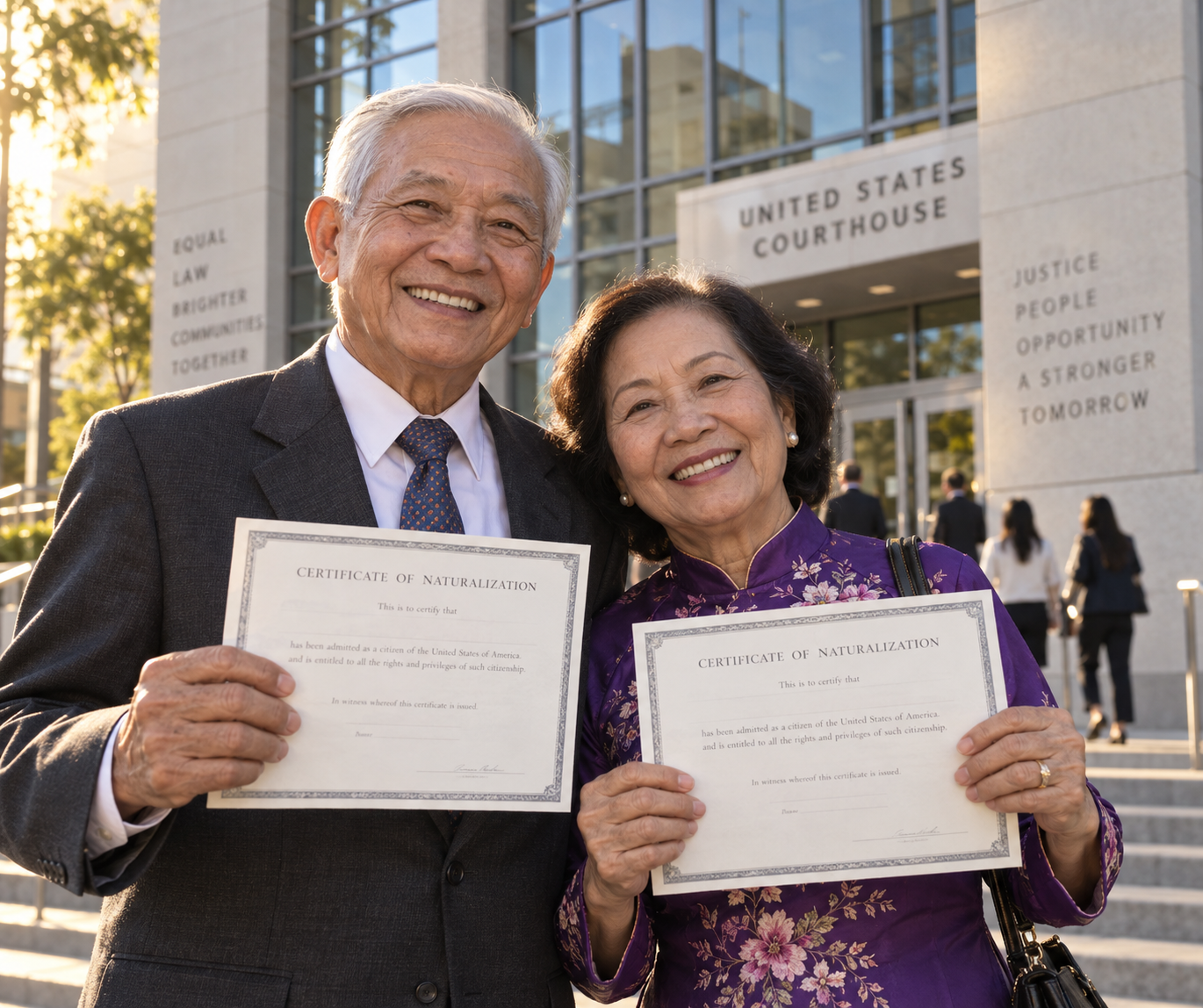
Taking the Oath of Allegiance before the American flag, hearing the national anthem, and holding that hard-earned Certificate of Naturalization is a life-defining milestone. It represents the culmination of years of sacrifice, perseverance, and quiet dedication to building a better life in the United States.
If your family has complex immigration questions or prior travel complications, browse verified bilingual professionals in the FindALoco Vietnamese Legal Directory to ensure your parents enter their citizenship interview with complete confidence and peace of mind.