

# Adults Don’t Need More Networking Events. They Need Somewhere to Belong.
The first time, the barista asked for his name.
The fifth time, she remembered the drink.
A few weeks later, she asked whether the interview had gone well. The man at the next table looked up and said he had been wondering the same thing. Nobody in the coffee shop was his friend, exactly. But when he missed a Tuesday, somebody noticed on Wednesday.
This is a small kind of belonging, so small that most surveys cannot measure it well. There is no group photo, no friendship anniversary, no text thread with a clever name. It is simply the comfort of being expected somewhere.
American adults are regularly told they are lonely. The diagnosis is supported by enough research to have become public language; the U.S. Surgeon General has described social disconnection as a serious health problem and called for stronger social infrastructure. Parks, libraries, community organizations and gathering places are not just pleasant extras in that framework. They are part of how a society keeps people connected.
The advice offered to individuals is usually more awkward.
Join a group. Attend a mixer. Put yourself out there. Network. Say yes. Download another app built around the promise that this time strangers will become your people.
All reasonable suggestions. All easy to give.
What they miss is that friendship is rarely one courageous conversation. It is repeated exposure with nowhere urgent to be.

Networking asks the wrong question
A networking event begins with a purpose. Everyone knows why they are there. The name tag announces the transaction before anyone speaks.
What do you do? Where do you work? What are you looking for? How can we help each other?
There is nothing inherently wrong with this. Jobs come from weak ties. Careers move because someone remembers a conversation. For people who enjoy a room full of introductions, networking can be energizing.
It is not the same as belonging.
Belonging does not require you to summarize your value before the other person’s drink gets warm. You do not have to arrive interesting. You can be quiet, tired, distracted or temporarily without a good answer to “What do you do?”
That distinction matters in adulthood because so much social life becomes productive by default. Parents meet through children. Coworkers socialize through work. Entrepreneurs attend founder dinners. Professionals join associations. Even hobbies acquire a personal-brand angle: post the run, grow the account, turn the craft into a side business.
A person can meet hundreds of useful contacts and still have nobody to call on a bad Sunday.
Childhood friendship had an unfair advantage: repetition
Children do not usually build friendships through superior social skills. They are placed near the same people over and over.
The same classroom. The same bus. The same patch of sidewalk. The same hour after school when no one has anywhere else to go.
Repetition handles the introductions. Shared boredom handles the rest.
Adults lose that structure gradually. College ends. Coworkers move. A neighborhood changes. Marriage, divorce, caregiving and parenthood rearrange calendars. Remote work removes casual contact. People move across the country for jobs and discover that a cheaper house can come with no one who has known them longer than the mortgage company.
Then friendship is treated like another goal to manage.
One coffee next Thursday, rescheduled twice. Dinner in six weeks because four calendars need to align. A message that begins, “We really should…” and means it sincerely.
The problem is not a lack of affection. It is a lack of unplanned overlap.
Third places—the places that are neither home nor work—create some of that overlap again. A good third place does not guarantee intimacy. It makes familiarity possible.
You have to go somewhere before you have a reason to go
This is the part that feels unnatural.
A lonely person waits for an invitation because going alone seems like proof of the loneliness they are trying to solve. A crowded café feels full of people who already belong to someone. The run club looks like a group of friends wearing the same shoes. The library event appears to have been designed for everyone except you.
So the person stays home until there is a reason to leave. The reason is usually supposed to be another person.
Third places work in the opposite direction. You go before you know anyone. You go for the book, the coffee, the walk, the game, the class, the volunteer shift or the reliable Wi-Fi. The activity gives your hands something to do while recognition develops slowly.
The first visit may be lonely. So may the second.
By the sixth, the room has edges. You know where to sit. You recognize the person who always arrives late. Somebody nods before remembering your name.
This sounds painfully minor compared with the promise of finding a “community.” It is how community often begins.
Run clubs succeed because nobody has to face the room
The rise of social running clubs makes sense even for people who do not particularly like running.
A traditional mixer asks strangers to stand in a room and begin talking. A run gives them a direction. Conversation happens sideways, interrupted by breathing, traffic lights and the shared understanding that silence is allowed.
Speed matters less in the most successful social groups than consistency. There is usually a slow pace, a short route, a coffee or drink afterward. New people can join without needing to explain why they came alone.
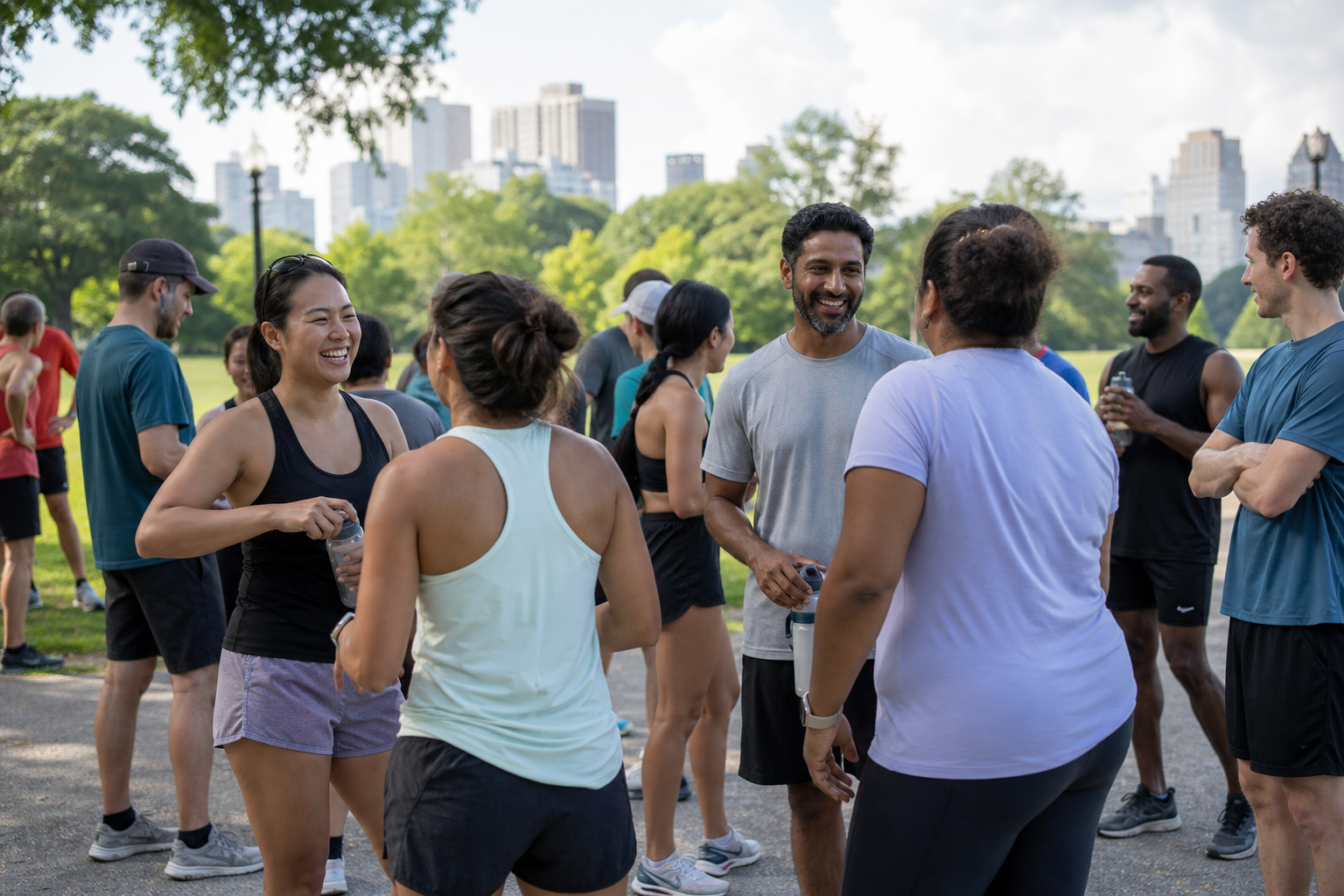
The running is not incidental, but neither is it the whole point. It creates a recurring appointment with a low threshold for participation. Miss a week and nobody demands an explanation. Return the next week and the group is still there.
Book clubs, community gardens, volunteer kitchens, board-game nights, choir rehearsals and dog parks can work the same way. The task carries the social weight until relationships are strong enough to carry themselves.
This is why “find a hobby” is incomplete advice. The useful hobby is not necessarily the one that best expresses your identity. It is the one that brings you near the same people regularly.
A third place cannot require a $40 cover charge every time
Belonging needs repetition. Repetition gets difficult when every visit is expensive.
Coffee shops are often romanticized as the classic American third place, but a customer may feel obligated to keep purchasing to justify the chair. Bars work for some people and exclude others through alcohol, noise, cost, age or schedule. Fitness studios can build strong communities behind monthly fees many residents cannot afford.
The most democratic third places ask little or nothing at the door.
Libraries are unusually powerful for this reason. You can enter without buying a product. You can be unemployed, newly retired, fourteen years old, eighty years old, housed, unhoused, learning English or simply trying to get out of your apartment. Nobody needs to know which category applies.
Modern libraries host far more than quiet reading: tax help, language practice, craft groups, lectures, technology support, children’s activities and clubs where the invitation is built into the calendar.
Parks, recreation centers, public pools, walking trails and community plazas perform similar work. Their value cannot be captured only by attendance at a single event. They make it possible to become a regular without turning presence into a purchase.
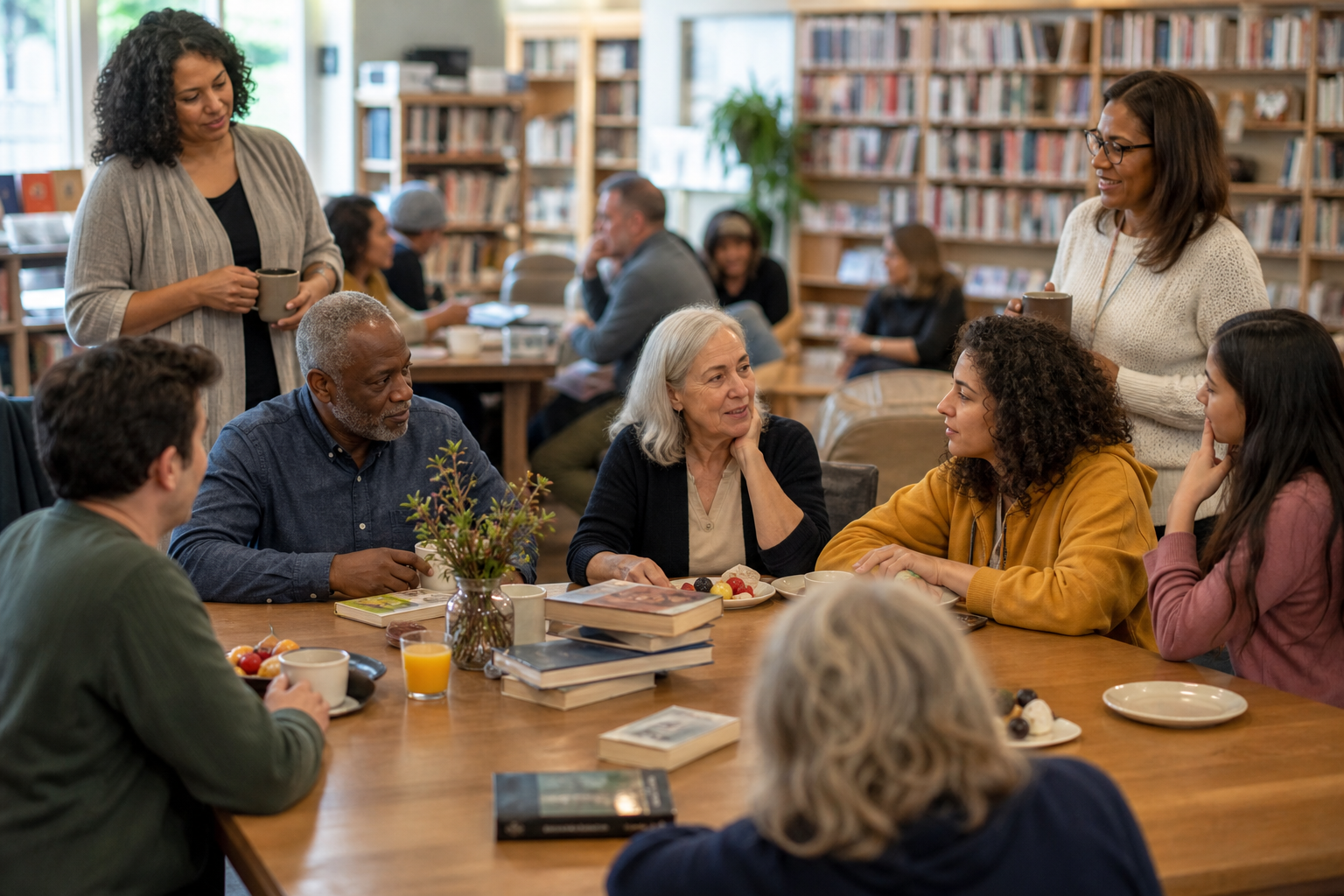
When cities lose these places, loneliness becomes a private problem with a public cause. Residents are told to connect while every available location asks them to spend money, keep moving or leave when the transaction ends.
The best places let relationships stay weak for a while
American culture tends to divide people into friends and strangers. There is a large, useful territory between them.
The neighbor whose dog’s name you know. The librarian who saves an event flyer for you. The older man at the gym who notices your new shoes. The parent you see every Saturday but have never met anywhere else.
Sociologists call some of these weak ties. The word “weak” undersells their importance.
Weak ties make a neighborhood feel inhabited rather than occupied. They offer news, practical help, job leads and the quiet reassurance that your life leaves an impression outside your home. They can become strong ties. They do not have to.
A person with several close friends can still benefit from being recognized at the hardware store. A person without close friends may need these small contacts before deeper friendship feels possible.
The pressure to turn every promising conversation into plans can ruin the pace. Not everyone needs your number on day one. Not every familiar face needs to become a best friend. Letting a relationship remain small is often what allows it to grow.
Digital connection is real, but it does not occupy the empty chair
Online friendships are not lesser friendships. People find understanding, creative partners and lifelong relationships through screens. For disabled people, caregivers, rural residents and anyone who has felt isolated in the room they physically occupy, digital communities can be essential.
The question is not whether online connection counts.
It is what disappears when every connection must be actively opened.
A group chat waits silently until someone types. A third place has background life. Someone drops a spoon. A familiar person walks past. You overhear a conversation you were not seeking. You can participate without announcing your arrival.
Physical places create what the internet cannot perfectly simulate: the possibility of company without direct engagement.
Sometimes a lonely adult does not need a deep conversation. They need to read for an hour while other people are nearby.
That counts too.
Becoming a regular is an act of patience
There is no viral transformation in becoming known.
You choose one place. You return at roughly the same time. You learn a name. You ask a small question. You help stack a chair. You resist the conclusion that two quiet visits mean the experiment failed.
Eventually you participate in the memory of the place.
The barista remembers the interview. The run club asks where you were. The librarian says the group moved to another room. Someone saves you a seat without discussing it.
None of these people may know the whole story of your life. They know that your absence changes the room by one person.
That is not the final cure for loneliness. It is something more believable than a cure: a place to start.
Adults do not always need another event built around meeting strangers. They need places where strangers have enough time to stop being strange.