
# The $20 Lunch Is Quietly Changing the American Workday
It happens at the register, not on the menu.
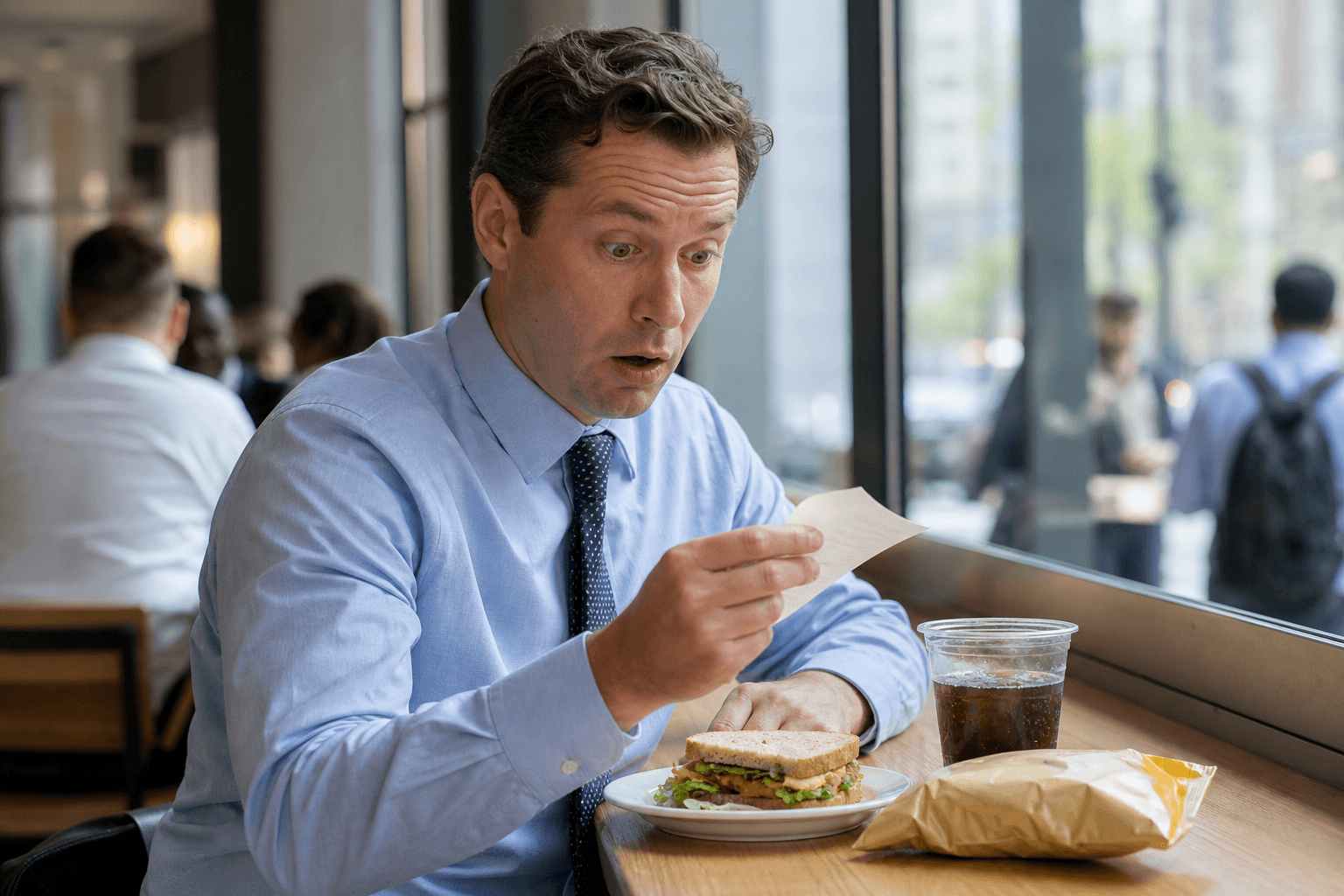
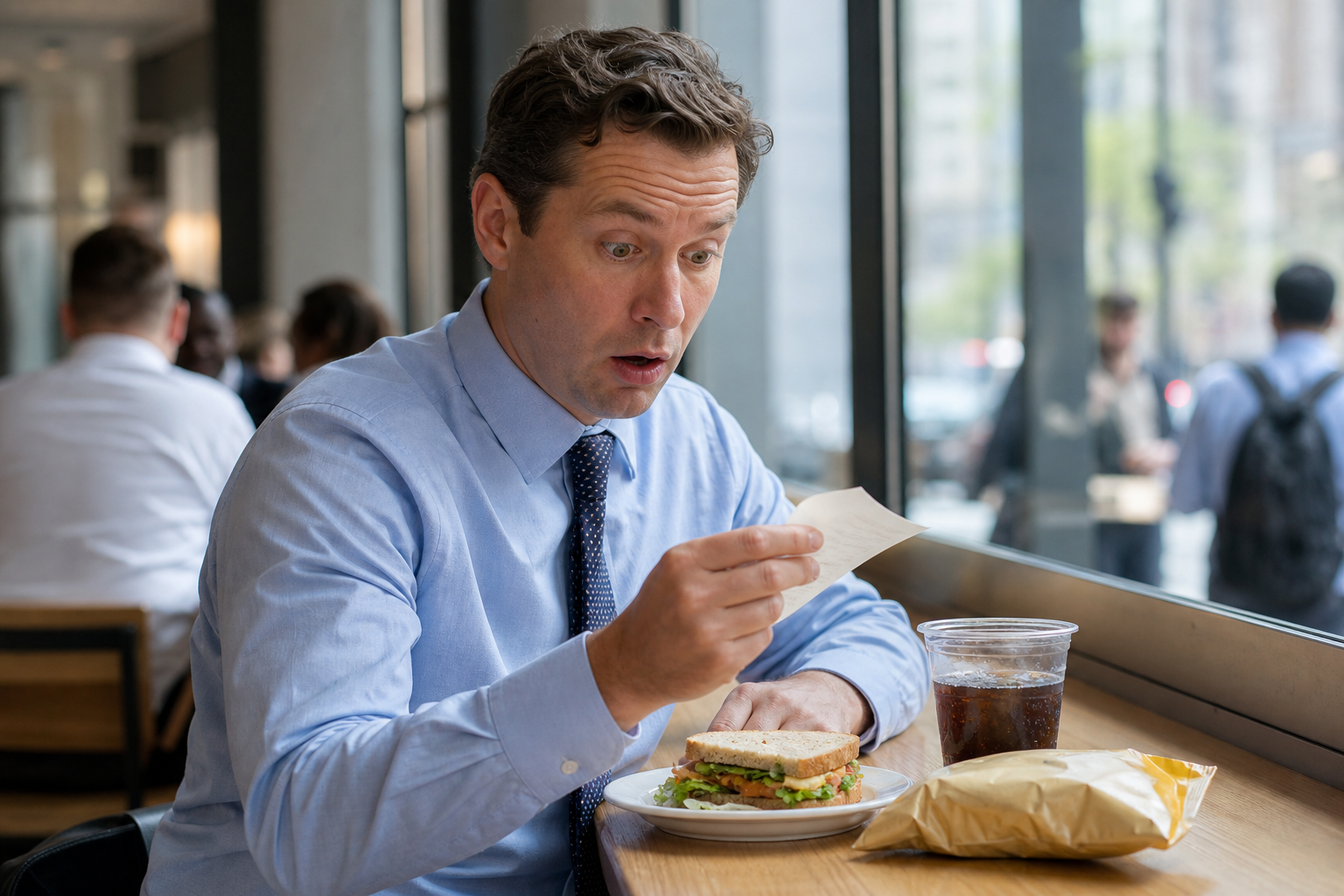
The sandwich was $13. The drink was $3. There was tax, then a screen asking whether you would like to leave 18, 20 or 25 percent. You tapped something quickly because three coworkers were waiting behind you.
The receipt said $20.84.
Nothing about the meal felt like twenty dollars. It came in paper. You carried your own tray. Nobody refilled the drink. Forty minutes later, you were back at your desk trying to remember whether you had anything in the freezer for dinner.
This is the modern office lunch: ordinary enough to happen without planning, expensive enough to quietly alter the rest of the week.
Restaurant prices have kept rising faster than many workers’ idea of what lunch should cost. According to the Bureau of Labor Statistics, prices for food away from home were still climbing year over year in 2026. The increases may look modest on a chart. At the counter, they sit on top of years of earlier increases.
A dollar here, two dollars there, a smaller portion, a tip prompt where no prompt used to be. Eventually the casual lunch becomes a financial decision.
Lunch used to be the cheap part of going to work
The office has always cost workers money. Gas, trains, parking, clothes that look presentable on camera and in person, daycare hours long enough to cover the commute. Lunch was part of the expense, but it also felt optional and manageable.
There was a dollar slice, a soup special, a cafeteria plate, a deli sandwich large enough to become dinner. You could say yes when someone asked, “Want to grab something?” without mentally opening your banking app.
Return-to-office policies made those costs visible again. At home, lunch might be leftovers eaten over the sink. At the office, the same meal requires buying groceries ahead of time, packing them before dawn and carrying a container through a commute. Forget the container and the city sets the price.
For a worker going in three days a week, a $20 lunch is $60 before coffee, parking or transit. Do it every workday and the annual number begins to resemble a small vacation, a student loan payment or several months of groceries.
Most people do not calculate the annual number while ordering. They feel it later, as a vague impression that going to work has become strangely expensive.
The paycheck did not shrink. The workday started charging admission.
“Want to grab lunch?” is no longer a neutral question
Office lunch has never been only about food.
It is where the new employee learns which manager answers emails at midnight. It is where two people from different teams realize they can solve the same problem. It is where someone mentions a job opening, an apartment, a doctor or a divorce before any of it becomes public information.
A calendar may schedule collaboration. Lunch creates the parts no one knew to schedule.
That is why the rising price changes office culture in uneven ways. When a group goes out, some coworkers are deciding whether the restaurant sounds good. Others are deciding whether participation is worth $20.
They rarely say that out loud.
They say they brought food. They have a call. They are trying to eat healthier. They need to finish something. All of those things may be true. Money can be true at the same time.
The awkwardness is sharper in workplaces where salaries vary widely but everyone is invited to the same restaurant. A director experiences lunch as convenience. An assistant experiences it as an hour of pay. The invitation sounds identical.
Declining once is easy. Declining every week can move a person to the edge of relationships that shape work.
No one intended to charge admission to belonging. The menu did it anyway.
The packed lunch has acquired a personality
Bringing food from home used to carry a faint air of practicality: leftovers, a sandwich in a plastic bag, perhaps a yogurt with a spoon you hoped was still in the drawer.
Now the packed lunch can mean several things at once. It is financial discipline. It is health. It is evidence that someone had enough time the night before to prepare. It is sometimes a quiet refusal to spend money because the company decided proximity was worth more than flexibility.
Social media has turned meal prep into its own aesthetic—matching containers, colorful grain bowls, five lunches arranged on Sunday. Real office refrigerators tell a less organized story. A takeout container with masking tape. Half a rotisserie chicken. Rice and something that tastes better than anything within three blocks. A frozen meal with a corner of the film peeled back exactly as instructed.
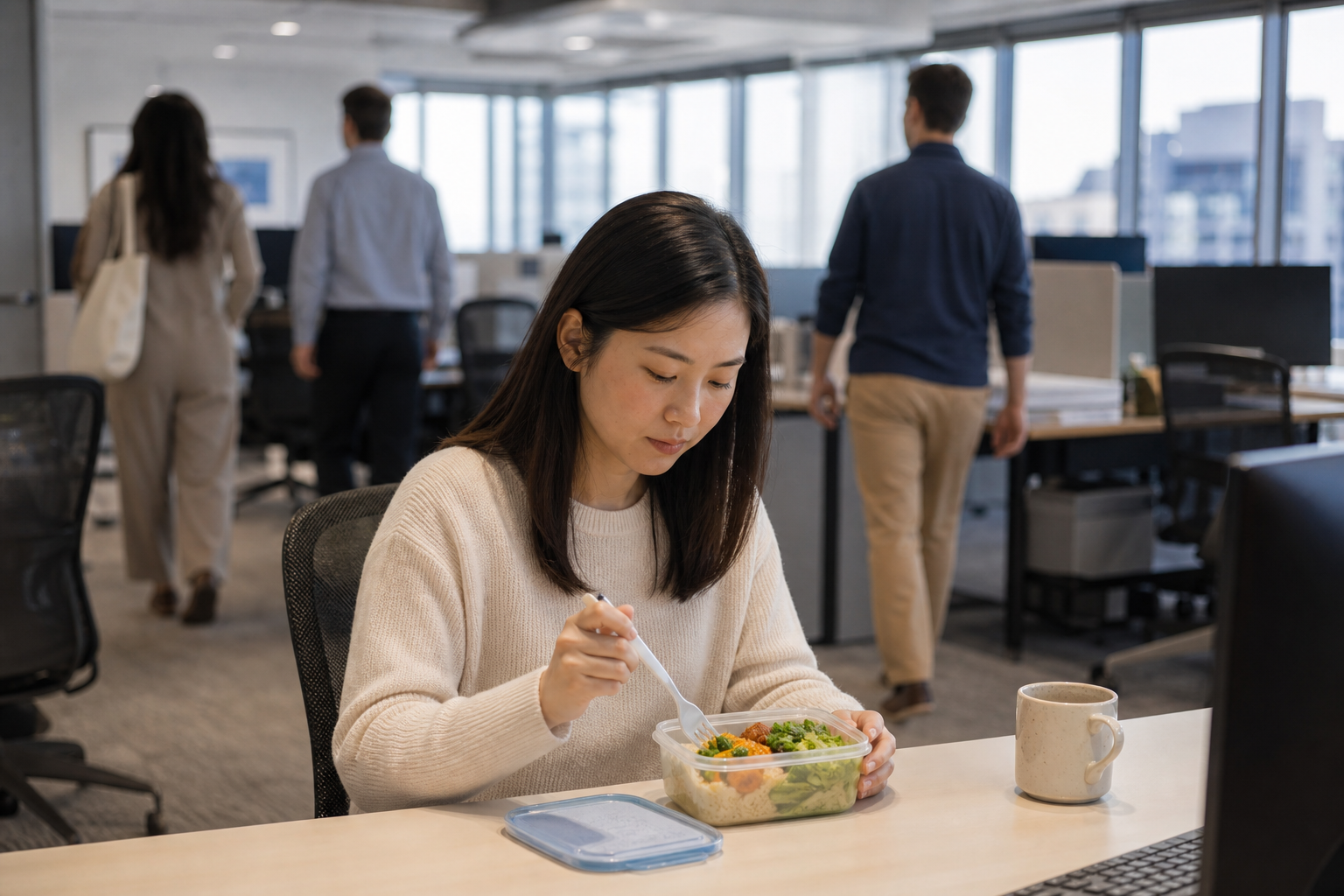
Bringing lunch saves money. It can also create a new kind of separation.
The people buying food leave together. The people who packed food remain behind, reheating meals one at a time. If the office has a good common area, the groups may reunite. If it does not, lunch becomes another hour spent at the same screen.
This is how a small economic choice becomes a design problem. An office that wants people to connect cannot assume connection will happen at restaurants employees have to fund themselves.
The tip screen is where frustration lands
Restaurant workers did not create lunch inflation. Neither did the cashier turning the tablet around.
Food costs more. Rent costs more. Labor costs more. Insurance, packaging and delivery cost more. Restaurants operate on margins that can disappear with one bad season. Workers behind the counter are often dealing with the same expensive lunch problem after their shift ends.
Still, the payment screen has become the emotional center of the transaction.
Customers see suggested tips on fast-casual service that once had no tip step. Employees watch customers hesitate. Both sides feel judged by a machine designed to increase the total without having to explain why the menu price was not the final price.
The resentment points in the wrong direction. A worker buying lunch feels squeezed. A worker serving lunch feels underpaid. The software offers them a chance to blame each other.
Meanwhile, the sandwich costs $13 before either person touches the screen.
Cheap lunch spots disappear before people stop needing them
Every office district depends on a hidden layer of affordable food: the family-run deli, the counter inside a grocery store, the food truck, the cafeteria in a building nobody notices, the place with faded photographs above the register and a lunch special that still includes a drink.
These businesses absorb economic pressure until they cannot. Rent rises. Ingredients rise. The owner works more hours. Eventually the special costs more, the portion changes or the door closes.
When an inexpensive lunch place disappears, the replacement is often not another inexpensive lunch place. It may be a polished fast-casual chain selling a bowl designed to survive delivery. The food photographs well. The base price starts in the low teens. Protein is extra.
This matters to office neighborhoods because affordable restaurants function like workplace infrastructure, even when employers do not pay for them. They make a district usable for the people who spend all day there.
A company can require five days in the office while ignoring what it costs to exist around that office. The local lunch menu keeps the more accurate record.
Free food is a benefit because it removes a decision
Employers sometimes treat lunch as a culture perk: catered Wednesdays, pizza during a meeting, a stocked kitchen, meal credits on anchor days. Workers generally appreciate it, though enthusiasm depends on whether the free lunch comes with an agenda and whether dietary options extend beyond “salad is available.”
The value is not only the price of the meal. It removes the small daily negotiation between money, time and belonging.
Everyone can sit down without deciding whether the conversation is worth the receipt. A junior employee does not need to reveal a tight budget. A parent who rushed out without packing food is not punished for the morning going wrong.
Companies that want people back in person often talk about spontaneous collaboration. Food is one of the oldest technologies for creating it. But spontaneous collaboration is less spontaneous when employees have to pay twenty dollars to attend.
The solution does not need to be luxury catering. A modest subsidy, shared table, functional kitchen or occasional meal can do more for office connection than branded merchandise nobody requested.
Workers are redesigning lunch themselves
People adapt faster than policies.
Coworkers coordinate packed-lunch days so nobody is left behind. They walk to a park with food from home. They split large orders and skip individual delivery fees. They keep hot sauce, real silverware and a rotating supply of snacks in a drawer. One person brings rice; another picks up something to share.

These arrangements lack the glamour of a restaurant reservation. They often create better conversation.
The office potluck has always carried risk. Somebody forgets serving utensils. Somebody’s famous recipe is mostly mayonnaise. But shared food changes the economics of participation. Contribution can be scaled to money, time and ability. The person who cannot cook brings drinks. The person with leftovers brings enough for two.
In a strange way, the expensive lunch may push workplace social life back toward something more communal—not because companies designed it, but because workers got tired of paying retail prices to know their coworkers.
The receipt is telling us something about work
A twenty-dollar lunch is not a national emergency. It is possible to pack food. It is possible to order less. Many workers have far more urgent expenses.
That is precisely why the lunch matters.
It is small enough to be dismissed and frequent enough to shape behavior. It reveals which parts of office life employees are expected to finance privately. It shows how economic differences appear inside teams that use the same laptops and sit at matching desks. It explains why a return-to-office mandate can feel like a pay cut even when salary remains unchanged.
Most of all, it changes the casual moments that workplaces claim to value.
The next time someone asks whether the team wants to grab lunch, listen to the half-second before people answer. That pause contains grocery prices, daycare, parking, student loans, a partner between jobs and the leftovers waiting in the office refrigerator.
Then someone will smile and say, “I’m good with anything.”
They may mean the cuisine.
They may be asking what anything costs.