
# Strolling Through Autumn in Historic Boston from Beacon Hill Gaslit Bricks to Harbor Seafood Feasts
There is an intoxicating, bookish romance that sweeps through Boston every October. As the sticky heat of summer yields to crisp Atlantic breezes, Massachusetts’ ancient capital wraps itself in a rich tapestry of autumn color. The city feels intimate and human in scale—a walking city where four centuries of revolutionary history, maritime resilience, and literary legacy are woven directly into every crooked alleyway and red-brick sidewalk.
Under a canopy of blazing scarlet sugar maples and golden American elms, fallen leaves swirl across colonial gravestones and centuries-old cobblestones. Antique brass gas lamps flicker with warm amber flames as twilight settles over Federal-style townhomes, casting long shadows across wrought-iron balustrades. The air smells of salt brine drifting off Boston Harbor, roasted espresso beans from the Italian bakeries of the North End, and rich, simmering pots of clam chowder warming tavern patrons who have ducked inside from the brisk afternoon chill.
Boston does not boast through glass-and-steel skyscrapers; it captivates through quiet gravitas. It is a place where you can trace the footsteps of the Founding Fathers along the red-brick Freedom Trail in the morning, lose an afternoon among antique bookshops and gaslit alleys in Beacon Hill, and finish your evening leaning over a scarred wooden tavern table, dipping crusty sourdough into a bowl of steaming clam chowder while church bells chime across the harbor.
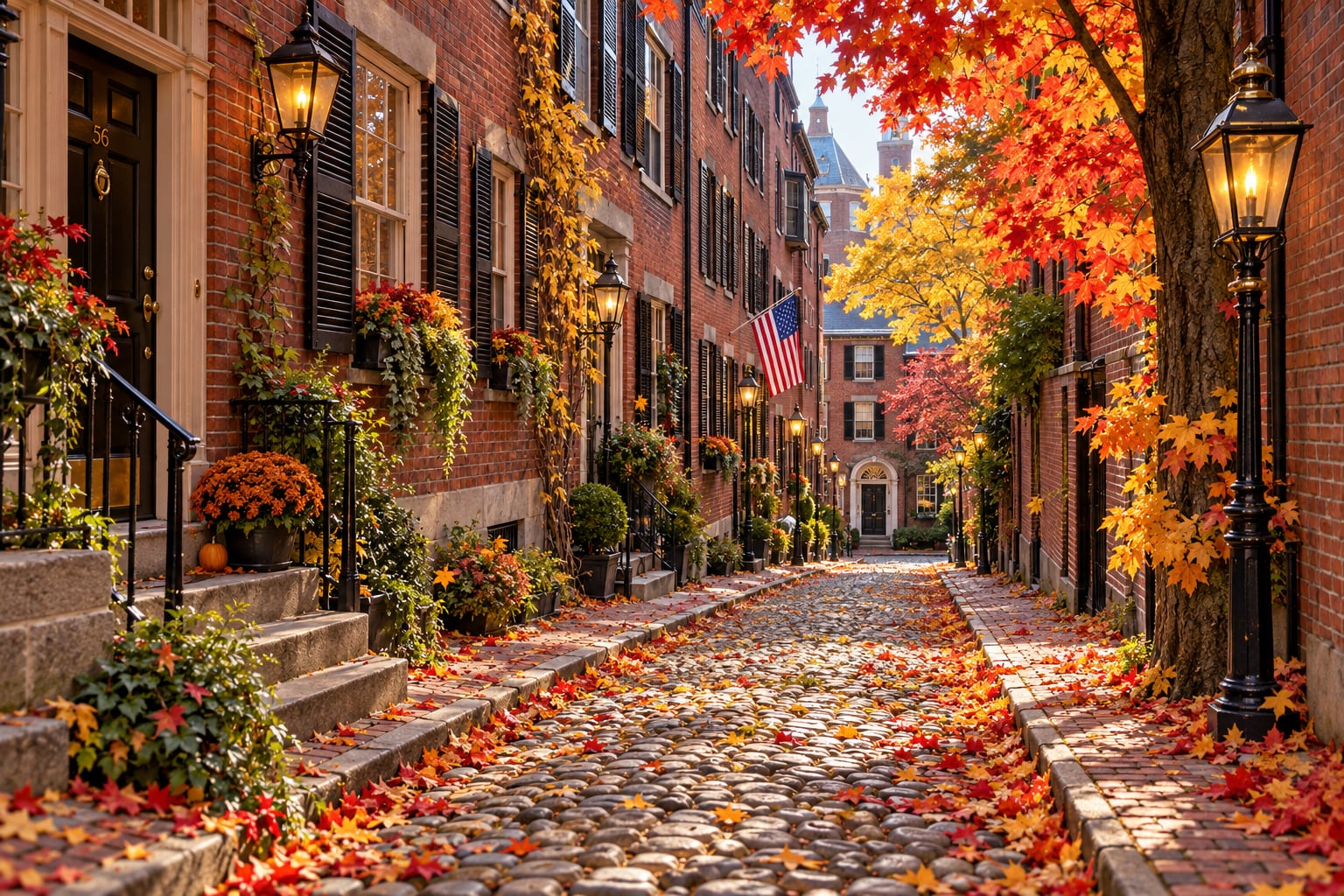
Timeless Elegance Along the Cobblestones and Gaslit Rowhouses of Beacon Hill
Perched on the hill rising directly north of Boston Common, Beacon Hill is widely considered the most picturesque historic neighborhood in the United States. Established in the late 18th century as an enclave for Boston’s intellectual and mercantile elite—the legendary "Boston Brahmins"—this neighborhood remains an impeccably preserved architectural sanctuary.
Wandering Beneath Fiery Maples on Acorn Street and Louisburg Square
Exploring Beacon Hill on foot is like stepping into an intimate 19th-century oil painting:
- Acorn Street is often hailed as the most photographed street in America, and for good reason. Paved with true rounded river cobblestones that glisten softly under autumn rain, this narrow carriage way is framed by elegant three-story red-brick rowhouses with glossy black louvered shutters, polished brass lion door knockers, and flower boxes overflowing with purple ornamental cabbages and golden chrysanthemums. Above, overhanging branches of sugar maples shower the cobblestones with vibrant orange and gold leaves.
- The neighborhood's streets are still illuminated by hundreds of original working gas street lamps. As darkness falls in the late afternoon, the soft, fluttering yellow-orange gas flames cast a nostalgic glow against hand-laid brick sidewalks, making evening walks an enchanting, timeless ritual.
- Louisburg Square forms the aristocratic centerpiece of Beacon Hill. Surrounding a private elliptical garden enclosed by ornamental iron fencing and shaded by colossal century-old beech and elm trees, these grand Greek Revival and Federal brick mansions once housed literary giants including Louisa May Alcott and William Dean Howells.
- Charles Street serves as the neighborhood's vibrant village main street. Brick storefronts house independent bookstores, cozy cafes serving cinnamon-dusted chai lattes, antique galleries filled with nautical brass instruments and vintage oil paintings, and neighborhood florists displaying decorative autumn pumpkins and gourds on wooden crates outside their doors.
- Tucked into the northern slope of the hill lies the Black Heritage Trail and the historic African Meeting House, constructed in 1806 as the oldest surviving Black church building in the country, standing as a powerful monument to the city’s pivotal abolitionist history.
Classic New England Harbor Feasts with Steaming Clam Chowder and Crispy Cannoli
Boston’s culinary identity is anchored in the deep, cold waters of the North Atlantic and enriched by generations of immigrant craft. From historic seaside oyster houses where politicians have dined since the American Revolution to the buzzing Italian pastry counters of the North End, dining in Boston is deeply authentic, hearty, and comforting.
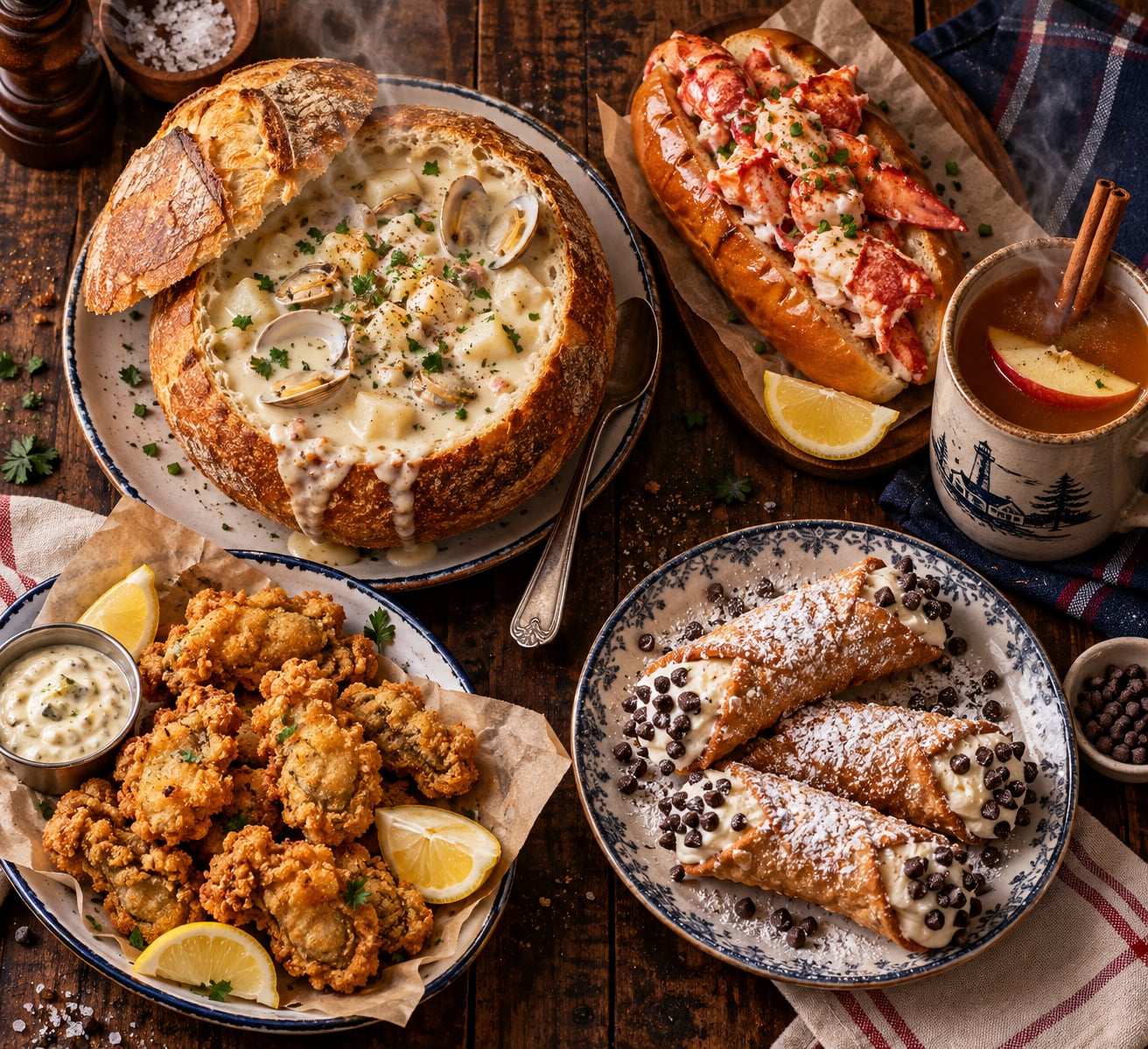
From Historic Waterfront Oyster Taverns to the Sweet Italian Bakeries of the North End
To feast like a seasoned Bostonian, you must explore these timeless culinary institutions:
- Authentic New England Clam Chowder is the undisputed culinary soul of the city. Prepared with tender Atlantic quahog clams, diced salt pork, yellow onions, and tender Yukon Gold potatoes simmered in a velvety cream broth perfumed with fresh thyme and cracked black pepper, it contains no tomatoes and no artificial thickening starch. Served piping hot inside a hollowed-out artisan sourdough bread bowl with a handful of crispy oyster crackers, every spoonful delivers rich, savory ocean sweetness that banishes any autumn chill.
- The legendary Maine-style Lobster Roll remains an essential indulgence. Packed with giant, tender chunks of sweet knuckle and claw meat lightly tossed in pure melted sweet butter or a mere whisper of mayonnaise and fresh chives, it is served overflowing inside a griddled, split-top brioche bun toasted golden brown on both sides. Paired with crispy kettle-cooked potato chips and a sour dill pickle spear, it represents seafood simplicity at its finest.
- Union Oyster House, open continuously since 1826 along the historic Freedom Trail, is the oldest continuously operating restaurant in the United States. Sitting at its semicircular mahogany raw bar—where Daniel Webster once consumed dozens of freshly shucked oysters with tall mugs of ale—you can watch master shuckers pry open cold, briny Wellfleet and Duxbury oysters harvested directly from nearby Massachusetts bays.
- Stepping across the Greenway brings you into the narrow, lively streets of the North End, Boston’s historic Little Italy. Walking along Hanover Street and Salem Street, the aromas of roasted garlic, simmering marinara sauce, and fresh espresso billow from basement trattorias. Here, traditional pasta shops hand-roll lobster ravioli pillows drizzled in sherry cream sauce, while neighborhood bakeries like Mike's Pastry and Modern Pastry draw lively queues for freshly piped Italian cannoli—crispy fried pastry shells filled to order with sweet ricotta cream, mini dark chocolate chips, or crushed roasted pistachios, dusted with a snowfall of powdered confectioners' sugar.
- For an afternoon pick-me-up, visit the historic Boston Public Market for warm apple cider donuts fried golden brown in front of your eyes, rolled in coarse cinnamon sugar, and served in brown paper bags alongside steaming mugs of hot spiced cider pressed from orchard-fresh McIntosh apples.
Walking Through Living American History on the Freedom Trail and Boston Common
Unlike cities that lock their history away in dusty archives, Boston wears its founding events proudly on the pavement. The famous Freedom Trail—a 2.5-mile ribbon of red bricks laid into the sidewalk—guides visitors effortlessly through sixteen of the most significant historic sites in the birth of the United States.
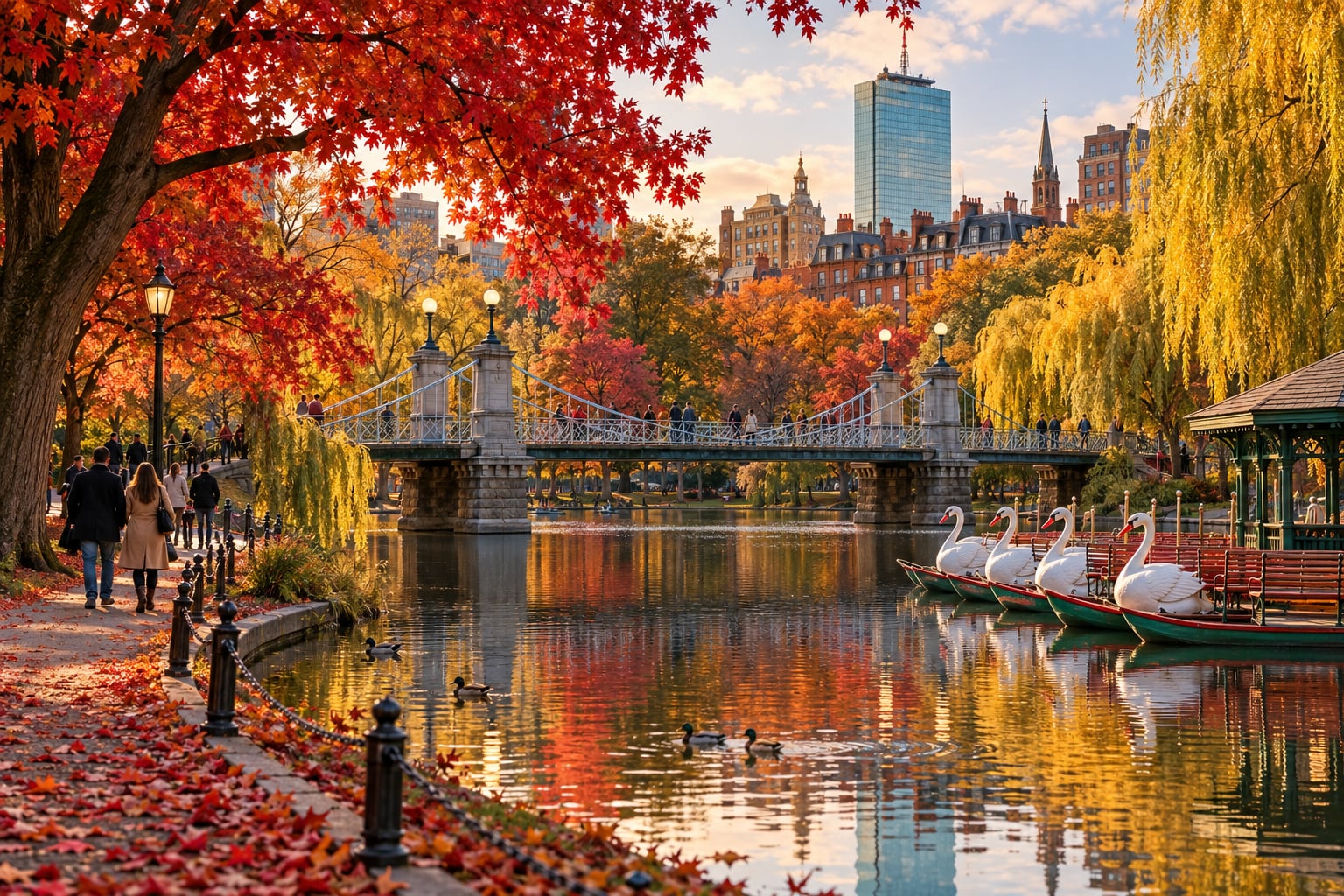
Following the Red Brick Path Beneath Golden Elm Trees and Historic Spindles
Tracing this historic walking path reveals an astonishing density of American heritage:
- Boston Common, established in 1634 as the country’s oldest public park, serves as the triumphant starting point of the trail. In autumn, its fifty acres of rolling emerald lawns are framed by magnificent golden elm trees and scarlet oaks. Historically used for grazing cattle, public rallies, and colonial militia drills, today it is a peaceful green oasis where students, dogs, and strollers mingle under crisp blue skies.
- Adjacent to the Common lies the Boston Public Garden, America’s first public botanical garden. Famous for its Victorian floral borders and the whimsical bronze duckling statues inspired by Robert McCloskey’s beloved children’s book Make Way for Ducklings, the garden’s tranquil central lagoon is spanned by an ornate 1867 miniature suspension bridge. In October, majestic weeping willows drape golden ribbons over the water, where the famous pedal-powered wooden Swan Boats conclude their seasonal voyages.
- The Massachusetts State House crowns Beacon Hill with its magnificent golden dome, originally sheathed in copper rolled by Paul Revere in 1802 and later gilded in pure twenty-three-karat gold leaf that catches the afternoon sun like a beacon.
- Granary Burying Ground offers a contemplative walk among moss-covered slate headstones beneath towering maple trees. Here lie the final resting places of some of the most celebrated figures of the American Revolution, including Paul Revere, Samuel Adams, John Hancock, and the victims of the 1770 Boston Massacre.
- Old North Church, nestled in the North End, is famous as the historic steeple where church sexton Robert Newman hung two lanterns on the night of April 18, 1775, signaling to Paul Revere across the Charles River that British troops were advancing "by sea" toward Lexington and Concord.
- The trail concludes across the harbor in Charlestown, where the formidable timber hull of the USS Constitution—"Old Ironsides," the oldest commissioned naval warship afloat in the world—rests proudly in the Charlestown Navy Yard beside the towering granite obelisk of the Bunker Hill Monument.
Autumn Breezes Along Boston Harbor and Waterfront Sunsets Across the Bay
As day gently draws to a close, Boston's historic waterfront provides the perfect vantage point to embrace the maritime soul of New England:
- Boston Harborwalk, a continuous public walkway tracing the shoreline, offers panoramic vistas across Boston Harbor toward the Harbor Islands and the Atlantic horizon. Walking along Rowes Wharf beneath its soaring granite archway, you can watch historic sailing schooners and passenger ferries glide through golden-tinted water as the sun sinks behind the downtown skyline.
- Across the Charles River Esplanade, running between Boston and Cambridge, rowers from Harvard and collegiate rowing clubs slice their slender shells through the glassy water beneath overhanging golden sycamores and willows, while the city skyline reflects in shimmering bands across the river.
- Fan Pier in the Seaport District provides arguably the single best vantage point of the downtown Boston skyline at blue hour twilight. Looking across the harbor waters, the illuminated facades of historic wharves and gleaming contemporary waterfront buildings glow brilliantly against the deep evening sky.
Practical Travel Advice for Exploring the Cradle of Liberty with Ease
Planning an autumn getaway to Boston is delightfully simple thanks to the city's pedestrian-friendly layout and comprehensive public transit:
- Boston is universally recognized as "America’s Walking City." Most major historic sights, restaurants, and neighborhoods—from Back Bay and Beacon Hill to Downtown and the North End—are clustered within easy walking distance of one another. Bringing a comfortable, supportive pair of walking shoes is the single most important travel decision you can make, especially for navigating uneven cobblestones and historic brick sidewalks.
- The Massachusetts Bay Transportation Authority (MBTA)—known locally simply as "The T"—is the oldest subway system in the United States. Its clean, color-coded subway lines (Red, Green, Blue, and Orange) make hopping across the Charles River to Harvard Square in Cambridge or traveling to the airport seamless and inexpensive without ever needing a rental car.
- The peak autumn foliage window in Boston typically runs from the second week of October through early November. Packing layers is essential, as brisk ocean winds can turn a mild sunny afternoon into a chilly evening very quickly; a cozy wool sweater, scarf, and a wind-resistant jacket will keep you perfectly comfortable.
- When visiting the North End's famous pastry shops or historic seafood taverns, keep in mind that several beloved legacy bakeries—including Mike's Pastry—remain cash-only businesses, so carrying a modest amount of cash ensures you won't be caught off guard when the cannoli craving strikes.