
# Discovering the Cobalt Blue Waters of Lake Tahoe and Emerald Bay in Autumn with Lakeside Wood Fired Feasts
Straddling the border between northern California and Nevada at an elevation of over 6,200 feet, Lake Tahoe is universally recognized as the Jewel of the Sierra. Formed millions of years ago by ancient faulting and carved by colossal glaciers during the last ice age, this massive alpine freshwater lake is the second deepest in the United States, plunging to an astonishing depth of 1,645 feet. Its waters are so pure that in many spots you can look straight down through seventy feet of translucent liquid crystal to watch granite boulders resting on the sandy floor.
While summer draws crowded flotillas of speedboats and winter transforms the surrounding peaks into world-class ski arenas, October is the lake's best-kept secret. Known to locals as the golden season, autumn brings a serene stillness to the Sierra Nevada. The summer traffic evaporates, the mountain air turns crisp and pine-scented, and the quaking aspens in the tributary valleys ignite into ribbons of incandescent gold against deep evergreen forests and towering granite crags. It is a time for quiet lakeside walks, scenic scenic drives along sheer cliffs, watching wildlife along mountain streams, and gathering beside stone hearths for unforgettable wood-fired mountain meals.
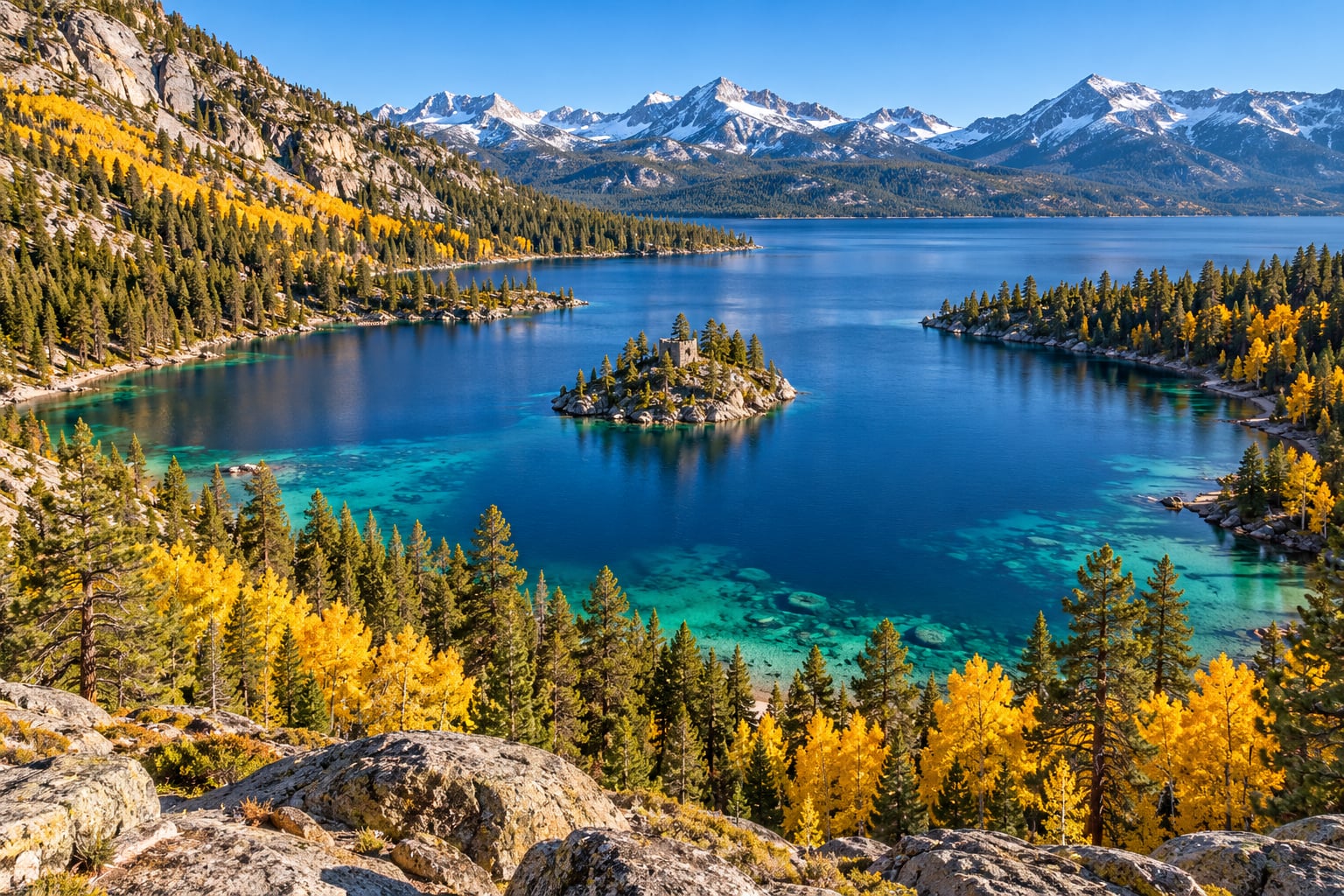
Gazing Across the Glacial Jewel of the Sierra from Emerald Bay Overlook
If there is a single view that defines the legendary grandeur of the Sierra Nevada, it is the panoramic vista from the granite bluffs high above Emerald Bay. Located along the southwestern curve of the lake, this designated National Natural Landmark is an emerald-green inlet carved into the mountain flank, connected to the deeper cobalt expanse of Tahoe by a narrow strait.
Arriving at the overlook just as the morning sun crests the eastern Carson Range is a transcendent moment. The low-angled autumn light strikes the bay at an angle that reveals its mesmerizing gradient of color, shifting from brilliant pale turquoise along the shallow granite shoals to deep, hypnotic sapphire in the center:
- Rising from the center of the bay is Fannette Island, the only island in the entire lake, crowned by the stone ruins of a miniature tea house built in the late 1920s.
- Dense stands of ponderosa pines, sugar pines with enormous hanging cones, and incense cedars cling to the precipitous granite cliffs that plunge straight into the water.
- In October, bright yellow quaking aspens trace the path of Eagle Creek as it cascades down from the high Desolation Wilderness, adding brushstrokes of vibrant gold to the evergreen slopes.
A steep but rewarding one-mile trail leads from the highway down through the pine forest to the water's edge, bringing you to the shore of Vikingsholm. This extraordinary thirty-eight-room Scandinavian castle, constructed in 1929 from hand-hewn local granite and timber without a single modern nail, sits in perfect architectural harmony with its alpine surroundings. Walking across the quiet sandy beach in front of the castle when the morning mist is rising from the lake feels like stepping into a hidden Nordic fjord tucked away in the American West.
Walking the Serene Rubicon Trail Along Granite Cliffs and Sugar Pines
For hikers seeking the ultimate lakeside trek, the Rubicon Trail connecting D.L. Bliss State Park and Emerald Bay delivers non-stop visual drama. Unlike high alpine routes that climb above the tree line, this scenic singletrack contours directly along the rocky shoreline, hovering between fifty and two hundred feet above the water.
In the autumn season, hiking this trail is pure joy. With summer crowds gone and daytime temperatures hovering in the comfortable mid-sixties, you have the path almost to yourself:
- The trail winds around soaring granite promontories like Rubicon Point, where the lake bottom drops off precipitously into water so dark and deep it resembles molten lapis lazuli.
- Towering sugar pines and Jeffrey pines perfume the crisp air with the distinctive, comforting scents of vanilla and warm butterscotch baked by the autumn sun.
- Below the trail, hidden coves and pocket beaches feature water so impossibly transparent that floating pine needles cast sharp dark shadows on the sunlit sand ripples beneath the surface.
- Looking across the wide expanse of the lake, snow dustings from early autumn storms often powder the summits of Mount Tallac and the peaks of the East Shore, creating stark white crowns against the cloudless azure sky.
The complete roundtrip between the two state parks spans approximately six to eight miles of undulating terrain, offering countless flat granite ledges where you can sit in silence, listen to the gentle lap of alpine waves, and soak in the soothing warmth of the midday sun.

Watching the Autumn Kokanee Salmon Run and Golden Aspens at Taylor Creek
Just south of Emerald Bay lies Taylor Creek, the stage for one of the most remarkable wildlife spectacles in North America. Every October, tens of thousands of landlocked sockeye salmon, known locally as kokanee, leave the deep waters of Lake Tahoe and swim upstream into this shallow gravel creek to spawn and complete their life cycle.
A visit to the Taylor Creek Visitor Center and its paved Rainbow Trail provides front-row viewing of this ancient natural ritual:
- As the salmon enter freshwater streams, their silvery bodies undergo an astonishing transformation, turning a brilliant, shocking crimson red with hooked jaws and humped backs.
- From the wooden viewing footbridges spanning the creek, visitors can watch thousands of scarlet fish jockeying for position in clear, shallow riffles over polished pebbles beneath the golden canopy of autumn foliage.
- The underground stream profile chamber allows you to look through thick glass windows directly into the underwater world of the creek, viewing the salmon and native trout at eye level as they navigate the currents.
- The massive congregation of spawning fish attracts an array of wildlife, including majestic bald eagles perching in dead pine snags, osprey diving for fish, and occasional black bears foraging along the willow banks in the quiet early mornings.
Surrounding the creek are extensive groves of quaking aspens that turn a luminous, shimmering gold during the second week of October. Walking beneath the yellow leaves while watching bright red salmon battle upstream through emerald water creates a symphony of color that defines autumn in the Sierra.
Savoring Cedar Plank King Salmon and Rustic Mountain Lodge Cooking
After hours spent exploring chilly lakeside trails and breathing crisp mountain air, returning indoors to a rustic lakeside tavern with a roaring stone fireplace is one of the greatest pleasures of visiting Lake Tahoe. The culinary culture of the Sierra Nevada is deeply tied to the bounty of the Pacific Northwest and the rugged frontier cooking of California and Nevada gold country.
Mountain chefs around South Lake Tahoe, Tahoe City, and Incline Village embrace wood-fired hearths, seasonal root crops, and sustainable cold-water seafood:
- Whole wild King salmon fillets roasted over aromatic western red cedar planks, seasoned with coarse sea salt, cracked black pepper, fresh garden rosemary, and a glistening glaze of pure maple syrup and whole-grain mustard. The cedar wood imparts a gentle, fragrant smokiness that permeates the rich, buttery fish.
- A hot cast-iron skillet of creamy smoked trout dip, prepared with flaked rainbow trout caught in local alpine reservoirs, folded into whipped mascarpone cheese with fresh chives, shallots, and lemon zest, served with golden sourdough crostini.
- A side of roasted autumn vegetables featuring caramelized butternut squash, Brussels sprouts, wild chanterelle mushrooms, and toasted pine nuts tossed in brown butter.
- A cast-iron skillet of wild mountain blackberry and huckleberry cobbler served bubbling hot from the wood oven, topped with a generous scoop of handcrafted vanilla bean ice cream that melts into the tart purple fruit.
- Frosty pint glasses of locally brewed Lake Tahoe craft IPA, bursting with fragrant pine and citrus hop aromas, or crisp hard apple cider made from heirloom orchards in the nearby foothills of Apple Hill.
Dining beside large picture windows as the last twilight colors fade from the lake, listening to the crackle of pine logs burning in the hearth, provides the perfect conclusion to an autumn day in the high country.
Soaring on the Heavenly Mountain Gondola for Lake Panoramas
To fully appreciate the colossal scale and geographical drama of Lake Tahoe, one must view it from above. Located right in the heart of South Lake Tahoe on the California-Nevada state line, the Heavenly Mountain Gondola carries passengers on an exhilarating 2.4-mile ascent straight up the mountainside.
The gondola ride rises over 2,800 vertical feet in less than fifteen minutes:
- As the enclosed glass cabin glides silently above towering pine canopies and rugged granite ledges, the forest falls away beneath you, revealing ever-expanding vistas of the Tahoe basin.
- Midway up the mountain at an elevation of 9,123 feet, the gondola stops at a massive fourteen-thousand-square-foot observation deck perched on the edge of a cliff.
- Stepping onto the deck, the panoramic view simply defies description. Spread out before you is the entire twenty-two-mile length of the lake, glowing like a colossal sapphire set into a ring of snow-dusted granite peaks.
- To the east, the mountain drops off into the stark, golden expanse of Nevada's Carson Valley, while to the west, the jagged spine of the Sierra Nevada stretches as far as the eye can see.
Visiting the observation platform in late afternoon when the sun begins its descent behind the western peaks illuminates the water in shades of liquid platinum and gold. The crisp mountain wind at nine thousand feet is exhilarating, reminding every traveler of the sheer alpine power of this mountain sanctuary.
Sunset Among the Translucent Waters and Giant Boulders of Sand Harbor
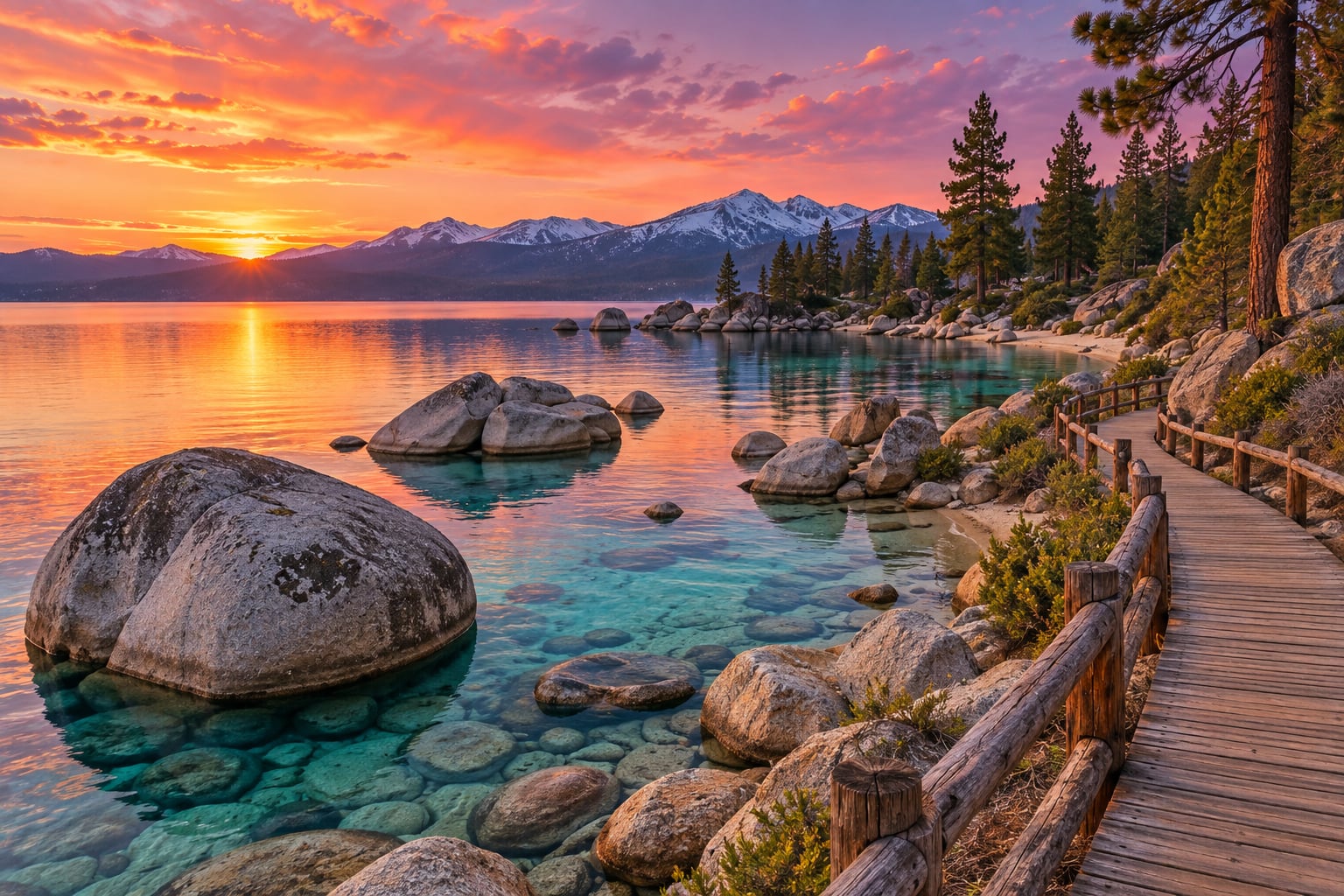
On the northeast shore in Nevada, Sand Harbor State Park presents an entirely distinct landscape from the steep forested cliffs of Emerald Bay. Here, colossal, rounded granite boulders sculpted smooth by millions of years of water and ice lie scattered across shallow, gently sloping coves of pale white sand.
During the summer months, Sand Harbor is packed with sunbathers, but in the peaceful calm of October evenings, it becomes an oasis of tranquility:
- The water here is legendary for its crystal clarity, appearing in striking shades of electric turquoise, mint green, and aquamarine that rival the finest Caribbean beaches, set against a backdrop of fragrant pine forests.
- A wooden boardwalk winds gracefully along the rocky coastline, providing intimate eye-level views of the massive monoliths resting peacefully in the transparent shallows.
- As the sun dips behind the Sierra peaks across the lake, the sky explodes in a painterly palette of soft pastel peach, dusty rose, and deep lavender.
- The glassy surface of the lake mirrors the vibrant evening colors, turning the boulders into dark, dramatic silhouettes surrounded by water that looks like liquid glass.
Photographers and romantics gather quietly along the sandy spit, wrapped in fleece jackets and sipping hot cocoa, watching the final twilight embers give way to a brilliant canopy of stars. The sheer stillness of Sand Harbor at dusk captures the soul of Lake Tahoe at its most peaceful and poetic.
Practical Travel Tips for Autumn Weather Driving Passes and Lake Exploring
Planning an autumn road trip to Lake Tahoe requires mindful attention to mountain elevations and changing weather patterns:
- Elevation and packing for rapid temperature shifts. Lake Tahoe sits at 6,225 feet, meaning you will experience high altitude conditions. Daytime temperatures in October are often sunny and delightful, reaching the mid-sixties, but as soon as the sun dips behind the mountains, temperatures quickly drop into the thirties and below freezing. Pack plenty of versatile layers, including moisture-wicking base layers, a warm fleece or down jacket, a windproof shell, a knit beanie, and warm gloves.
- Autumn driving across Sierra mountain passes. Accessing Lake Tahoe from Sacramento or the San Francisco Bay Area requires crossing major mountain passes like Echo Summit on Highway 50 (elevation 7,382 feet) or Donner Summit on Interstate 80 (elevation 7,227 feet). Autumn snowstorms can occur unexpectedly in October. Always check the Caltrans and Nevada DOT road condition hotlines before setting out, ensure your vehicle has good tire tread, and carry tire chains if required by weather advisories.
- Off-peak park access and parking. Unlike summer when parking lots at Emerald Bay and Sand Harbor fill by eight in the morning, autumn visitors enjoy ample parking throughout the day. However, trailhead parking at popular spots like Taylor Creek and D.L. Bliss can still be busy on October weekends. Visiting mid-week or arriving in the early morning ensures complete solitude and prime wildlife viewing.
- Sun protection and high altitude hydration. Because the high Sierra atmosphere is thin and dry with minimal cloud cover, UV radiation is significantly stronger than at sea level. Apply broad-spectrum sunscreen regularly, wear polarized sunglasses to protect your eyes from intense lake glare, and drink at least three liters of water daily to prevent altitude headaches and fatigue.
- State park fees and seasonal facility closures. Both California and Nevada state parks around the lake charge daily vehicle entrance fees ranging from ten to fifteen dollars. Keep cash or a credit card handy. Note that while parks and trails remain open year-round, certain seasonal facilities such as visitor centers, boat rentals, and public campgrounds begin closing for the winter season in mid to late October.