
# Beyond the Neon Glow of the Las Vegas Strip and Into the Fiery Silence of the Desert Canyons
Driving south across the barren expanse of the Mojave Desert at twilight, there is a singular moment when the ink-black horizon suddenly cracks open. A shimmering pyramid of golden light shoots straight into the heavens, followed by a radiant basin of neon pink, electric cobalt, and emerald green blazing like a dropped jewel box in the middle of nowhere. This is Las Vegas—a city engineered entirely out of human audacity, illusion, and sheer willpower.
For decades, popular culture has reduced Las Vegas to a punchline of quick weddings, slot machines, and sensory overload. But travelers who take the time to peel back the neon veneer discover a destination of striking dualities. It is a city where world-class dining sits beside authentic immigrant enclaves, where vintage mid-century architecture whispers stories of the Rat Pack, and where just forty minutes past the casino towers lie some of the most geologically surreal, silent sandstone canyons in North America.
The Mirage in the Mojave: Why Las Vegas Still Captivates the Imagination
There is an intoxicating freedom that settles over you the moment you step out into the warm, dry desert air of Clark County. Las Vegas does not keep regular hours. Day bleeds into night without apology beneath crystal chandeliers and climate-controlled atriums. Time feels elastic here; an afternoon that starts with a leisurely dip in a palm-shaded pool can easily morph into an impromptu concert, an unforgettable midnight feast, and an early morning road trip into glowing red rock canyons.
What makes Vegas truly captivating today is its transformation into a global cultural crossroads. Travelers from Tokyo, London, Sydney, and São Paulo cross paths on the pedestrian bridges, all seeking their own version of spectacle. Whether you come for high-stakes excitement, world-class theater productions, or simply to marvel at human engineering pushed to its theatrical extreme, the city delivers an intensity found nowhere else on earth.
Navigating the Neon Boulevard: The Grand Spectacle of the Las Vegas Strip
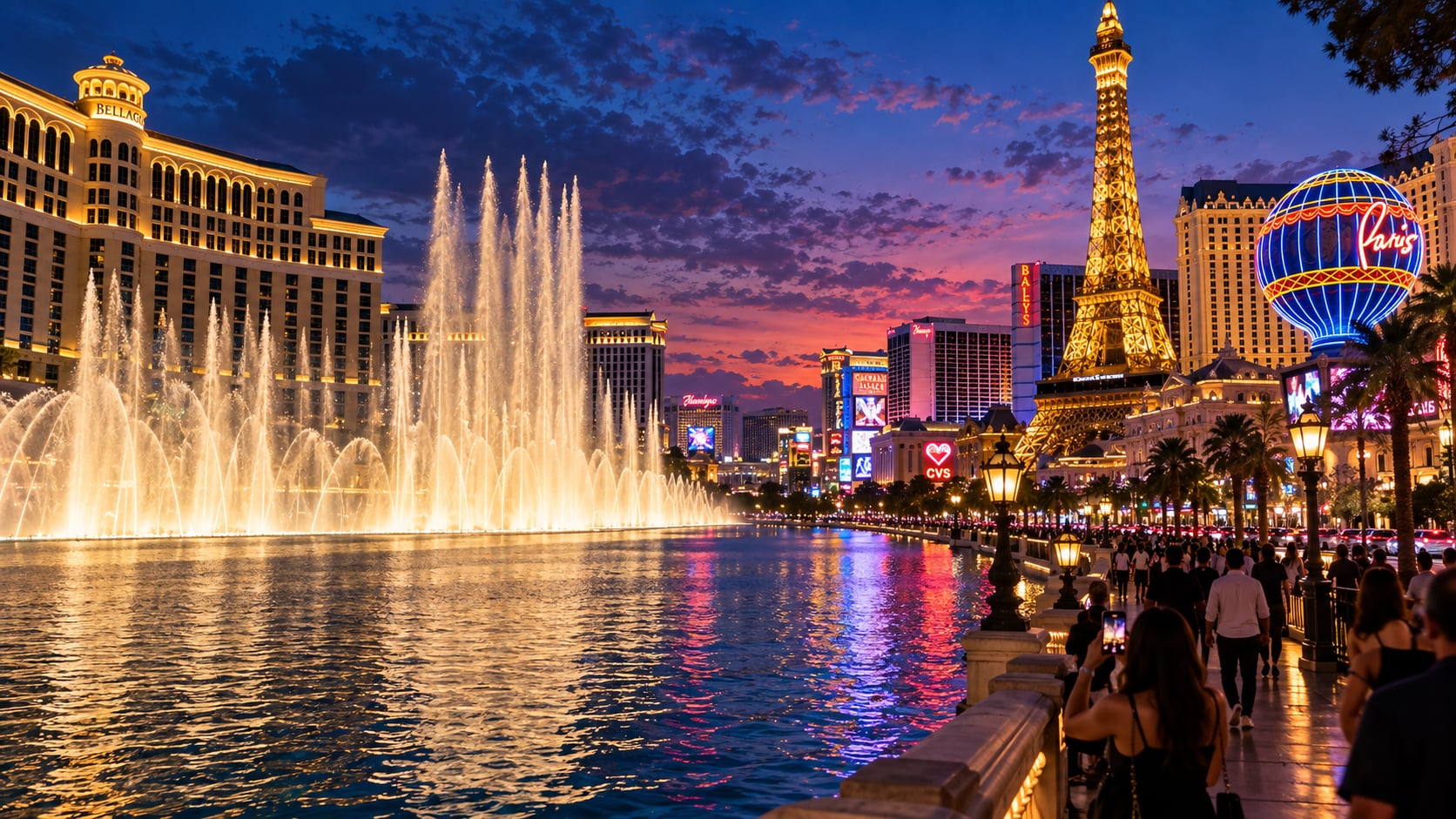
Las Vegas Boulevard—universally known as The Strip—is a four-mile corridor of pure sensory indulgence. Walking along this glittering canyon of mega-resorts is an exercise in suspended disbelief. In a single afternoon, you can stroll past the marble colonnades of Caesars Palace, take in the gilded replicas of the Eiffel Tower and Arc de Triomphe at Paris Las Vegas, and watch gondoliers glide along turquoise canals beneath an artificial indoor sky at The Venetian.
The best time to experience The Strip on foot is during the magic hour right after sunset. As the desert sky deepens into indigo, the lights ignite. Stand along the promenade of the Bellagio to witness its choreographed fountain show. When the music swells and thousands of water jets blast over four hundred feet into the air, creating billowing plumes of mist that catch the golden reflections of the lake, even the most cynical travelers pause in awe.
- Take advantage of the free elevated tram systems connecting major properties like Bellagio, CityCenter, and Park MGM to save your feet from the punishing distances between mega-resorts.
- Cross between resorts using the pedestrian skybridges; street-level crossings are strictly prohibited on the busiest sections of Las Vegas Boulevard and police enforce pedestrian laws actively.
- Visit the Conservatory and Botanical Gardens inside Bellagio, where a team of over one hundred horticulturists transforms a 14,000-square-foot glass dome into breathtaking seasonal living displays using tens of thousands of fresh flowers and trees.
Beyond the Casino Floor: The Culinary Revolution on Spring Mountain Road and Beyond
If you judge Las Vegas food solely by thirty-dollar hotel breakfast buffets, you are missing the most exciting culinary movement in the American Southwest. Today, the world’s most celebrated chefs operate flagship establishments alongside a fiercely creative independent dining scene that thrives just minutes away from the tourist corridor.
For an authentic local experience, head two miles west of The Strip to Spring Mountain Road—the culinary spine of Las Vegas Chinatown. Spanning more than three miles of unassuming strip malls, this district holds a concentration of Asian culinary talent that rivals Los Angeles, Vancouver, or San Francisco. Here, you will find master noodle makers hand-pulling steaming bowls of Lanzhou beef soup, Vietnamese immigrants simmering forty-eight-hour bone broths for rich Northern and Southern phở, and bustling izakayas grilling binchotan-charred skewers of wagyu and pork belly until three in the morning.
Back along the corridor, the culinary choices span every indulgence imaginable. You can savor forty-five-day dry-aged Tomahawk ribeyes seared over mesquite wood, delicate Cantonese dim sum served in tiered bamboo steamers, and artisanal cocktails garnished with desert botanicals and aromatic smoke.

- Venture to Lotus of Siam on East Sahara or Flamingo Road for northern Thai khao soi and garlic prawns that food critics have consistently hailed as the finest Thai food in North America.
- Book reservations for marquee dinners four to six weeks in advance, especially for Friday and Saturday evenings when convention crowds and weekend travelers converge.
- Explore the off-Strip Arts District along Main Street, where restored industrial warehouses now host craft microbreweries, artisanal sourdough bakeries, and chef-driven farm-to-table bistros.
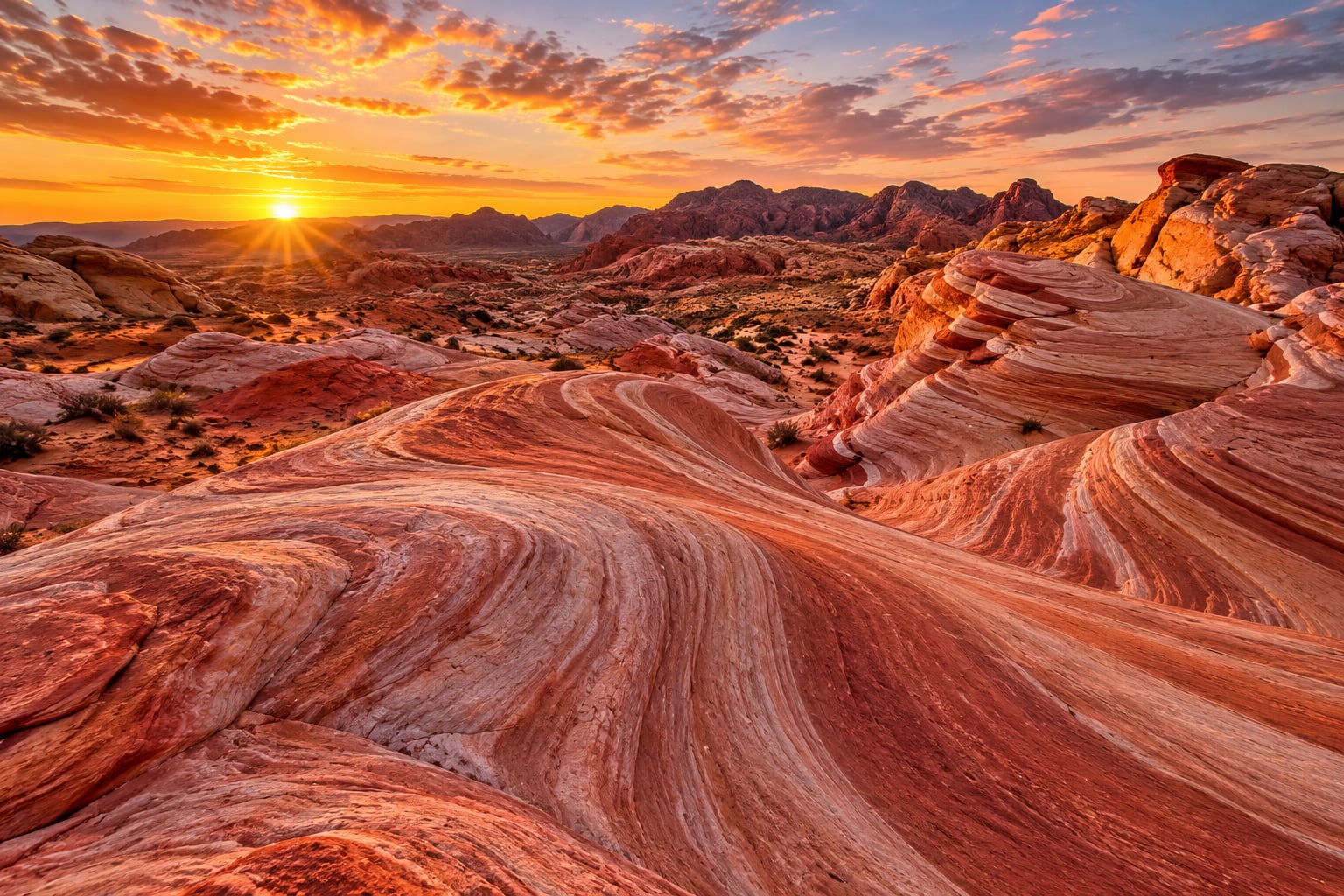
The Fiery Waves of Aztec Sandstone: Sunrise at Valley of Fire State Park
When the sensory bombardment of slot machines and flashing video boards starts to overwhelm, the desert offers an immediate and profound antidote. Located less than an hour’s drive northeast of Las Vegas lies Valley of Fire State Park—Nevada’s oldest and most astonishing state park.
Arrive just before dawn when the temperature is cool and the park roads are virtually deserted. As the morning sun clears the ragged eastern peaks, the 40,000 acres of Aztec sandstone ignite in an optical blaze of fiery crimson, burnt orange, and pale salmon pink. It feels less like planet Earth and more like wandering across the surreal floor of Mars.
Hike out to the Fire Wave, a gentle 1.5-mile trail leading across sweeping ripples of striped sedimentary stone where undulating bands of zebra-like red and white rock twist beneath your hiking boots. Wander past Atlatl Rock to inspect two-thousand-year-old petroglyphs carved deep into desert varnish by ancestral Puebloan peoples. Standing among these silent, wind-sculpted arches while desert bighorn sheep pick their way delicately across red stone ledges puts the temporary human frenzy of The Strip into breathtaking perspective.
- Enter the park via Valley of Fire Highway off Interstate 15 and purchase your day-use permit at the self-pay fee station or visitor center.
- Carry at least one gallon of water per person even during cooler autumn and spring months; desert humidity frequently hovers below ten percent, accelerating dehydration without noticeable sweating.
- Drive through the White Domes scenic byway for some of the most cinematic desert road photography in the American West, featuring dramatic carved slots and contrasting pastel rock formations.
Red Rock Canyon Escapes: Scenic Loops, Towering Escarpments, and Desert Silence
If you only have half a day for natural exploration, Red Rock Canyon National Conservation Area sits just twenty miles west of the casino towers, framing the city skyline with its monumental red-and-buff sandstone escarpment.
The centerpiece of the park is a one-way, thirteen-mile paved scenic drive that winds through dramatic elevation changes. Along the drive, pull over at Calico Tanks for a moderately challenging scramble over smooth sandstone slickrock. The trail rewards hikers with a hidden pocket of rainfall-fed water nestled among red boulders, offering a stunning panoramic vantage point that frames the distant gleaming towers of The Strip through a rugged natural canyon window.
In late autumn and winter, the desert air is crisp and invigorating. Scented by native creosote bushes and sagebrush, the canyon is a world-class rock climbing haven, attracting climbers from around the globe who scale the sheer vertical walls of Mount Wilson and Rainbow Mountain.
- Reservations are required for timed entry along the Scenic Drive between October and May from 8:00 AM to 5:00 PM; book your timed slot in advance via Recreation.gov to guarantee entry.
- Visit Red Springs boardwalk at Calico Basin on the eastern approach if you prefer a peaceful, flat nature walk shaded by ancient cottonwood trees without paying the park entry fee.
- Keep a watchful eye out for wild burros and desert tortoises grazing along the roadside; never feed or approach desert wildlife under any circumstances.
Vintage Glamour on Fremont: Neon Signs, Street Buskers, and Old Vegas Soul
To understand where the legend of Las Vegas began, take an evening journey north to Downtown Las Vegas and Fremont Street. Long before mega-resorts reshaped the southern desert, this was "Glitter Gulch"—the birthplace of legal gambling where Bugsy Siegel, Benny Binion, and the Rat Pack held court.
Beneath the colossal Viva Vision LED canopy stretching five blocks overhead, the atmosphere is loud, eccentric, and unapologetically alive. Street performers, live rock bands on outdoor stages, and zip-liners soaring overhead create a carnival-like energy.
Just past the canopy lies the Fremont East Entertainment District and the Neon Museum. Here, in the outdoor "Neon Boneyard," hundreds of retired, historic illuminated signs from defunct legendary casinos—the Stardust, the Sahara, the Moulin Rouge—have been lovingly preserved. Walking among these colossal metal letters and glowing gas tubes under the desert stars feels like walking through the archaeological ruins of mid-century American optimism.
- Stop into the historic Golden Gate Hotel & Casino, which opened its doors in 1906 and retains its vintage mosaic tile flooring and intimate brass fixtures.
- Take an evening guided tour at the Neon Museum to see the restored signs illuminated in their original incandescent brilliance.
- Explore the Downtown Container Park, an open-air shopping and dining venue built entirely from repurposed shipping containers, complete with a massive fire-breathing praying mantis sculpture at its entrance.
Desert Survival and Street Smarts: Resort Fees, Hydration, and Avoiding the Tourist Traps
Navigating Las Vegas smartly ensures your trip remains exhilarating rather than frustrating. Keep these practical considerations in mind as you plan your stay:
- Watch out for daily resort fees: Nearly every major hotel on and around The Strip adds an extra mandatory resort fee ranging from thirty-five to fifty-five dollars per night on top of the advertised room rate. Factor this fee into your budgeting when comparing hotel prices online.
- Walking distances are vastly deceiving: The colossal scale of the casino resorts makes properties appear much closer together than they actually are. Walking between two adjacent resorts often takes fifteen to twenty minutes through cavernous casino floors, moving walkways, and skybridges. Wear thoroughly broken-in athletic walking shoes rather than fashion boots or dress heels when exploring on foot.
- Hydration is a serious health priority: The desert climate wicks moisture from your body rapidly, even in winter when temperatures are mild. Always carry a reusable water bottle, apply lip balm and moisturizer, and alternate every alcoholic cocktail with a glass of pure water.
- Avoid renting cars for Strip-only stays: Parking fees at Strip resorts have climbed steeply, often costing twenty to thirty dollars per day for self-parking. If you only plan to explore the Strip and Downtown, rely on rideshare services (Uber and Lyft) or the free trams. Rent a car only for the specific days you plan to drive out to Valley of Fire, Red Rock Canyon, or Hoover Dam.
- Seek out weekday travel: Hotel room rates fluctuate wildly between midweek (Sunday through Thursday) and weekends. A luxury suite that costs five hundred dollars on a Saturday night can often be booked for eighty to one hundred dollars on a Tuesday, allowing budget-conscious travelers to experience world-class luxury for a fraction of the cost.
When your plane banks hard over the desert mountains and leaves the valley behind, you will realize that Las Vegas is far more than its glittering reputation suggests. It is a place of grand contradictions—a sparkling electric dream planted squarely in the heart of timeless stone silence.