
There is a legendary quality to the late-afternoon light in Southern California that artists, cinematographers, and wanderers have chased for over a century. It hits the coastal basin at a long, golden slant, filtering through ocean haze and the crowns of Mexican fan palms before casting long shadows across warm asphalt. The air carries an unmistakable bouquet: salt spray from the Pacific, sweet blooming jasmine, warm exhaust from the sprawling freeway interchanges, and the intoxicating scent of spit-roasted al pastor pork sizzling over charcoal on neighborhood street corners.
Los Angeles is often misunderstood by those who only see it through the prism of Hollywood tourist cliches and bumper-to-bumper traffic jams. In reality, the City of Angels is not a single coherent metropolis at all, but rather a sprawling archipelago of eighty-eight distinct cities and hundreds of vibrant cultural enclaves stitched together by winding asphalt and shared sunshine. To understand its true soul, you must leave the tour buses behind and embrace its glorious contrasts: hiking chaparral-covered hills at dawn, eating hand-made pupusas and street tacos from smoking sidewalk planchas, and watching the neon lights of Santa Monica Pier reflect on the Pacific surf as night falls.
The Sprawling City of Angels: Why Los Angeles Still Casts a Spell
Stretching from the dramatic foothills of the San Gabriel Mountains all the way down to the sun-bleached shores of Santa Monica Bay, Los Angeles commands a geographical breadth that defies easy comprehension. You can wake up with an early-morning surf session in the cool swells of Malibu, spend the afternoon browsing independent bookstores in Pasadena or viewing world-class contemporary art at The Broad, and wrap up the evening sharing steaming bowls of sundubu jjigae in a neon-lit Koreatown plaza.
What makes the city endlessly seductive is its culture of reinvention. For generations, dreamers, immigrants, cooks, and rebels from every corner of the earth have converged on this sunlit basin, bringing their recipes, languages, and artistic traditions with them. Los Angeles does not ask you to conform to a rigid historical template; instead, it invites you to craft your own narrative among its palm-lined avenues and sun-warmed hillsides.
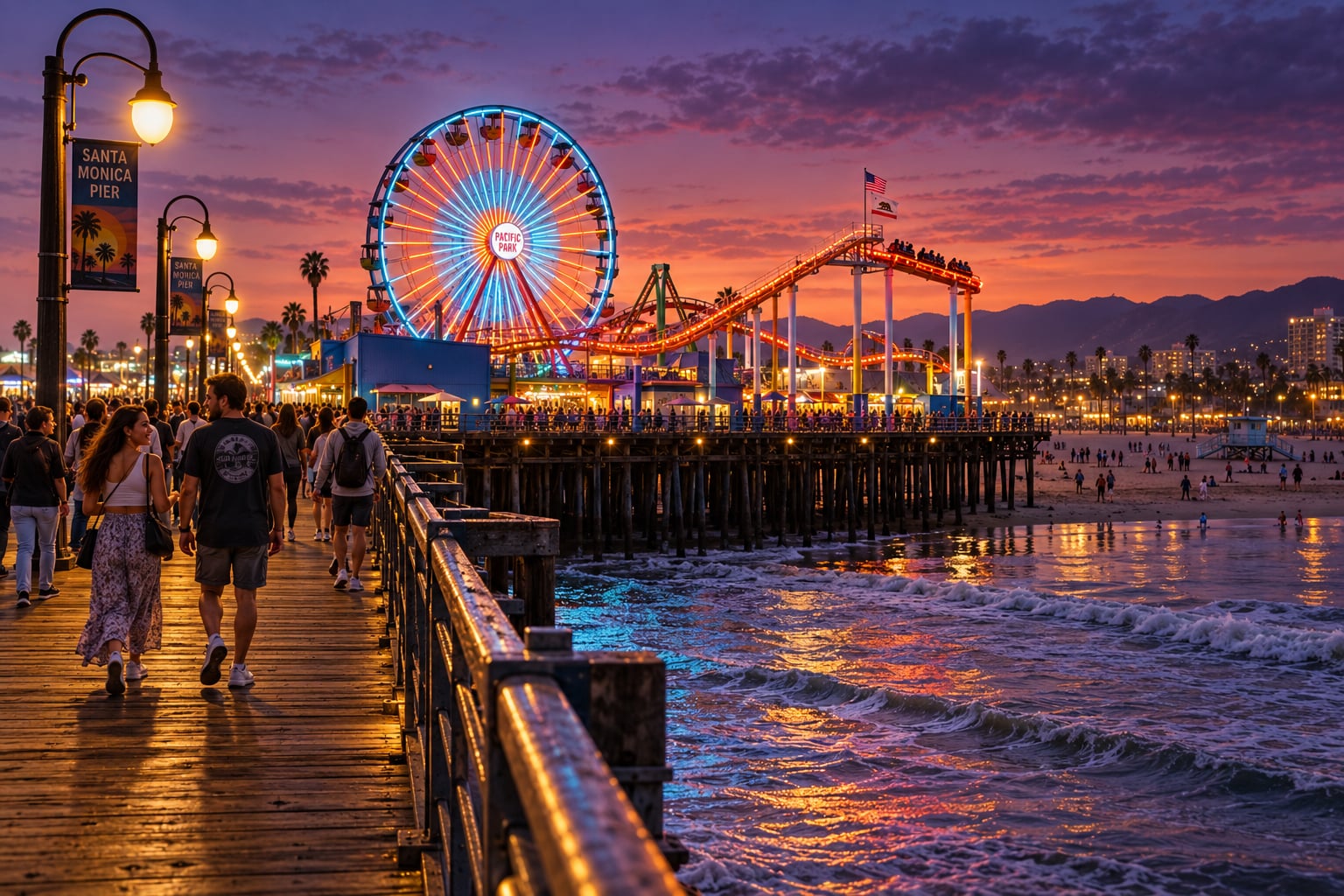
Sunset on Santa Monica Pier: Pacific Waves, Wooden Boardwalks, and Ferris Wheel Lights
If Los Angeles has an official front porch, it is the historic Santa Monica Pier, jutting boldly into the open ocean since 1909. Marking the symbolic western terminus of the legendary Route 66, this weathered wooden landmark represents the romantic essence of the California coast.
Arrive in the late afternoon when the fierce midday sun softens into warm amber. Stroll down the timber planks, listening to the creak of pylons beneath your feet and the rhythmic roar of surf breaking against the sandy shore below. The air is thick with seaside nostalgia: the sweet fragrance of warm churros dusted in cinnamon sugar, buttery popcorn, and fresh ocean brine.
As twilight settles over Santa Monica Bay, Pacific Park’s solar-powered Ferris wheel blazes into life, spinning a kaleidoscopic wheel of orange, cyan, and magenta light against an indigo Pacific sky. Look south toward the bohemian sands of Venice Beach, or look north toward the dramatic, darkening cliffs of the Pacific Palisades. Stand at the end of the pier as fishermen lean over wooden railings with their fishing poles, and you will feel the deep, timeless romance of the continent’s western edge.
- Rent a beach cruiser bicycle from the concessions near the base of the pier and pedal along The Strand, a paved 22-mile coastal bike path winding past the historic Venice canals, skateboard parks, and muscle beach.
- Walk up the bluff into Palisades Park for a tranquil stroll along landscaped paths shaded by eucalyptus and palm trees, offering sweeping panoramic views of the entire bay.
- Savor warm, freshly fried churros filled with dulce de leche from the boardwalk carts while listening to acoustic guitar buskers near the historic carousel building.
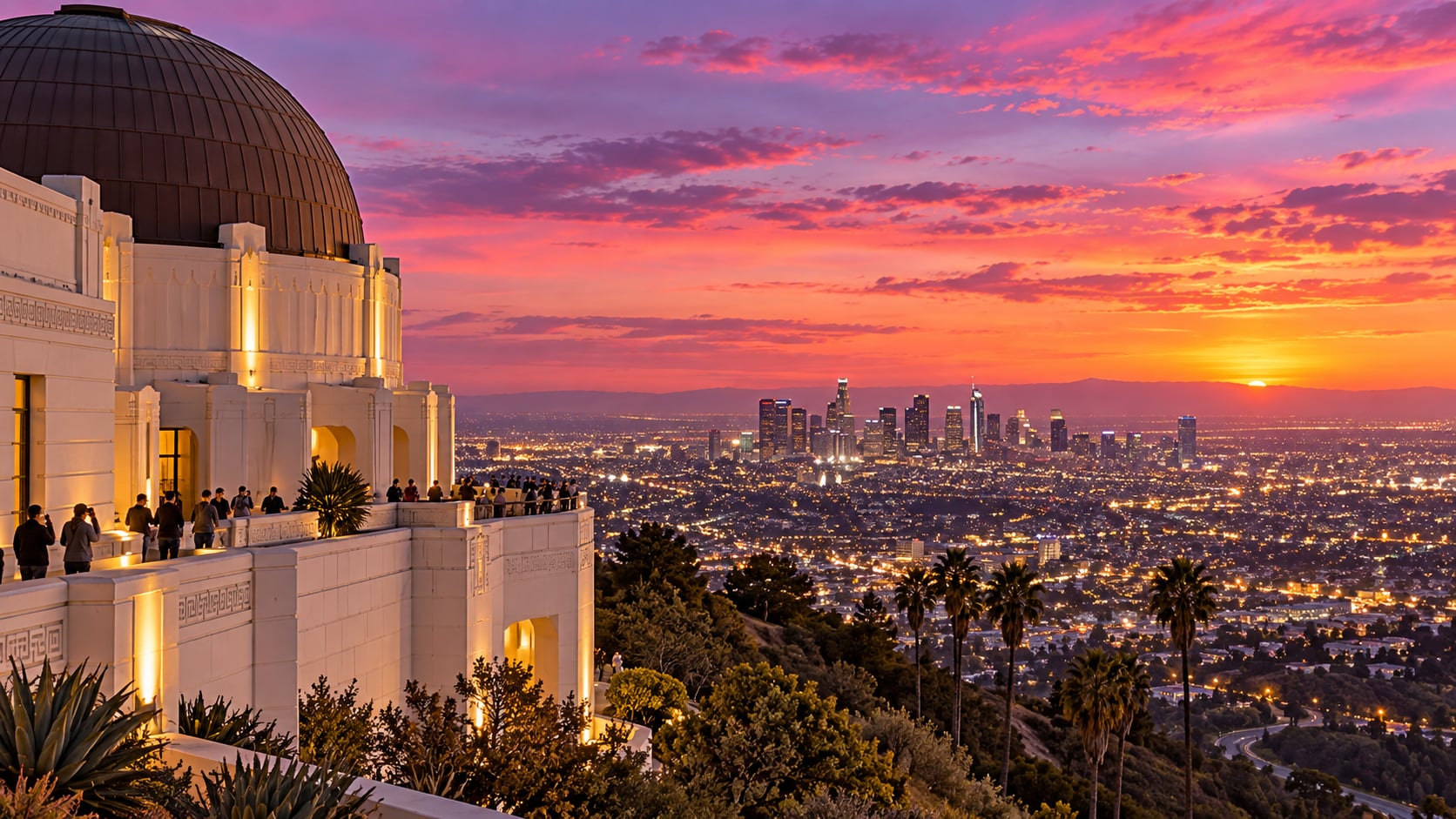
Looking Down Over the Basin: The Twilight Magic of Griffith Observatory
Perched high on the south-facing slope of Mount Hollywood inside Griffith Park, the historic Griffith Observatory offers the most breathtaking, iconic vantage point in the American West. Completed in 1935 in an elegant blend of Art Deco and Beaux-Arts styles, its gleaming white concrete walls and patinated copper domes look out over the entire Southern California expanse.
The experience of visiting Griffith Observatory at magic hour is virtually sacred. Arrive an hour before sunset and walk out onto the sweeping stone terrace. To your right, the iconic Hollywood Sign stands in sharp relief against the chaparral peaks of Mount Lee. Directly below, the sprawling urban grid of Los Angeles unfolds in miniature, crisscrossed by avenues lined with tiny matchstick palm trees.
As the sun sinks behind the western hills, painting the sky in layers of dusty rose, apricot, and deep violet, the city below transforms. One by one, millions of streetlights, headlamps, and neon signs flicker to life across the basin. From downtown’s towering glass skyscrapers to the distant shores of Long Beach, the vast basin becomes a glittering sea of urban starlight stretching all the way to the horizon.
- Admission to the observatory grounds, terraces, and interior exhibits is completely free to the public, though planetarium shows require a small ticket fee.
- Parking near the observatory fills rapidly on weekend evenings; consider parking near the Greek Theatre at the base of the hill and taking the inexpensive public DASH Observatory bus straight to the front doors.
- Take a leisurely pre-sunset hike along the West Observatory Trail or Charlie Turner Trail to enjoy panoramic canyon views and native sagebrush breezes away from the crowded terraces.
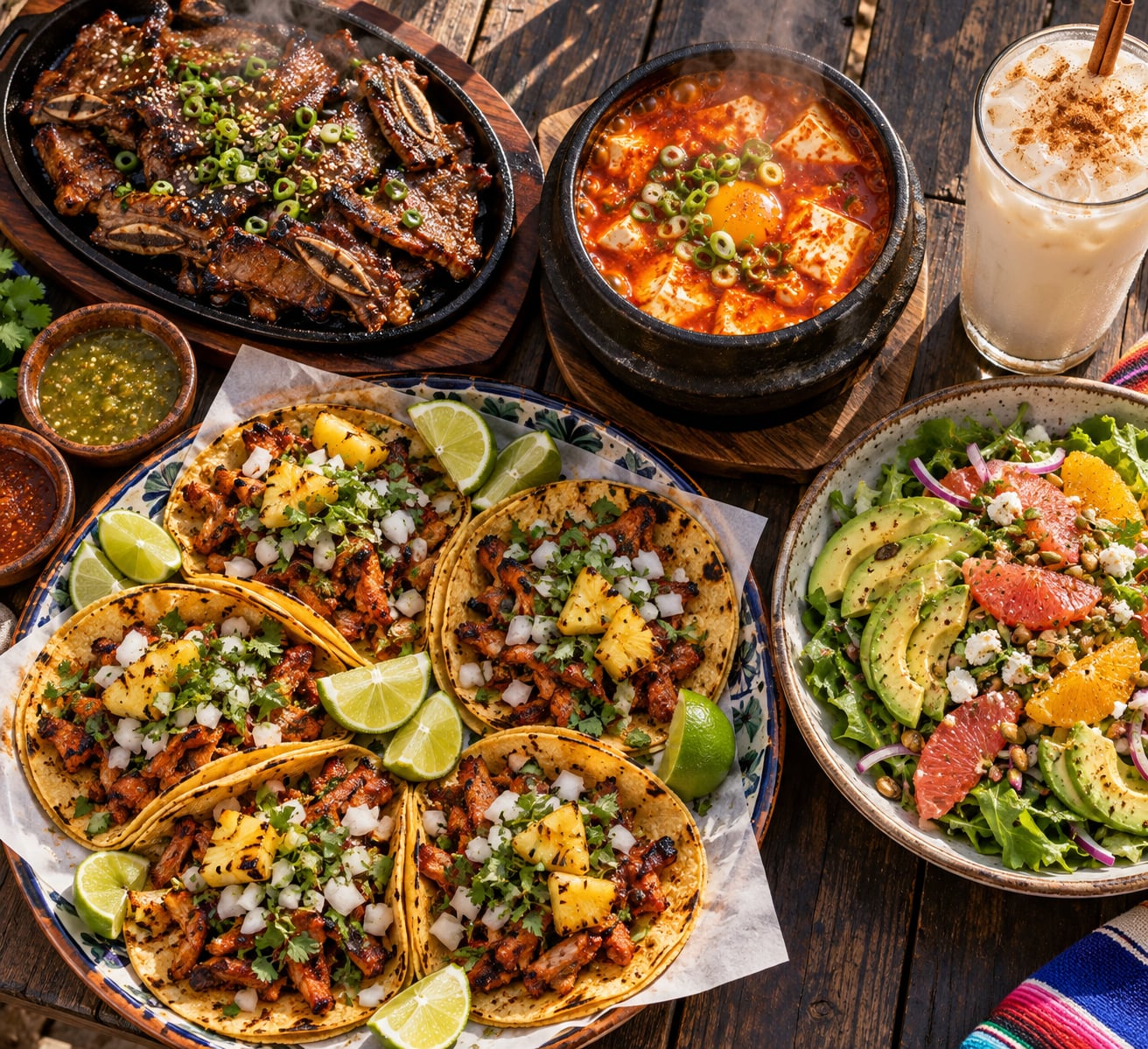
A Melting Pot on Every Plate: Spit-Roasted Street Tacos, Sizzling Galbi, and Coastal Feasts
To understand Los Angeles, you must eat it with your hands on sidewalks, under canvas canopies in strip mall parking lots, and inside family-run diners where grandmothers have spent decades perfecting regional sauces. It is arguably the most dynamic, unpretentious food city in the Western Hemisphere.
The undisputed king of LA cuisine is the street taco. As darkness falls, mobile taqueros set up smoking trompos on street corners from East LA to Boyle Heights and South Central. Slices of marinated pork shoulder, caramelized from rotating against an open flame beneath a whole pineapple, are shaved directly onto warm doubled corn tortillas. Topped with a shower of diced white onions, fresh cilantro, fiery salsa verde, and a roasted pineapple slice, eating two or three tacos standing on a sidewalk curb with a cold glass of horchata is an essential Los Angeles ritual.
Just a few miles west lies Koreatown—the densest and most vibrant Korean culinary district outside Seoul. In bustling twenty-four-hour barbecue halls, tabletop charcoal grills hiss as thick cuts of marinated galbi short ribs and pork belly sizzle to a charred, caramelized perfection. Accompanied by dozens of small banchan dishes—spicy kimchi, pickled radish, and seasoned soybean sprouts—alongside bubbling stone pots of soft tofu stew, a meal here is a boisterous celebration of community and heat.
And because California produces the finest agricultural bounty in North America, coastal dining celebrates fresh, seasonal abundance: creamy Hass avocados mashed onto artisan sourdough, citrus-marinated Pacific ceviche, and farmers market strawberries bursting with natural sweetness.
- Seek out neighborhood taco trucks like Leo’s Tacos or Mariscos Jalisco, where deep-fried shrimp tacos topped with avocado and spicy tomato salsa have attained legendary culinary status.
- Explore Grand Central Market in Downtown LA, an open-air food hall operating continuously since 1917, where you can sample Salvadoran pupusas, wood-fired Texas brisket, and gourmet egg sandwiches under one historic roof.
- Stop at an authentic neighborhood panadería for sweet conchas and warm horchata to fuel your morning explorations.
Wandering the Historic Hills: Mid-Century Bungalows, Palm-Lined Avenues, and Secret Canals
Beyond the tourist magnets, the real architectural charm of Los Angeles lives in its historic residential neighborhoods, where visionary architects created a relaxed indoor-outdoor living style that redefined modern living.
In Silver Lake and Los Feliz, winding hillside staircases—built in the 1920s to allow commuters to reach streetcars before private automobiles dominated—climb through lush bougainvillea, citrus trees, and mid-century modern architectural gems. Walking these public stairways offers an intimate glimpse into bohemian LA history, complete with hidden terraced gardens and pocket views of the Silver Lake Reservoir.
Down toward the coast in Venice, step away from the boardwalk madness into the tranquil Venice Canal Historic District. Built in 1905 by tobacco magnate Abbot Kinney to recreate the romantic waterways of Venice, Italy, these four miles of quiet canals are framed by arched pedestrian bridges, floating duck families, and an eclectic mix of Craftsman cottages and striking contemporary glass homes.
- Explore the peaceful paths of the Venice Canals during the late morning when sunlight filters through weeping willows onto calm, reflective waters.
- Stroll along Abbot Kinney Boulevard in Venice for artisanal coffee, bespoke denim boutiques, and farm-to-table lunch spots shaded by olive trees.
- Walk the tree-shaded residential avenues of Beverly Hills along Carmelita and Eleanore to marvel at towering, eighty-foot Mexican fan palms standing in dramatic, symmetrical procession.
Cruising the Coast Toward Malibu: Ocean Cliffs, Salt Air, and Highway Magic
To experience the mythic California automotive freedom that has inspired countless road songs, rent a convertible or roll down your car windows and point your wheels west along Pacific Coast Highway (California State Route 1).
Leaving the bustle of Santa Monica behind, the highway hugs the narrow strip of land where the rugged Santa Monica Mountains plunge directly into the roaring Pacific Ocean. As you cruise north through Malibu, the city recedes completely, replaced by crashing ocean waves, sea kelp beds where harbor seals poke their heads through the surf, and majestic coastal bluffs.
Stop at El Matador State Beach, where steep dirt paths and wooden staircases descend down sheer cliffs to reveal dramatic natural sea caves, arches, and jagged sea stacks sculpted by millennia of ocean tides. As the tide recedes in the late afternoon, walking barefoot across the wet sand through natural stone arches while golden light streams through ocean spray is an experience of sublime coastal wonder.
- Pull off the highway at Malibu Seafood or Neptune’s Net for paper baskets of fried clam strips, fresh grilled swordfish, and chilled local beer at outdoor picnic benches overlooking the ocean.
- Keep a watchful eye on offshore waters during winter and spring migrations; gray whales and pods of Pacific bottlenose dolphins frequently breach close to the coastline.
- Pack a light jacket or windbreaker; the maritime marine layer frequently rolls in along the coast in the late afternoon, dropping temperatures rapidly compared to inland valleys.
Practical Southern California Street Smarts: Freeway Traffic, Parking Apps, and Local Rhythms
Navigating the vast sprawl of Los Angeles smoothly requires understanding a few essential local secrets that will save you hours of frustration:
- Master the rhythms of freeway traffic: The legendary Los Angeles traffic is real, but entirely manageable with strategic timing. Avoid driving across town during peak morning commute hours (7:30 AM to 9:30 AM) and evening rush hours (4:00 PM to 7:00 PM). Group your daily activities by geographical clusters—spend one entire day exploring Westside beaches (Santa Monica, Venice, Malibu), another day in Central LA (Hollywood, Griffith Park, Silver Lake), and a separate day downtown.
- Always read curb parking signs with extreme scrutiny: Los Angeles parking signs are notoriously complex, with multiple overlapping rules regarding street cleaning hours, preferential permit zones, and rush hour tow-away zones displayed on a single pole. Read every single sign from top to bottom before walking away from your parked vehicle.
- Leverage the expanding Metro rail network: Contrary to popular belief, Los Angeles has built an extensive, clean modern rail system. The E Line connects Downtown LA directly to the sands of Santa Monica Pier in under fifty minutes, bypassing gridlocked interstate traffic entirely. Load a digital TAP card on your smartphone wallet for effortless tap-and-go access.
- Dress for dramatic temperature drops: Because Southern California is situated in a coastal Mediterranean climate, temperatures can fluctuate dramatically between sun and shade, day and night. A sunny, warm 78°F afternoon in Hollywood can easily plunge to a brisk 55°F the moment the sun drops below the horizon. Always bring a light denim jacket, cardigan, or hoodie when heading out for the day.
- Embrace the casual, unhurried vibe: Despite its massive size, Los Angeles culture is fundamentally casual. You will rarely need formal clothing for dining, and servers and locals are warm, relaxed, and welcoming. Slow down, savor your street tacos on the curb, and let the gentle rhythm of the Pacific coast wash over you.
When your plane lifts off from LAX and banks out over the Pacific before turning east, the vast glittering basin of Los Angeles will glow beneath your window like an endless field of diamonds. You will carry home the warm scent of sea salt and eucalyptus, the memory of twilight from Griffith Observatory, and the unmistakable feeling that you have witnessed one of the most vibrant, diverse, and sun-blessed corners of the earth.