
# Nashville Music City Travel Guide: Lower Broadway Honky-Tonks, Fiery Hot Chicken & Legendary Sound Stages
Curving gently alongside the Cumberland River in the rolling limestone hills of middle Tennessee, Nashville vibrates with a kinetic musical energy found nowhere else on earth. Widely revered across the globe as "Music City," Nashville is far more than the commercial headquarters of the country music industry—it is a creative sanctuary where music permeates the morning air, flows out of open tavern windows at noon, and roars until the early hours of dawn across multi-story neon stages.
Here, virtuosic musicians from every corner of the planet converge to test their mettle, playing for tips in gritty honky-tonk bars where legends from Hank Williams to Willie Nelson once stood.
Beyond its thunderous guitar amplifiers and neon marquees, Nashville welcomes travelers with profound cultural depth: from the hallowed wooden pews of the historic Ryman Auditorium and the storied recording tape reels of RCA Studio B to a mouth-scorching culinary obsession known as Nashville Hot Chicken, served alongside soulful Southern "meat-and-three" feasts that comfort the spirit and ignite the palate.
The Neon Canyon of Lower Broadway and Honky-Tonk Highway
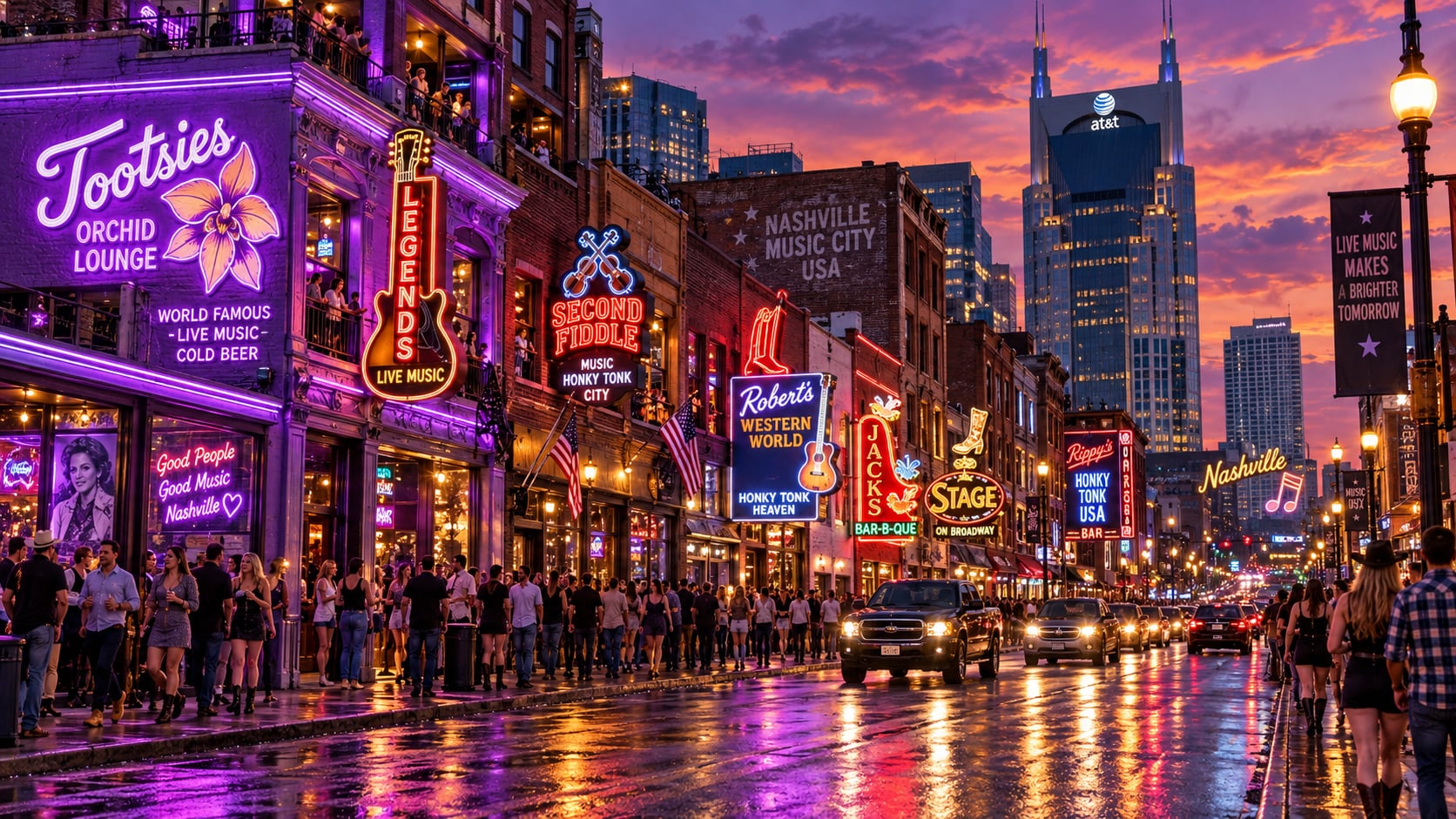
The electric epicenter of Nashville’s live music scene is Lower Broadway, affectionately dubbed the "Honky-Tonk Highway." Strolling down this four-block stretch of historic brick buildings as dusk settles feels like walking through a sensory amusement park of pure Americana:
- World-Class Live Music Without Cover Charges: Unlike almost any other major entertainment district in the world, the legendary bars lining Broadway charge zero admission fees at the door. Live house bands kick off performances as early as ten in the morning and trade sets across multiple floors until three in the morning, seven days a week. The level of musicianship is astounding; the bass player or steel guitarist on stage at two in the afternoon might very well be a touring session musician who recorded on billboard-topping albums the day before.
- Tootsie’s Orchid Lounge: Easily identified by its unmistakable lavender-purple painted exterior, Tootsie’s is the undisputed royal matriarch of honky-tonks. Founded by Hattie Louise "Tootsie" Bess in 1960, its rear entrance opens directly onto the alleyway facing the Ryman Auditorium stage door. During the golden era of the Grand Ole Opry, country stars like Patsy Cline, Waylon Jennings, and Kris Kristofferson routinely slipped out of the Ryman during commercial breaks to grab a quick drink at Tootsie’s bar.
- Robert’s Western World: For travelers seeking authentic, unapologetic traditional country, rockabilly, and Western swing, Robert’s remains the sacred holdout against modern pop crossovers. Stepping through the front doors reveals walls lined with vintage cowboy boots, cold local draft beers, and blistering guitar solos. Food lovers can order the legendary "Recession Special"—a thick-cut fried bologna sandwich served on white toast with yellow mustard, a bag of potato chips, a moon pie, and an ice-cold Pabst Blue Ribbon.
- The Rooftop Revolution: In recent years, classic honky-tonks have expanded upward, creating open-air rooftop lounges where visitors can sip craft cocktails, dance under string lights, and take in panoramic views of the illuminated Batman Building (AT&T tower) and the sparkling Cumberland River bridges.
Sacred Ground: The Ryman Auditorium and the Grand Ole Opry
No visit to Nashville is complete without paying homage at the historic shrines where the sonic foundations of American roots music were codified:
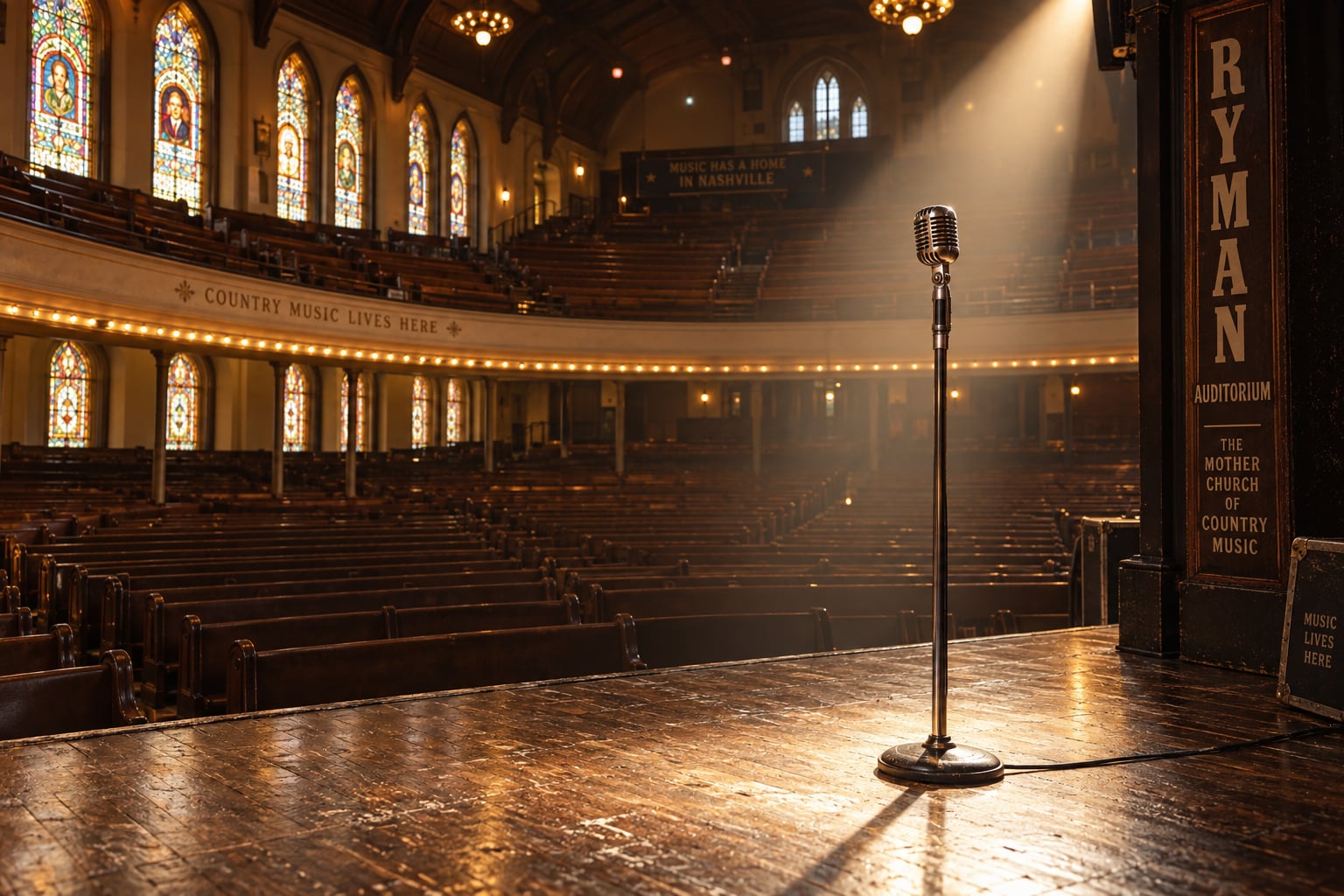
- The Ryman Auditorium (The Mother Church of Country Music): Originally constructed in 1892 by riverboat captain Thomas Ryman as the Union Gospel Tabernacle, this red-brick architectural marvel was designed for fiery evangelical tent revivals. Its curved oak church pews, glowing stained-glass lancet windows, and curved wooden balcony were engineered to project the unamplified human voice, creating acoustic properties so pristine that world-class vocalists rate it alongside Carnegie Hall and the Sydney Opera House.
- Where Legends Were Forged: From 1943 to 1974, the Ryman served as the home of the Grand Ole Opry radio show. It was on this stage that Bill Monroe and Earl Scruggs invented bluegrass music, where Johnny Cash first laid eyes on June Carter, and where a nineteen-year-old Elvis Presley performed for the first and only time on the Opry. Standing on the worn oak planks in the center of the stage—where generations of boot heels have grooved the wood—is an emotional rite of passage for any music enthusiast.
- The Modern Grand Ole Opry: Now broadcasting from the Grand Ole Opry House just northeast of downtown, this live entertainment phenomenon holds the title of the longest-running continuous radio broadcast in world history, having aired weekly since November 1925. Attending an Opry performance offers a dynamic showcase featuring country music hall-of-famers, rising bluegrass prodigies, and chart-topping contemporary superstars sharing a single microphone in an intimate circle of carved wood cut directly from the old Ryman stage.
Historic RCA Studio B and Music Row
Hidden away in the unassuming residential bungalows and low-rise brick offices of Music Row southwest of downtown lies the delivery room of mid-twentieth-century recorded sound:
- RCA Studio B: Built in 1957, this humble cinderblock studio became the epicenter of the famous "Nashville Sound"—a sophisticated production style pioneered by guitarist Chet Atkins and producer Owen Bradley that revived country music’s commercial fortunes by replacing traditional fiddle saw-strokes with lush orchestral string sections, vibraphones, and velvety smooth background crooners like the Jordanaires.
- The Magic of Elvis and the Blue Light: More than thirty-five thousand songs were recorded inside Studio B, including over two hundred tracks by Elvis Presley such as "Are You Lonesome Tonight?" and "It’s Now or Never." Tour guides allow visitors to sit at the Steinway grand piano used by Elvis, Floyd Cramer, and Dolly Parton, and dim the studio lamps to the famous blue mood lighting that Elvis demanded when recording late into the evening.
- The Country Music Hall of Fame and Museum: Spanning an entire city block downtown, this museum houses an extraordinary treasure trove of artifacts—from Hank Williams’s handwritten lyrics and Carl Perkins’s blue suede shoes to Web Pierce’s silver-dollar-studded Pontiac Bonneville convertible. The circular third-floor Rotunda displays bronze plaques honoring every inducted member, crowned by Thomas Hart Benton’s final masterwork mural, "The Sources of Country Music."
The Fiery Legend of Nashville Hot Chicken
Exploring Nashville inevitably ignites a voracious appetite, and no culinary tradition embodies the city’s bold, rebellious personality quite like Nashville Hot Chicken:
The origins of this blisteringly spicy dish read like folklore:
- A Tale of Scorn and Unexpected Genius: In the 1930s, a handsome Nashville gentleman named Thornton Prince III was known for his late-night philandering. After returning home in the early morning hours, his furious girlfriend decided to enact revenge by preparing him a Sunday breakfast of fried chicken laced with lethal quantities of fiery red cayenne pepper and fiery chili oils. To her shock, Thornton took one bite, fell deeply in love with the scorching heat, and immediately enlisted his brothers to perfect the recipe. They opened the legendary Prince’s Hot Chicken Shack, launching a worldwide culinary phenomenon.
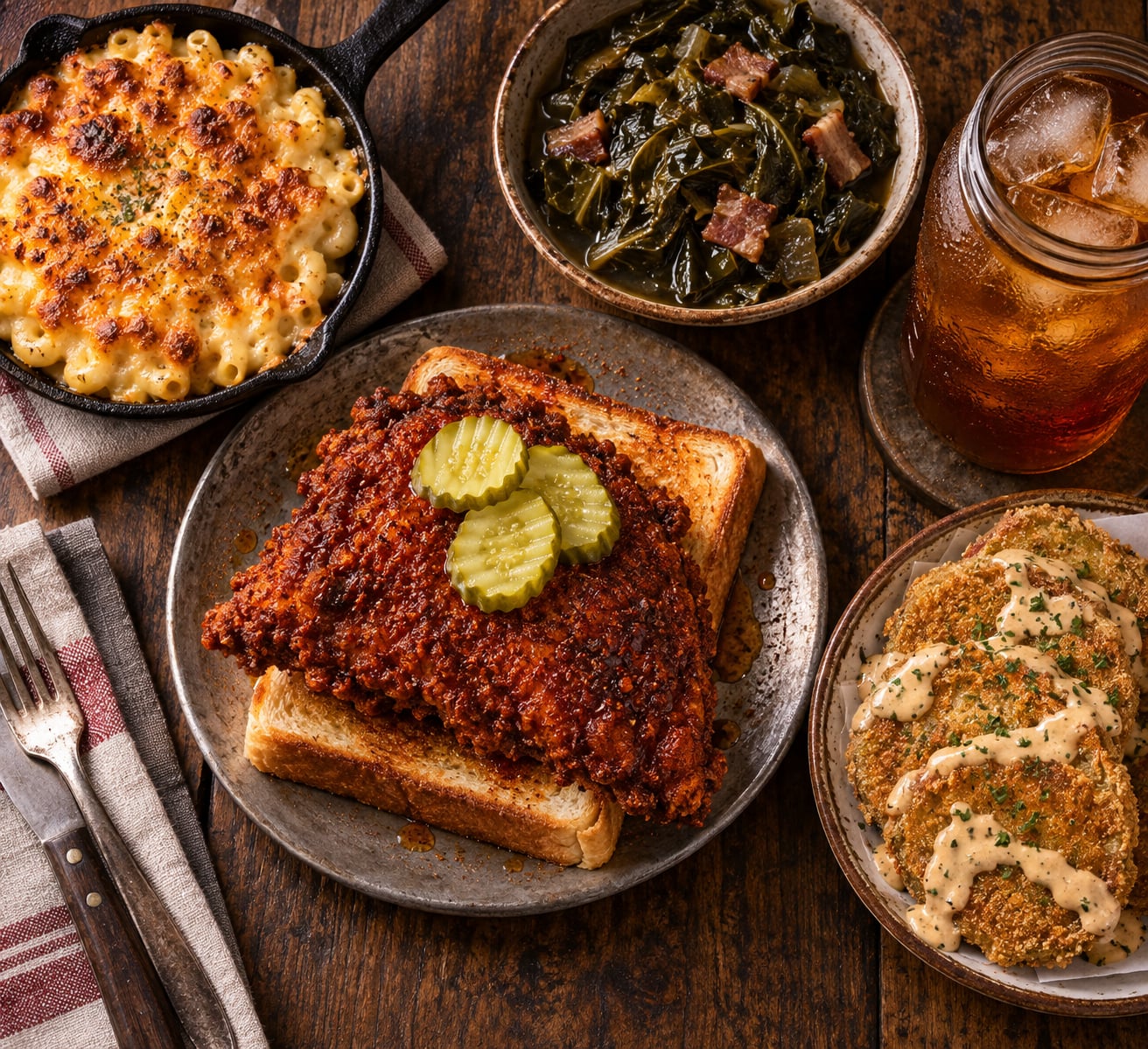
- The Anatomy of Authentic Hot Chicken: True Nashville hot chicken begins with bone-in chicken thighs, breasts, or whole wings that are marinated in seasoned buttermilk, double-dredged in flour, and deep-fried to golden, crunchy perfection. The defining magic occurs the moment the chicken emerges from the fryer: it is immediately mopped or dredged in a fiery crimson paste crafted from molten frying lard, ground cayenne pepper, brown sugar, garlic powder, and paprika.
- The Essential Accompaniments: Hot chicken is never served naked; it is traditionally plated atop two slices of plain white sandwich bread with crinkle-cut dill pickle chips skewered to the top. The cooling acid of the sour pickles cuts through the rich heat, while the humble white bread acts as an edible sponge, soaking up the radiant red, chili-infused rendered fat for a transcendent final few bites.
- Choosing Your Heat Level Wisely: First-time visitors should proceed with genuine caution. Heat scales typically range from "Southern (No Heat)" to "Mild," "Medium," "Hot," and "Shut the Cluck Up / XXX-Hot." The "Medium" at historic joints like Prince’s or Bolton’s Spicy Chicken & Fish packs significantly more heat than the highest level found at mainstream national fast-food chains.
Southern Comfort Traditions: The Meat-and-Three Feast
For travelers craving hearty home cooking without the mouth-numbing peppers, Nashville is the capital of the quintessential Southern dining institution known as the Meat-and-Three:
- Cafeteria-Style Comfort: At revered institutions like Arnold’s Country Kitchen, Swett’s, or Silver Sands Cafe, diners slide a plastic tray down a stainless-steel counter and choose one central protein along with three homestyle side dishes, accompanied by sweet cornbread or fluffy yeast rolls.
- The Daily Meat Rotation: Offerings rotate daily according to tradition, featuring falling-off-the-bone slow-braised beef pot roast with rich brown gravy, crispy cornmeal-dredged fried catfish fillets, roasted turkey with cornbread dressing, or chicken-fried steak smothered in country white pepper gravy.
- The Holy Trinity of Southern Sides: The sides are the true stars of the meal—slow-simmered collard greens braised with smoked ham hocks and cider vinegar; baked macaroni and cheese with a blistered cheddar crust; green beans stewed with bacon lardons; creamy mashed potatoes; and cornmeal-crusted fried green tomatoes served with tangy remoulade sauce.
- The Bushwacker Cocktail: When it is time to unwind after dinner, Nashville locals reach for a Bushwacker—a decadent boozy frozen milkshake invented in the Caribbean but adopted as Nashville’s unofficial summer drink. Blending dark rum, Kahlúa, crème de cacao, milk, and chocolate syrup into a rich, slushy dessert cocktail, it provides a cooling respite from hot summer afternoons.
Architectural Wonders and Creative Enclaves
Beyond the neon core of Broadway, Nashville reveals distinct neighborhoods brimming with creative vitality and striking architectural landmarks:
- The Parthenon at Centennial Park: Standing proudly in Centennial Park just west of downtown is the world’s only full-scale, exact architectural replica of the ancient Parthenon in Athens, Greece. Originally constructed for Tennessee’s 1897 Centennial Exposition to celebrate Nashville’s reputation as the "Athens of the South" (due to its high concentration of universities), the building houses an art museum and an awe-inspiring forty-two-foot gilded statue of the Greek goddess Athena—the largest indoor sculpture in the Western Hemisphere.
- East Nashville: Located across the Cumberland River, East Nashville is the city’s bohemian heartland, filled with restored Victorian cottages, independent record shops, third-wave artisan coffee roasteries, and craft cocktail speakeasies.
- The Gulch and Germantown: The Gulch features chic modern boutiques, mural street art like the famous "WhatLiftsYou" wings, and sleek restaurants housed in former industrial railway depots. To the north, historic Germantown charms visitors with brick sidewalks, preserved 19th-century architecture, and some of the city’s most sophisticated farm-to-table dining establishments.
Practical Advice for a Seamless Music City Vacation
To ensure your journey through Nashville is comfortable, memorable, and safe, keep these insider tips in mind:
- Best Times to Travel: Spring (April to May) and autumn (September to October) offer delightful temperatures, blooming dogwood trees, and vibrant fall foliage. Midsummer brings intense southern humidity and large convention crowds, while winter is generally mild with occasional dusting of snow.
- Tipping the Musicians: While the music on Broadway is technically free, the musicians on stage work almost entirely for gratuities. Passing a cash tip into the giant plastic pitchers, guitar cases, or scanning the band’s digital payment code (Venmo/CashApp) prominently displayed on stage is customary and essential southern etiquette. Carrying small cash bills (\$5, \$10, \$20) will ensure you can request your favorite tunes with respect.
- Transportation and Getting Around: Lower Broadway and downtown are easily walkable on foot. However, reaching outer neighborhoods like Music Row, 12 South, East Nashville, or Centennial Park requires rideshare services (Uber/Lyft), which are abundant and inexpensive throughout the metro area. Renting a car is only necessary if you plan to venture out into the Tennessee countryside to visit historic distilleries in Lynchburg or Tullahoma.
- Pacing Yourself on the Trail: Hot chicken and neon music marathons are endurance sports. Stay hydrated with plenty of water between sweet teas and craft beers, apply sun protection when exploring open-air rooftops, and never underestimate the culinary power of Tennessee cayenne pepper!