
# Wandering the Moss Draped Canopy of Hoh Rain Forest and Wild Pacific Shores of Olympic National Park
Tucked into the far northwestern corner of the contiguous United States, Washington State's Olympic Peninsula harbors one of the most ecologically diverse wildernesses on earth. Designated as both a UNESCO World Heritage Site and an International Biosphere Reserve, Olympic National Park spans nearly a million acres of untamed nature. Within just a few hours of travel, you can journey from the sun-dappled glacier caps of nearly eight-thousand-foot Mount Olympus down through temperate rainforests dripping with ancient emerald mosses, ultimately arriving at windswept Pacific beaches piled high with colossal driftwood tree trunks and jagged offshore sea stacks.
While every season on the peninsula possesses its own stark beauty, autumn carries a distinctly magical, primeval atmosphere. By October, the dense summer crowds have vanished, leaving the trails enveloped in peaceful mist and silence. The roaring Pacific Ocean sends waves crashing violently against the rocky coast, towering bigleaf maples turn luminous gold beneath cascading tapestries of club moss, bugling Roosevelt elk herds echo through the river valleys, and coastal fishing ports land some of the sweetest wild Dungeness crab and cold-water shellfish in the world. It is a realm that feels ancient and untamed, offering travelers a profound immersion into the raw wilderness of the Pacific Northwest.
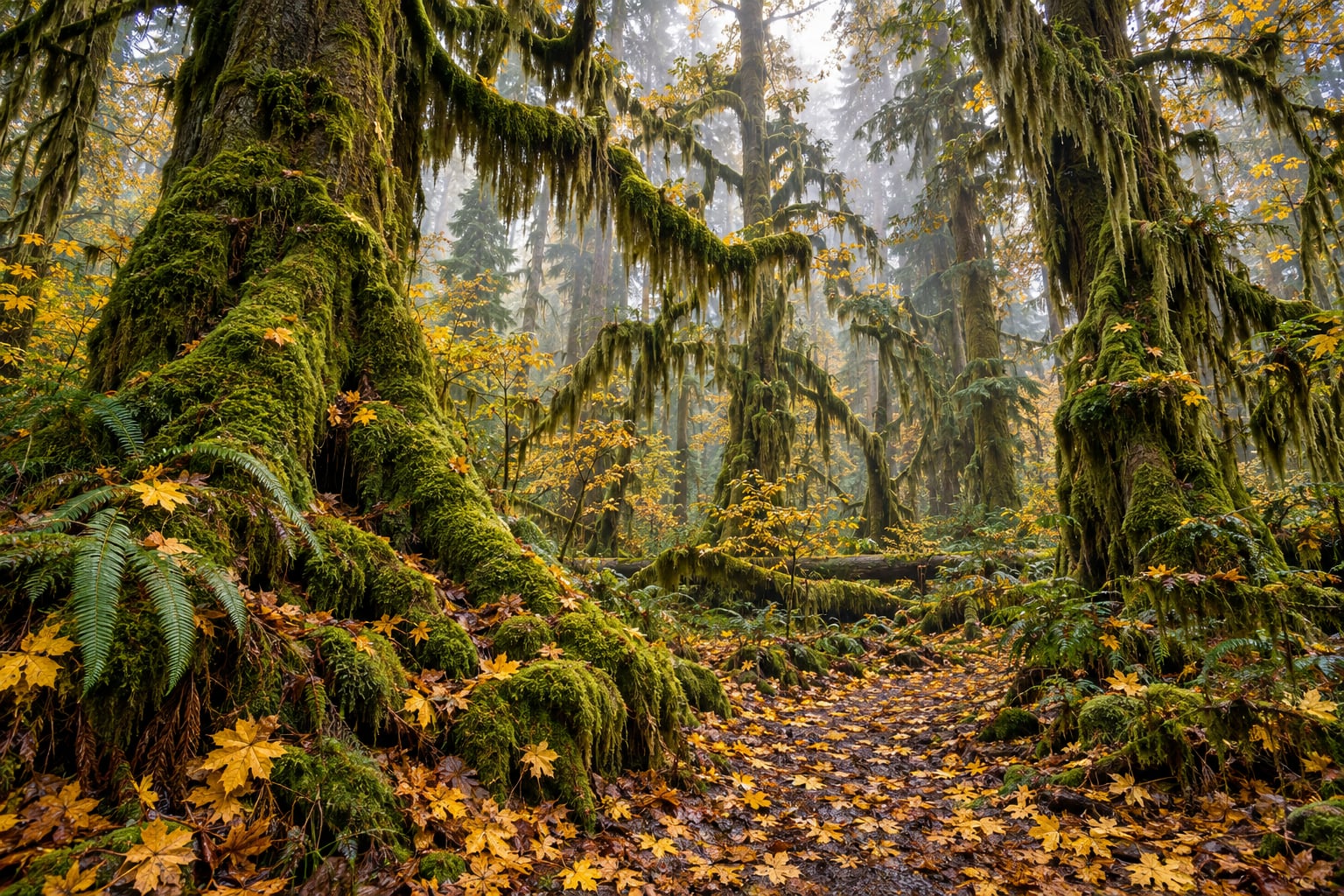
Stepping into the Primeval Emerald Sanctuary of the Hall of Mosses
Carved by glacier meltwater flowing from the western flanks of Mount Olympus, the Hoh River Valley receives up to one hundred and forty inches of rainfall each year, making it one of the wettest places in North America. This constant deluge of moisture creates a temperate rainforest unlike anything else on the continent, characterized by colossal Sitka spruce, western hemlock, and massive bigleaf maples that have stood undisturbed for centuries.
Walking the loop trail through the famed Hall of Mosses feels like stepping directly into a prehistoric fairy tale. The scale of the living landscape is staggering:
- Ancient bigleaf maples extend sprawling, horizontal branches that are entirely engulfed in thick, velvet draperies of epiphytic club moss and licorice ferns, hanging like green curtains through the misty air.
- Immense Sitka spruce trees soar more than two hundred and fifty feet toward the canopy, their furrowed trunks measuring over twelve feet in diameter.
- Massive nurse logs—fallen giant trees decaying slowly on the forest floor—provide rich organic soil for new seedlings, producing orderly colonnades of young hemlocks growing in straight lines along the spines of fallen ancestors.
- In October, the foliage of the bigleaf maples ignites into brilliant butter-yellow, dropping broad leaves across the damp trail like golden flagstones and adding bright bursts of warm color against the saturated emerald green forest.
The acoustic environment inside the rainforest is equally mesmerizing. The thick blankets of moss and soft carpet of decomposing needles act as a colossal natural acoustic baffle, deadening outside noise until you hear only the gentle drip of condensation falling from the high canopy, the soft rustle of wandering wildlife, and the distant, soothing rumble of the glacier-fed Hoh River.
Watching Massive Roosevelt Elk Roam the Glacial Valleys
While the ancient flora provides the stage, the undisputed royalty of the Olympic rainforest is the Roosevelt elk. Named after President Theodore Roosevelt, who established Mount Olympus National Monument in 1909 to protect them from extinction, these magnificent animals are the largest subspecies of elk in North America, with mature bulls tipping the scales at more than a thousand pounds.
Autumn marks the peak of the annual mating rut, making October prime time for observing these majestic creatures along the river flats of the Hoh and Queets valleys:
- Unlike Rocky Mountain elk that inhabit open high-altitude meadows, Roosevelt elk navigate dense, dripping rainforest undergrowth, their dark brown and tan coats blending effortlessly into the cedar shadows.
- Bull elk sport colossal, heavy antler racks with distinctive crown-like points, which they rake aggressively against alder trees and willow bushes to deposit their scent and challenge rivals.
- The piercing, flute-like bugle of a bull elk echoing down the misty river bottom at dawn is an unforgettable sound that raises the hairs on your arms, resonating deep within the damp valley walls.
- Family harems of cows and calves browse quietly along the gravel bars and riverbanks, feeding on lush ferns, horsetails, and fallen maple leaves while watchful bulls patrol the perimeter.
Visitors who explore the valley with binoculars and spotting scopes are treated to a rare wildlife spectacle that has unfolded continuously in these isolated valleys for thousands of years, entirely undisturbed by modern development.
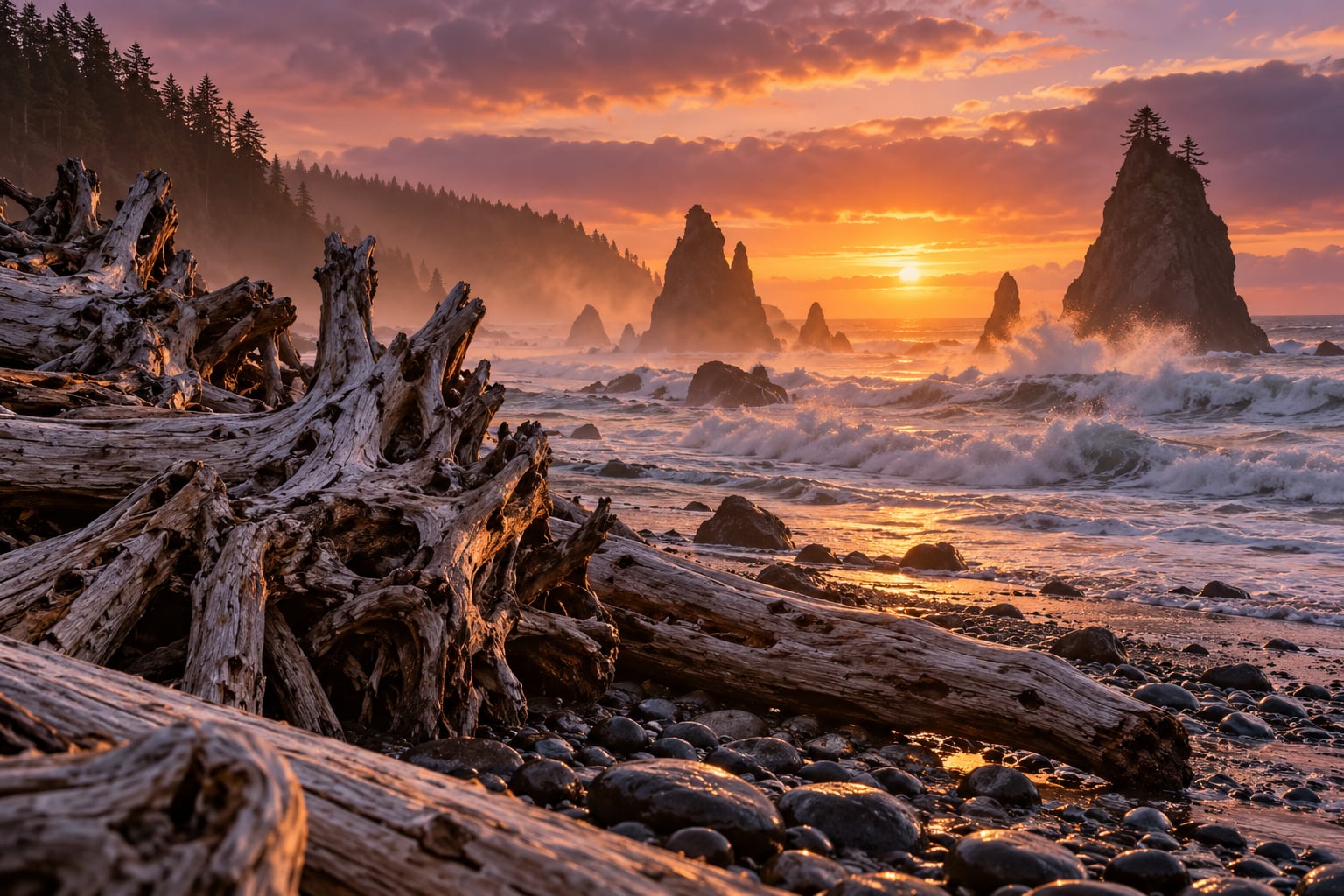
Scrambling Over Giant Driftwood Logs to the Sea Stacks of Rialto Beach
Driving west from the rainforest toward the Pacific Ocean brings a dramatic shift in sensory experience. The tranquil hush of the forest gives way to the thunderous roar of Pacific surf, the sharp scent of ocean salt, and the cool, invigorating breezes rolling in off the open ocean.
Among the peninsula's wild coastal sanctuaries, Rialto Beach stands out as an iconic testament to the sheer power of the Pacific:
- The upper shoreline is fortified by a massive, tangled seawall of bleached driftwood logs, giant Sitka spruce and Douglas fir trunks tossed onto the pebbles by ferocious winter storms like pick-up sticks, with roots splayed wide like wooden sculptures.
- The beach itself is composed of smooth, dark gray cobblestones and coarse black sand, glistening wet beneath the crashing white foam of rolling breakers.
- Offshore, colossal sea stacks known as the Giants Graveyard thrust upward out of the churning water like ancient fortress towers, their vertical rock faces battered continuously by the swell.
- Low-lying coastal fog frequently drifts across the beach in waves, partially obscuring the sea stacks before parting to let rays of golden late afternoon light set the ocean spray ablaze.
Walking north along Rialto Beach toward the natural rock arch known as Hole in the Wall is a legendary coastal hike. With each step over rounded stones polished smooth by millennia of waves, the wild, untamable essence of the Pacific Northwest coastline takes hold.
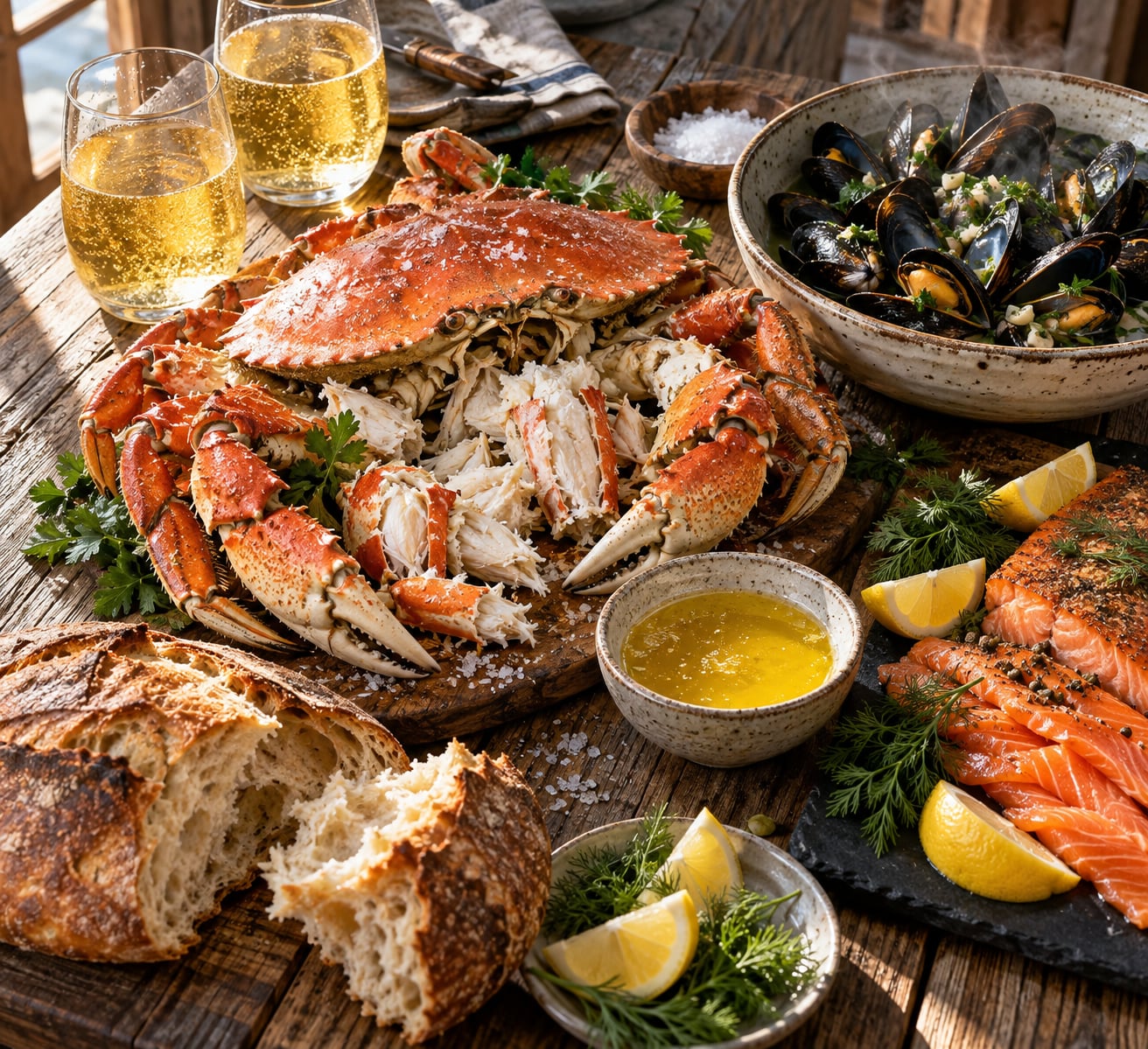
Feasting on Fresh Dungeness Crab and Steamed Mussels Along the Coast
After a long day of navigating rain-slicked forest trails and braving the salty winds of the Pacific, nothing restores the spirit like gathering inside a warm timber tavern for a feast of Olympic Peninsula seafood. The cold, nutrient-rich marine waters surrounding the peninsula—from Puget Sound and the Strait of Juan de Fuca to the open Pacific—produce some of the finest shellfish on the planet.
Coastal ports like Port Angeles, Sequim, and Neah Bay celebrate maritime harvesting traditions with hearty, unpretentious elegance:
- Whole Pacific Dungeness crab, pulled fresh from coastal pots and steamed to order. The shell is cracked open to reveal succulent, snow-white meat that is sweet, tender, and naturally buttery, eaten simply by dipping into small bowls of warm drawn garlic butter with fresh lemon wedges.
- Steamed Penn Cove mussels and Manila clams harvested from nearby sheltered bays, simmered in cast-iron pots with dry Washington white wine, minced shallots, garlic, cracked black pepper, and generous handfuls of fresh flat-leaf parsley, served alongside thick slices of crusty sourdough bread to soak up the aromatic broth.
- Hot-smoked wild King salmon fillets with glistening, peppered crusts and rich, flaky pink flesh, paired with local herbed cream cheese, capers, and crisp sourdough crackers.
- A hot skillet of roasted wild chanterelle and morel mushrooms foraged straight from the autumn rainforest floor, sautéed in clarified butter with fresh thyme.
- Cold pints of crisp craft cider pressed from heirloom apples in Chimacum Valley or piney Pacific Northwest IPAs, followed by a warm slice of Olympic mountain blackberry cobbler with sweet cream.
Eating fresh Dungeness crab while rain patters softly against the restaurant window and the scent of woodsmoke drifts from the fireplace is one of the quintessential culinary memories of the American Northwest.
Climbing Through Alpine Clouds to the Glaciers of Hurricane Ridge
To understand the extraordinary climatic variety of Olympic National Park, you must climb from sea level to the high alpine kingdom of Hurricane Ridge. Located seventeen miles south of Port Angeles, the winding mountain road climbs from maritime sea breeze to an elevation of 5,242 feet in less than forty minutes.
On clear autumn days, stepping out at the ridge top delivers a breathtaking panoramic shock:
- Spread out across the southern horizon is the jagged, snow-encrusted spine of the Olympic Mountains, anchored by the massive blue glaciers and sheer granite precipices of Mount Olympus.
- Deep, U-shaped glacial valleys carved thousands of feet below are blanketed in dense dark green conifer forests, with ribbons of white river water catching the morning sun.
- To the north, you can look straight across the blue waters of the Strait of Juan de Fuca to see the snowy volcanic peak of Mount Baker and the distant skyline of Vancouver Island in Canada.
- Subalpine meadows that bloomed with wildflowers during summer transition into warm rust, gold, and bronze tones, while colonies of Olympic marmots scurry over granite scree slopes to prepare their winter burrows before the heavy snowfalls begin.
Hiking the easy paved trail along the ridge toward Hurricane Hill provides front-row viewing of swirling mountain clouds that dance across the peaks, creating an ever-shifting tapestry of light, shadow, and monumental rock.
Exploring Sea Caves and Tide Pools Around the Hole in the Wall
Returning to the coast during low tide unlocks one of the most vibrant marine environments on earth. At the northern end of Rialto Beach, approximately 1.5 miles from the trailhead, sits Hole in the Wall, a dramatic natural sea arch carved through a solid volcanic headland by the relentless pounding of the Pacific tide.
Visiting this rocky promontory at minus tide reveals an astonishing kaleidoscope of intertidal life:
- Natural tide pools nestled in basalt hollows burst with vivid color, featuring bright chartreuse giant green anemones waving their fleshy tentacles under crystal-clear ocean water.
- Clusters of purple and orange ochre sea stars cling tightly to barnacle-encrusted rocks alongside black turban snails, hermit crabs, and spiny purple sea urchins.
- Sea caves hollowed out behind the arch echo with the gurgle of retreating water, their damp walls covered in delicate sea sponges and layers of glistening red and green kelp.
- From the rocks, you can gaze through the natural stone window of the arch to frame the distant sea stacks and breaking waves in a dramatic natural portrait.
Timing your walk precisely with the tide chart is critical, as high tide submerges the passage and traps hikers against the sheer sea cliffs. Experiencing this miniature marine jungle exposed between tides is an unforgettable window into the raw biodiversity of the Pacific rim.
Practical Travel Advice for Olympic Peninsula Weather Tides and Ferries
Exploring the wild corners of Olympic National Park requires thoughtful logistics and specialized preparation for maritime climate conditions:
- Managing rain and maritime moisture. Rain is an integral element of the Olympic experience, not an obstacle. Equip yourself with high-grade waterproof gear, including a breathable Gore-Tex rain jacket with an adjustable hood, waterproof rain pants, and sturdy waterproof hiking boots with Vibram traction soles. Avoid denim and cotton clothing, which hold water and lead to rapid hypothermia; instead, choose merino wool and quick-drying synthetic layers.
- Understanding tide charts for coastal hikes. When hiking Rialto Beach, Ruby Beach, or Shi Shi Beach, carry a printed tide table and know the exact timing of low and high tide. Routes around headlands like Hole in the Wall are impassable at high tide and can trap hikers against sheer rock walls. Never attempt to round coastal points when the tide is rising, and always watch the ocean for rogue sleeper waves that can sweep heavy driftwood logs into unsuspecting walkers.
- Washington State ferry logistics. The most scenic and efficient way to reach the Olympic Peninsula from Seattle is aboard the Washington State Ferries, crossing Puget Sound from downtown Seattle to Bainbridge Island or from Edmonds to Kingston. Ferries run frequently throughout the day, offering sweeping skyline views of Seattle and the Cascade Mountains. Arrive at least thirty to forty-five minutes before scheduled departure times on weekends to secure your vehicle boarding position.
- Driving the Highway 101 loop. Olympic National Park is massive and does not have a single road that crosses through its center. Travel relies entirely on U.S. Highway 101, which circles the entire perimeter of the peninsula. Driving between different park regions—such as from Hurricane Ridge to the Hoh Rain Forest—takes two to three hours. Plan multi-day itineraries with overnight stays in Port Angeles, Forks, or Lake Quinault to avoid rushing through these pristine wildernesses.
- Wildlife safety and respectful viewing. When encountering Roosevelt elk or black bears along river bottoms, always maintain a minimum distance of one hundred and fifty feet. During the autumn rut, bull elk can charge aggressively if they perceive a threat to their herd. Keep dogs on leashes only where permitted, pack out all food scraps to prevent habituating wildlife, and carry a reliable headlamp for late afternoon walks beneath the dense rainforest canopy.