
# Pacific Coast Highway & Big Sur Road Trip Guide: Bixby Bridge, Coastal Redwoods & Pacific Seafood
Carving a daring ribbon of asphalt between the sheer granite precipices of the Santa Lucia Mountains and the crashing rollers of the Pacific Ocean, California’s State Route 1 through Big Sur is universally celebrated as one of the most breathtaking scenic drives on earth. This ninety-mile stretch of wild, undeveloped central California coastline represents the raw edge of the American continent—a mystical sanctuary where dense coastal fog billows through primeval redwood canyons, sea otters frolic in dense kelp forests, and jagged cliffs plunge vertically into swirling emerald and turquoise waters.
Constructed over nearly two decades through the sheer grit of convict labor and New Deal engineering during the Great Depression, Highway 1 transformed what was once an isolated wilderness accessible only by pack mule into an enduring pilgrimage route for motorists, artists, and bohemian free spirits.
From the architectural majesty of Bixby Creek Bridge and the fairy-tale tidefall of McWay Falls to the soulful clifftop dining terraces of Nepenthe, an expedition through Big Sur offers an unforgettable communion with untamed nature and refined California coastal living.
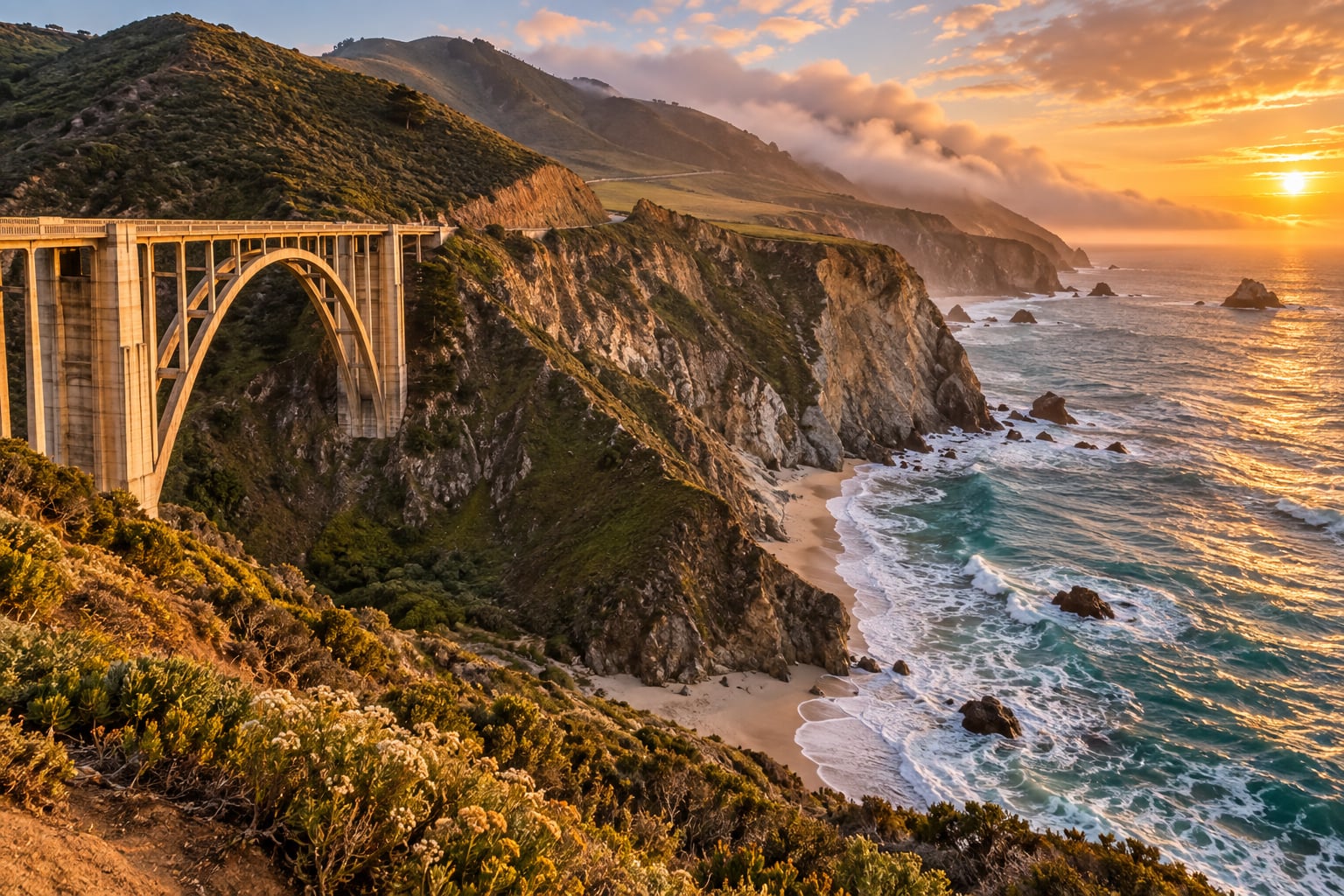
The Monumental Majesty of Bixby Creek Bridge
No single structure defines the visual iconography of the American West quite like Bixby Creek Bridge:
- An Engineering Triumph of the Golden Era: Completed in 1932 at a cost of roughly two hundred thousand dollars, this soaring reinforced concrete open-spandrel arch spans three hundred and twenty feet across a dizzying canyon, suspended two hundred and sixty feet above the rocky bed of Bixby Creek where it empties into the roaring Pacific. Before its completion, residents of Big Sur were cut off from Carmel and Monterey whenever winter storms washed out the inland dirt switchbacks of Old Coast Road.
- Viewing the Masterpiece: Approaching from the north, pullouts along the oceanside cliffs offer spellbinding vantage points. During late afternoon golden hour, low-angled sunlight bathes the pale concrete buttresses in warm amber hues, contrasting sharply with the deep indigo sea, white foaming surf, and shifting blankets of marine fog rolling off the ocean.
- The Mystery of Hurricane Point: Just two miles south of Bixby Bridge, Hurricane Point towers above the roadway, named for the relentless gale-force winds that buffet its exposed headland. From this lofty summit, sweeping panoramas stretch southward across miles of untamed, surf-battered coastline.
Cathedral of the Giants: Ancient Coastal Redwood Sanctuaries
While Big Sur is famous for its soaring oceanic views, ducking just a few hundred yards inland transports travelers into a hushed, primeval world governed by the tallest living organisms on the planet—the coastal redwoods (Sequoia sempervirens):
- Pfeiffer Big Sur State Park: Often called "mini-Yosemite," this park encompasses the scenic gorge of the Big Sur River, where cathedral-like groves of ancient redwoods flourish along the canyon floor. Fed by the moist marine layer that condenses on their high needles, these trees have stood for over a thousand years, their fibrous cinnamon-red bark and massive buttresses creating a cool, silent sanctuary far removed from highway traffic.
- The Big Sur River Gorge and Valley Trails: Walking the Buzzards Roost Trail or ambling along the shaded river path leads to deep swimming holes framed by granite boulders and ferns. The air beneath the redwood canopy is clean, cool, and pungent with the scent of damp earth, bay laurel leaves, and redwood duff.
- The Southern Frontier of the Redwoods: The canyons of Big Sur mark the southernmost geographic boundary where coastal redwoods grow naturally in North America. These trees rely heavily on the heavy summer fog that blankets the coastline, absorbing up to forty percent of their moisture directly from the mist.
The Secluded Wonder of McWay Falls
Located inside Julia Pfeiffer Burns State Park, McWay Falls is one of the most photographed and pristine natural spectacles in the world:
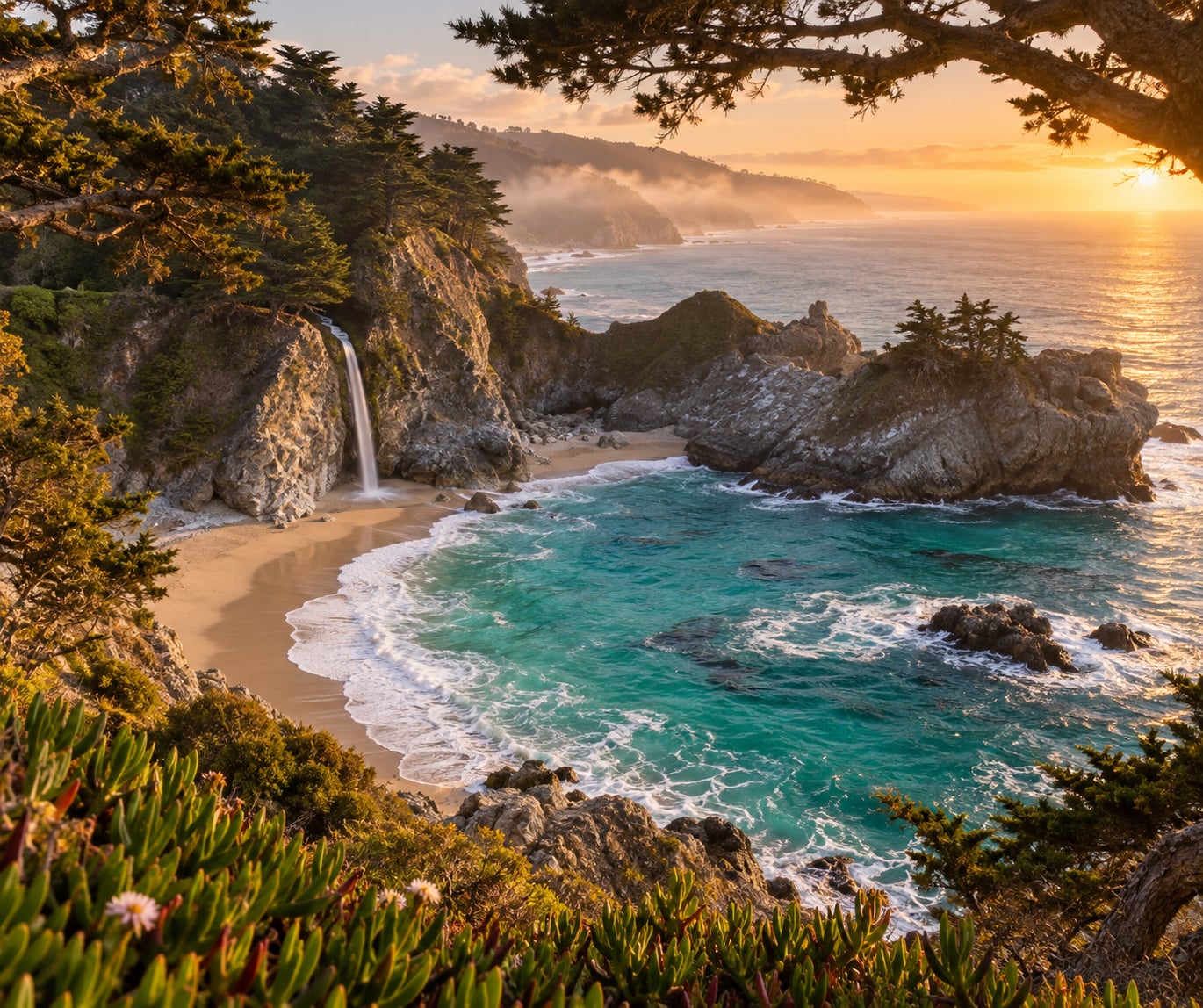
- A Rare Coastal Tidefall: Dropping eighty feet down a sheer granite cliff directly onto the untouched golden sands of McWay Cove, McWay Falls is one of only two "tidefalls" in California—waterfalls that pour directly into the ocean or onto the beach during high tide.
- The Overlook Trail: Reached via a gentle half-mile stroll through an ocean-facing tunnel under Highway 1, the Overlook Trail wraps around the perimeter of the cove. Looking down into the protected amphitheater reveals swirling waters in unreal gradients of azure, emerald, and crystalline turquoise, framed by wild yellow lupine and twisting Monterey cypress branches.
- Preserved in Perpetuity: Because the cliffs surrounding the cove are exceptionally fragile and prone to landslides, direct human access to the beach is strictly forbidden. This permanent preservation ensures the white sand remains completely free of footprints, preserving an Eden-like vista that looks entirely untouched by modern civilization.
Marine Sanctuaries and Sea Otters at Point Lobos
Anchoring the northern threshold of the Big Sur coast just south of Carmel-by-the-Sea lies Point Lobos State Natural Reserve, hailed by landscape artist Francis McComas as the "greatest meeting of land and water in the world":
- The Playful Southern Sea Otters: In the early 20th century, the southern sea otter was feared completely extinct due to commercial fur trapping. In 1938, a tiny remnant colony of approximately fifty surviving otters was discovered hiding in a secluded Big Sur kelp bed. Today, visitors walking the Cypress Grove Trail or Whalers Cove can spot dozens of otters floating peacefully on their backs in giant canopy beds of bull kelp, diligently cracking open sea urchins and wrapping their pups in sea kelp to keep them from drifting away.
- Cypress Groves Clinging to Granite: Point Lobos is home to one of only two naturally occurring, native groves of Monterey cypress trees remaining on Earth. Gnarled by centuries of ocean storms and encrusted with bright orange velvet algae (Trentepohlia), their twisted branches drape dramatically over crystalline coves where harbor seals nurse their pups on rocky beaches.
- Whale Watching Migrations: From December through April, the high promontories of Point Lobos offer front-row seats for observing the epic migration of thousands of Pacific gray whales journeying between their Arctic feeding grounds and the warm birthing lagoons of Baja California. In summer and autumn, massive humpback and blue whales regularly feed on krill just offshore, their towering spouts visible against the horizon.
Coastal California Gastronomy: Ocean Feasts and Clifftop Dining
The culinary ethos of Big Sur and the Monterey Peninsula is deeply rooted in the surrounding Pacific waters, coastal organic farms, and hillside vineyards:
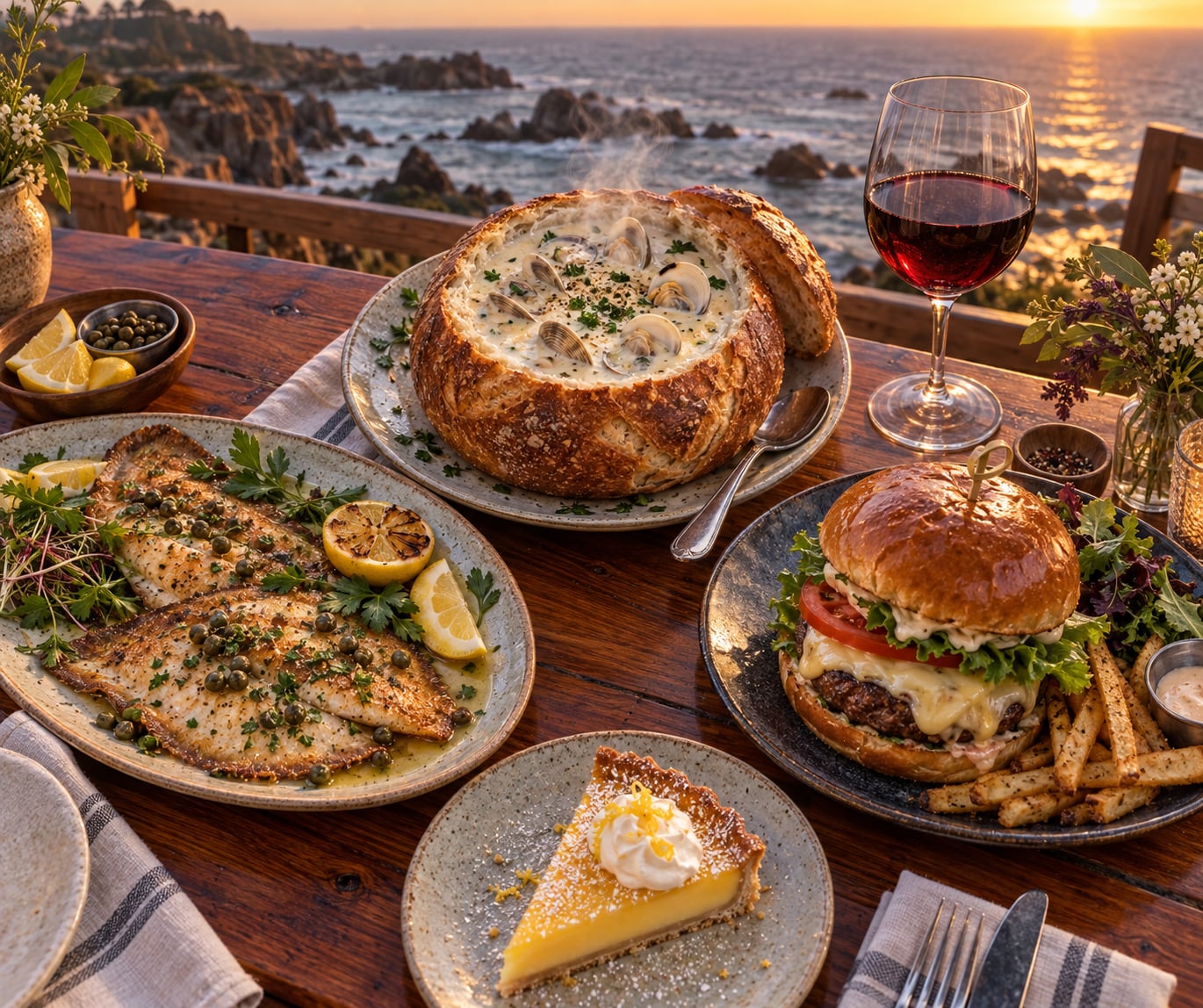
Exploring Highway 1 introduces road-trippers to signature regional flavors that celebrate central California bounty:
- Monterey Bay Clam Chowder in Sourdough Bread Bowls: Pulling in from cool, misty coastal trails calls for comforting warmth. Fresh Pacific littleneck clams are simmered with tender potatoes, sweet celery, smoky bacon lardons, and rich heavy cream, served steaming inside a round loaf of crusty, tangy San Francisco-style sourdough bread. Scooping out spoonfuls of savory chowder while tearing away chunks of soup-soaked sourdough crust is a quintessential coastal ritual.
- Pan-Seared Pacific Sand Dabs: A local delicacy native to the sandy seafloor of Monterey Bay, sand dabs are small, sweet, and delicate flatfish. Lightly dredged in seasoned flour and pan-seared in browned butter with fresh lemon juice, capers, and chopped flat-leaf parsley, the fish is flaky, moist, and wonderfully clean on the palate.
- The Legendary Ambrosia Burger at Nepenthe: Perched eight hundred feet above the crashing surf on a cliffside redwood deck designed by a student of Frank Lloyd Wright, Nepenthe has been the spiritual gathering hub of Big Sur since 1949. Their world-famous Ambrosia Burger features freshly ground beef grilled over open flame, served on a toasted sourdough roll and slathered with their proprietary, secret-recipe Ambrosia Sauce—a spiced tomato-mayonnaise relish with deep savory herbs. Sitting on the open terrace with a glass of local wine while watching the sunset melt into the Pacific fog is an essential Big Sur memory.
- Central Coast Pinot Noir and Santa Lucia Highlands Chardonnay: The cool maritime winds and afternoon fogs rolling in from Monterey Bay create ideal microclimates for world-class cool-climate viticulture. Savoring an earthy, ruby-red Santa Lucia Highlands Pinot Noir or a crisp, mineral-driven Chardonnay pairs impeccably with coastal seafood.
- Meyer Lemon Tart: California’s sun-kissed coastal orchards yield fragrant, sweet Meyer lemons. Baked into a silky, tart curd nestled inside a buttery shortbread crust and topped with a cloud of toasted meringue, it provides a bright, refreshing finish to a day of mountain driving.
Bohemian Spirit and Literary Legends
Big Sur has long served as a magnet and sanctuary for writers, poets, and philosophical visionaries seeking refuge from industrial conformity:
- The Henry Miller Memorial Library: Nestled within a serene redwood grove along Highway 1, this non-profit cultural center and bookstore honors the iconoclastic author Henry Miller, who lived in Big Sur from 1944 to 1962 and wrote "Big Sur and the Oranges of Hieronymus Bosch." Visitors can relax on outdoor sofas beneath towering trees, browse rare vintage paperbacks, sip organic coffee, and enjoy impromptu acoustic concerts under the redwoods.
- Jack Kerouac’s Bixby Canyon Retreat: In 1960, Beat generation pioneer Jack Kerouac retreated to Lawrence Ferlinghetti’s secluded cabin in Bixby Canyon to seek solace from fame, an intense emotional experience that yielded his famous novel "Big Sur," recounting the thunderous roar of the ocean echoing through the canyon night.
- The New Camaldoli Hermitage: Located high on a mountain ridge south of Lucia, this Roman Catholic Benedictine hermitage welcomes travelers of all faiths into silent contemplation. Perched above the cloud layer at thirteen hundred feet, the hermitage grounds offer profound panoramic quietude, ocean vistas, and artisan fruitcakes and date nut loaves baked by the resident monks.
Essential Practical Advice for Driving Highway 1
Navigating the winding switchbacks of the Pacific Coast Highway requires mindfulness, patience, and respect for fragile coastal geography:
- Check Highway Status Before Departing: The geology of Big Sur is dynamic; heavy winter atmospheric river rains frequently trigger landslides (such as at Paul’s Slide or Regent’s Slide) that can temporarily close sections of Highway 1 for repairs. Always verify real-time road conditions on the Caltrans QuickMap website or app before starting your journey.
- Driving Etiquette and Turnouts: Highway 1 is a narrow, twisting two-lane road with dramatic drop-offs and few guardrails. If you wish to admire the breathtaking scenery, never brake abruptly in the traffic lane. By California law, slower vehicles followed by five or more cars must pull entirely into designated paved turnouts to let traffic pass safely.
- Cell Service and Navigation: Cellular telephone reception disappears almost completely between Carmel Highlands and San Simeon. Download offline maps onto your smartphone, save reservations, and keep a physical paper road map in your glove compartment.
- Fuel and Supplies: Gasoline stations inside Big Sur (near Big Sur Station and Lucia) are few and charge some of the highest fuel prices in the nation. Fill your vehicle’s gas tank completely in Monterey, Carmel, or Cambria before entering the coastal corridor.
- Dress in Layers: Coastal microclimates shift dramatically throughout the day. A morning shrouded in fifty-degree coastal fog can transform by mid-afternoon into blazing seventy-five-degree sunshine, followed by brisk ocean breezes at twilight. Bring a windbreaker, fleece, sturdy walking shoes, and polarized sunglasses to cut ocean glare.