
# Chasing Cool Pacific Breezes in Seattle with Steaming Seafood Chowder and Snowcapped Peaks
There is an invigorating, maritime crispness that greets you the moment you step out onto the waterfront of Seattle. The air smells of cedar shavings, damp evergreen needles, and the deep, briny scent of the North Pacific Ocean rolling in across Puget Sound. Morning fog often clings low to the water like a gossamer veil, softening the sharp glass edges of downtown skyscrapers before the midday breeze sweeps it clean to reveal an impossibly blue sky anchored by jagged, snow-mantled mountain ranges on both horizons.
Seattle is often stereotyped by newcomers as a perpetually rainy, tech-dominated enclave. But spend a couple of days wandering its hilly brick neighborhoods, boarding its green-and-white state ferries, and sharing crowded counters inside century-old timber market halls, and you will understand why this corner of the Pacific Northwest commands such enduring devotion. It is a city that balances industrial vitality with deep natural reverence, where urban life yields effortlessly to old-growth rainforests, wild marine waterways, and towering volcanic glaciers.
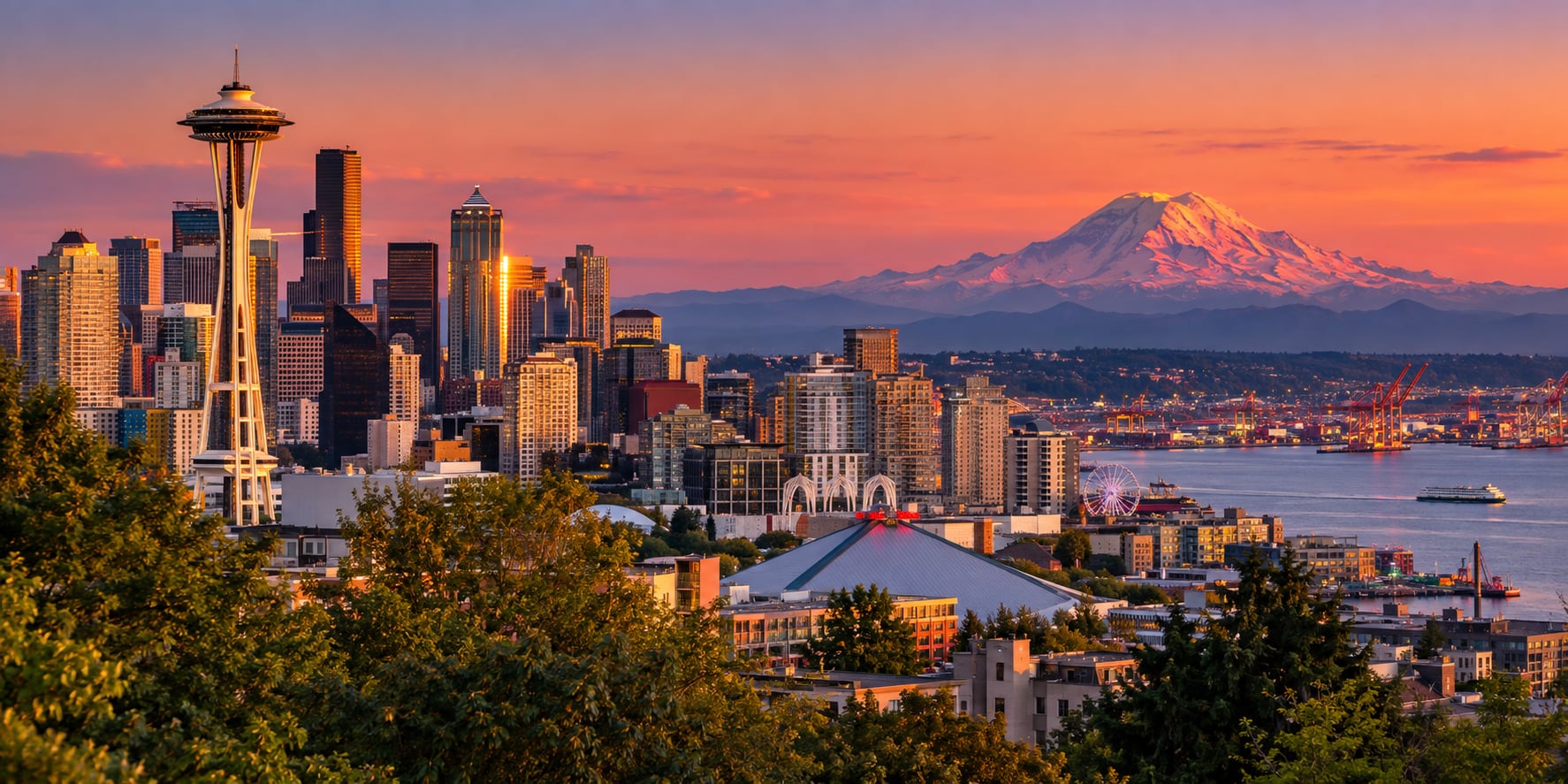
The Emerald Spell: Why the Pacific Northwest Steals Your Heart
Cradled between the salt waters of Elliott Bay and the freshwater expanse of Lake Washington, Seattle earns its title as the Emerald City through sheer abundance of life. Even in late autumn and winter, moss coats the bark of ancient western red cedars, towering Douglas firs stand like sentinels across residential hills, and native ferns spill over granite retaining walls.
Unlike many fast-paced American metropolitan centers, Seattle moves at a reflective, observant cadence. Locals embrace the misty drizzle with waterproof Gore-Tex parkas rather than umbrellas, heading outdoors regardless of cloud cover to hike alpine ridges, paddle cedar canoes along sheltered bays, or linger over single-origin coffees in neighborhood roasteries. Visiting the city means learning to appreciate subtlety: the gradual lifting of sea mist over the harbor, the sound of foghorns echoing across the bay at dusk, and the sudden, jaw-dropping appearance of a glacier-clad volcano on an otherwise ordinary afternoon.
Morning at Pike Place Market: Flying Salmon, Fresh Dahlias, and Cobblestone Charms
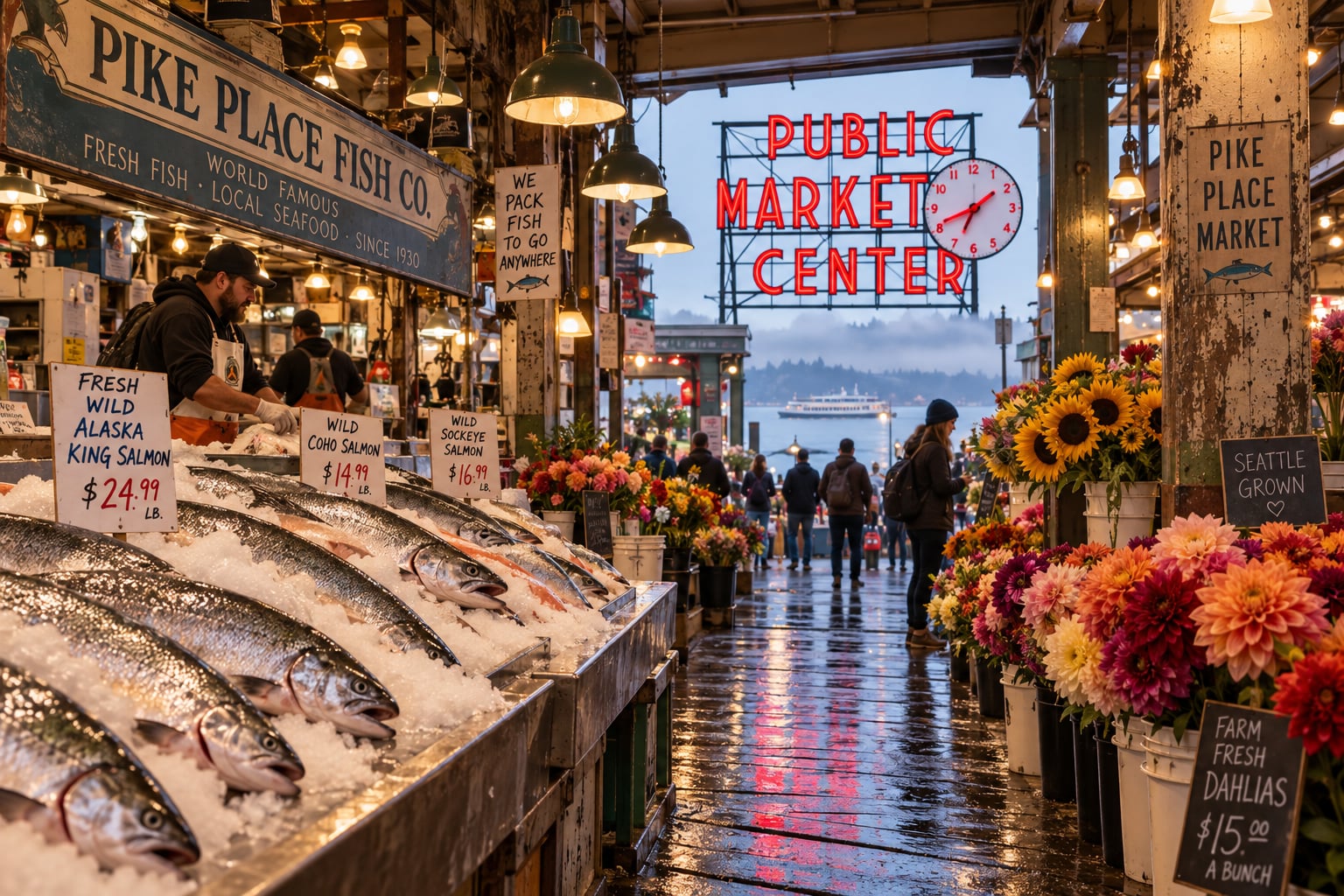
Perched high on the bluff overlooking Elliott Bay since 1907, Pike Place Market is one of the oldest continuously operated public farmers markets in the United States and the undisputed emotional heartbeat of Seattle. The best way to experience it is to arrive around eight in the morning, before tour buses arrive and while local chefs are still inspecting the day’s fresh catch.
Enter beneath the iconic red neon Public Market Center clock sign onto Pike Place’s historic cobblestones. Inside the multi-level covered arcade, the atmosphere is electric with sensory energy. Florists from nearby valleys arrange magnificent bouquets of autumn dahlias, sunflowers, and eucalyptus for a fraction of boutique florist prices. A few paces down, fishmongers in bright orange rubber overalls shout playful orders and toss gleaming twenty-pound wild King salmon across the ice counter to the delight of gathered onlookers.
Take time to explore the labyrinth of lower levels known as the "Down Under." Wooden ramps and creaking stairwells wind past vintage comic book shops, antique print sellers, magic stores, and artisanal spice merchants who have occupied the same wooden stalls for generations. It is a living museum of honest merchant culture, completely resistant to corporate homogenization.
- Watch for the brass hoof prints on the wooden floor leading to Rachel the Piggy Bank, the market’s bronze mascot whose daily coin donations support local low-income community clinics and food banks.
- Walk down the cobblestone incline of Lower Post Alley to inspect the famous Market Theater Gum Wall, a bizarre and colorful urban art installation spanning brick alley walls covered in thousands of pieces of colorful chewing gum.
- Duck into Mee Sum Pastry inside the market arcade for a piping-hot baked or steamed BBQ pork hom bow, a fluffy, slightly sweet yeast bun stuffed with savory glazed pork that makes an ideal morning hand-warmer.
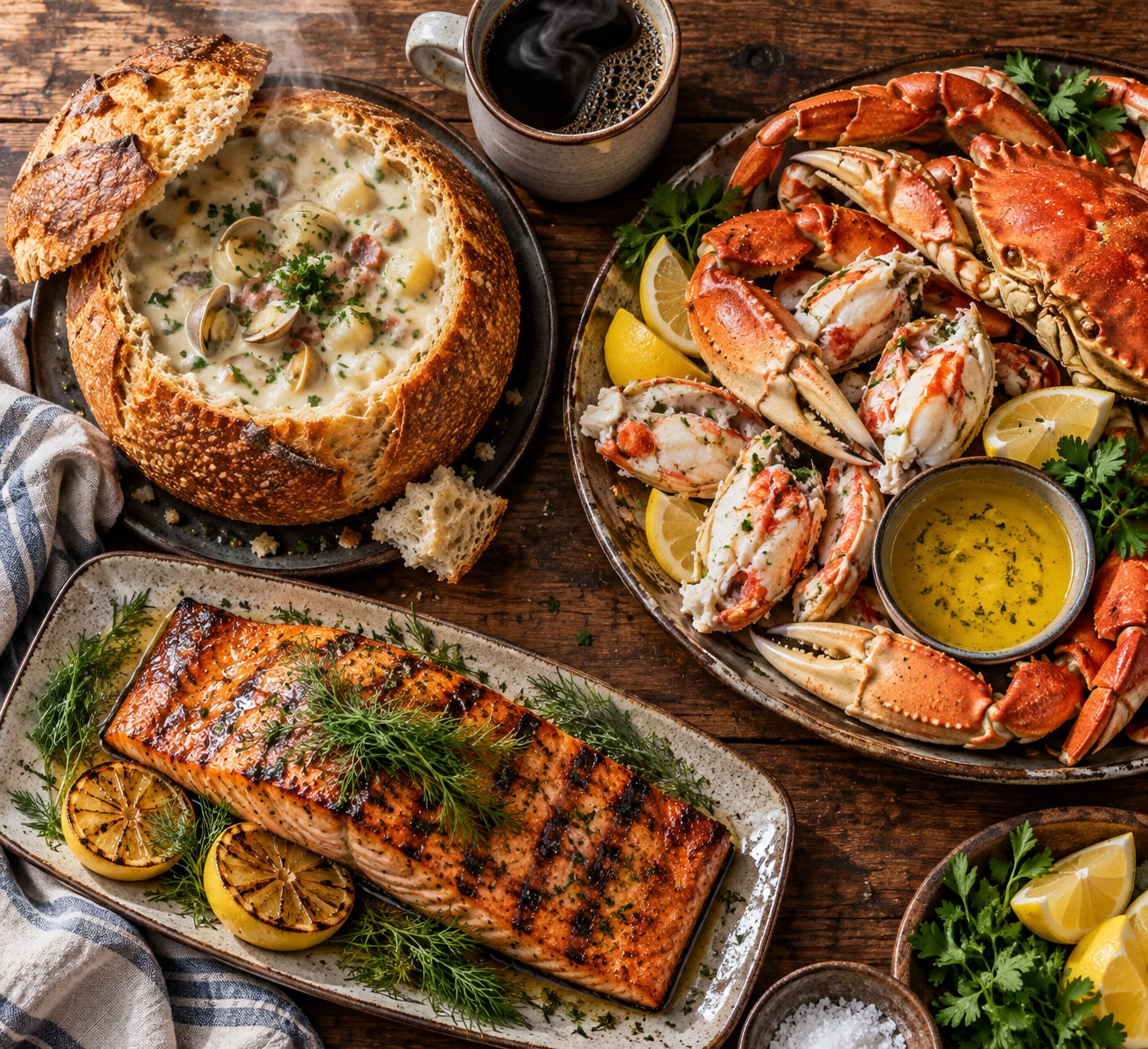
A Feast from the Cold Pacific: Sourdough Chowder Bowls and Sweet Dungeness Crab
The cold, oxygen-rich waters of the Pacific Northwest produce some of the finest seafood on the planet, and nowhere is that bounty celebrated with greater gusto than in Seattle’s seaside kitchens and neighborhood crab shacks.
A proper Seattle seafood ritual begins with a bowl of Pacific Northwest clam chowder. Unlike thick flour-heavy versions found elsewhere, local recipes let the clean sweetness of fresh ocean clams take center stage. Head to Pike Place Chowder tucked away in Post Alley or Duke’s Seafood on South Lake Union. Order your chowder ladled piping hot into a freshly baked round sourdough bread bowl. The steaming, velvety soup—studded with tender wild clams, diced red potatoes, and smoky uncured bacon—soaks into the tangy sourdough walls, creating a comforting, savory treat that warms you down to your fingertips.
Equally sacred is Dungeness crab, harvested wild along the coastal waters of Washington and Alaska. With its delicate, flaky white meat that tastes naturally sweet and nutty, whole steamed crab needs nothing more than a nutcracker, a wooden mallet, a wedge of lemon, and a ramekin of warm clarified butter. Cracking sweet claw meat while looking out over the ferry docks is the definition of Pacific Northwest culinary contentment.
And no culinary survey is complete without wild-caught Pacific salmon. Whether it is fatty King (Chinook), rich Coho, or ruby-red Sockeye, fresh salmon here is grilled over native alderwood planks, infusing the tender, flaky fish with a gentle woodsmoke perfume that lets its natural marine sweetness shine through.
- Venture to the historic Ballard neighborhood to sample freshly shucked Pacific oysters on the half shell at The Walrus and the Carpenter, paired with crisp local dry cider.
- Try cedar-planked smoked salmon jerky sold by weight at market smokehouses; it makes a lightweight, protein-packed trail snack for day hikes.
- Save room for a slice of warm blackberry pie made with wild Marionberries and served with a scoop of locally churned sweet cream ice cream.
The Sacred Coffee Ritual: Historic Roasteries, Single-Origin Cafes, and Rainy Day Comfort
It is impossible to write about Seattle without honoring its relationship with coffee. While the city birthed global chains like Starbucks—whose original 1971 storefront still draws queues outside Pike Place Market—the true soul of Seattle coffee lives in its fiercely independent micro-roasters and third-wave espresso temples.
The local obsession with high-elevation beans, meticulous roasting profiles, and precise extraction temperatures was born from a very practical need: on cool, overcast mornings when damp mist hangs in the air, a warm ceramic mug cradled between cold hands provides essential comfort and camaraderie.
Stroll through the artistic avenues of Capitol Hill and Fremont to explore legendary local roasters like Espresso Vivace, Monorail Espresso, and Herkimer Coffee. Step inside, smell the rich perfume of freshly ground Ethiopian and Guatemalan beans, and watch baristas steam whole milk into micro-foam with painterly precision. In Seattle, coffee is not treated as a rushed caffeine jolt on the way to an office cubicle; it is an artisanal craft, a neighborhood anchor, and a daily meditative practice.
- Order a traditional cortado or flat white to taste the precise balance of rich, velvety steamed milk and floral espresso acidity without excess syrup or artificial flavoring.
- Visit the Starbucks Reserve Roastery on Pike Street in Capitol Hill to marvel at its colossal copper roasting casks, pneumatic delivery tubes, and barrel-aged coffee flights.
- Seek out cozy neighborhood cafes equipped with vintage record players and rain-spattered bay windows to spend an unhurried afternoon reading a paperback.
Gliding Across Puget Sound: The Bainbridge Ferry and Sunset Over Elliott Bay
To truly appreciate Seattle’s geographical grandeur, you must leave the land behind and take to the water. The Washington State Ferry system is not merely public transit; it is the most magnificent and affordable scenic harbor cruise in the country.
Board the jumbo ferry departing from Colman Dock on Pier 52 bound for Bainbridge Island in the late afternoon. As the vessel sounds its deep horn and pulls away from the slip, head to the breezy upper open deck. Sea gulls swoop alongside in the boat’s updraft while salty maritime winds ruffle your hair.
Looking back toward the east, the entire downtown Seattle skyline unfolds before your eyes: the sleek needle of the Space Needle rising beside gleaming office towers, the Great Wheel illuminated in colored lights along the docks, and container cranes standing like robotic giraffes along the industrial waterways of Harbor Island.
Time your return crossing so you are on the water as dusk descends. As the sun sinks behind the jagged silhouette of the Olympic Mountains to the west, the eastern sky blushes in pale lavender and rose, and the Seattle skyline transforms into a glittering wall of diamonds reflected on the dark swells of Elliott Bay.
- Ferry walk-on passenger fares are inexpensive and return trips from Bainbridge Island back to Seattle are completely free for pedestrians.
- Once on Bainbridge Island, walk five minutes from the terminal into the charming village of Winslow to browse independent bookstores and savor homemade ice cream at Mora Iced Creamery.
- Keep a keen watch on the water during the crossing; pods of harbor seals, porpoises, and occasionally orcas (killer whales) navigate these cold coastal passages.
Standing in the Shadow of the Giant: A Day Trip Toward Mount Rainier National Park
On clear days, locals look to the southeast and proclaim with genuine awe: "The Mountain is out." They are referring to Mount Rainier, an active stratovolcano crowned by twenty-six major glaciers that soars 14,411 feet above sea level, dominating the horizon like an ethereal white fortress.
Located roughly two hours south of downtown, Mount Rainier National Park is an accessible day trip that transports you into another realm. Drive up through the Nisqually Entrance and wind through cathedral groves of towering thousand-year-old western red cedars and Douglas firs whose trunks are as wide as passenger cars.
Ascend to the Paradise visitor area at 5,400 feet. In autumn, the alpine subalpine meadows turn brilliant shades of crimson and burnt orange as mountain huckleberry shrubs prepare for winter snows. Towering glacier tongues crackle faintly in the midday warmth, cascading icy glacial melt into rushing rivers below. Walking along the paved Skyline Trail, breathing crisp, pine-scented alpine air while looking up at the colossal hanging seracs of Nisqually Glacier, you realize the profound natural power that defines the Pacific Northwest spirit.
- Always check road conditions and mountain webcam feeds before departing; alpine weather can change in minutes and tire chains are often required inside park boundaries starting in late autumn.
- Pack warm layered clothing including a windproof fleece, thermal base layer, and waterproof outer shell, as temperatures at higher elevations are significantly colder than in downtown Seattle.
- Stop in the historic timber town of Elbe along Highway 7 for hot country diner meals or espresso inside a converted vintage railcar.
Practical Northwest Street Smarts: Orca Cards, Rain Gear, and Exploring Like a Local
To make the most of your Seattle journey with seamless ease and local composure, keep these practical travel tips in your pocket:
- Ditch the umbrella for breathable rainwear: Locals rarely carry umbrellas because downtown sidewalks are windy and hilly, and precipitation often takes the form of light, misty drizzle rather than torrential downpours. A quality water-resistant jacket with an adjustable hood and comfortable, water-resistant walking shoes are all you need to stay dry and comfortable.
- Master the transit system with an Orca Card: Seattle’s public transit network is clean, punctual, and extensive. The Link Light Rail connects Seattle-Tacoma International Airport (Sea-Tac) directly to downtown, Capitol Hill, and the University of Washington in under forty minutes. Use a physical Orca card or load a transit pass to your digital phone wallet for seamless tap-and-ride convenience across light rail, city buses, streetcars, and foot ferries.
- Conquer the steep topography wisely: Downtown Seattle is built on steep coastal hillsides that slope dramatically toward the bay. Walking from the waterfront up to 5th Avenue or Capitol Hill involves serious stair-climbing. Use public elevators inside shopping galleries or take the free hillside transit elevators located near the Harbor Steps to save your knees.
- Explore beyond downtown into character-rich neighborhoods: The true character of Seattle lives outside the central business district. Take a bus or light rail to Ballard to see working salmon locks and craft breweries, explore Fremont to pose with the giant stone Fremont Troll lurking beneath the Aurora Bridge, or visit the Chinatown-International District for authentic hand-pulled noodles, dim sum, and historic cultural landmarks.
- Prepare for changing daylight: Summer brings nearly sixteen hours of glorious sunlight, but late autumn and winter days are short, with twilight arriving around 4:30 PM. Plan outdoor explorations, ferry rides, and mountain viewings for the morning and midday hours, reserving evenings for cozy dinners, craft beer taprooms, and acoustic live music venues.
When your plane banks over the dark evergreen forests and leaves Elliott Bay behind, the memory of Seattle lingers warmly. You will still recall the salty sea breeze hitting your face on the ferry deck, the steaming richness of fresh clam chowder in a crusty bread bowl, and the quiet magic of watching Mount Rainier gleam through the morning mist.