
# Sedona & Grand Canyon Arizona Travel Guide: Red Rock Vortices, South Rim Vistas & Southwestern Flavors
Rising abruptly from the high desert floor of central Arizona, the crimson sandstone spires and towering buttes of Sedona create one of the most visually arresting geological spectacles in North America. Bathed in brilliant sunshine that shifts the mineral strata from glowing amber to deep rust and fiery vermilion, this ancient landscape has long captured the imagination of wanderers, artists, and spiritual seekers.
A scenic northward drive through the pine-scented switchbacks of Oak Creek Canyon and across the volcanic Colorado Plateau leads directly to the monumental rim of the Grand Canyon, an unfathomable geological abyss carved over millions of years by the Colorado River.
Pairing the intimate, mystical beauty of Sedona’s red rock labyrinths with the overwhelming scale of the Grand Canyon offers an quintessential American Southwest pilgrimage, complete with ancient Indigenous history, exhilarating cliffside trails, and a vibrant culinary tapestry steeped in Native American traditions and bold borderland flavors.
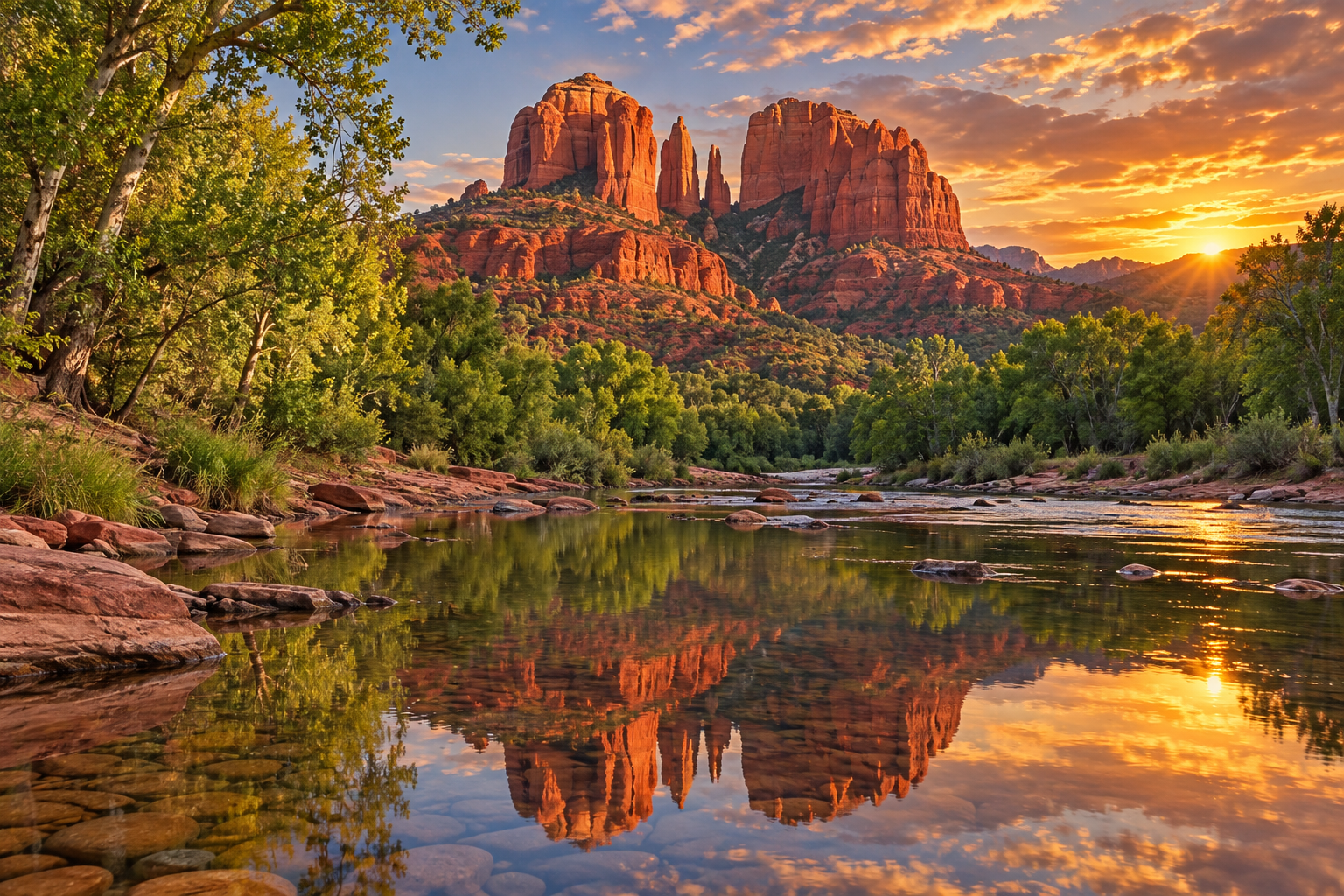
The Crimson Majesty of Red Rock Country
The dramatic gateway to Sedona begins along Highway 89A, descending through the lush green gorge of Oak Creek Canyon where cool perennial mountain waters nourish towering cottonwood, willow, and Arizona sycamore groves. As the canyon walls open up, the iconic red sandstone formations emerge in breathtaking panorama:
- Cathedral Rock: The undisputed silhouette of Sedona, soaring hundreds of feet into the azure sky. Composed of Permian-era Schnebly Hill Formation sandstone, Cathedral Rock glows with fierce intensity during golden hour, its weathered pinnacles resembling the vaulted spires of a gothic cathedral mirrored in the gentle eddies of Red Rock Crossing.
- Bell Rock and Courthouse Butte: Welcoming travelers approaching from the south along Highway 179, Bell Rock rises in distinct bell-shaped stepped terraces. The trail looping around its sandstone apron offers one of the most accessible scrambles in the region, yielding panoramic 360-degree vistas across the entire Verde Valley.
- Devil’s Bridge: A natural sandstone arch standing over fifty feet high, sculpted by millions of years of wind, rain, and thermal fracturing. Reached via a moderate four-mile roundtrip hike through juniper and manzanita scrubland, stepping onto the natural stone walkway feels like walking on air above a sea of crimson desert canyon.
- Boynton Canyon and the Secret Mountain Wilderness: A box canyon revered for its sheer multi-colored sandstone walls, ancient Sinagua cliff dwellings tucked into alcoves, and dense evergreen chaparral that remains blissfully cool even during warm desert afternoons.
Tapping into the Earthly Vortices of Sedona
For decades, Sedona has held international acclaim as a nexus of subtle metaphysical energy, known colloquially as "vortices." Whether approached from a perspective of meditation, mindful wellness, or curious cultural exploration, these designated vortex sites coincide with some of the most striking viewpoints in the region:
- Airport Mesa Vortex: Perched atop a basalt-capped mesa overlooking the entire town, this vortex is celebrated for an upward-flowing, masculine or electric energy that inspires clarity, confidence, and internal vitality. Sunrises here are legendary as early light sets the red rocks ablaze.
- Cathedral Rock Vortex: Regarded as a downward-flowing, feminine or magnetic energy center that invites deep introspection, stillness, emotional healing, and gentle grounded awareness, best experienced while sitting along the smooth, creek-polished red rocks at the base of the spire.
- Boynton Canyon Vortex: Celebrated as a balanced vortex that harmonizes feminine and masculine polarities, situated against dramatic canyon walls where indigenous cultures once held sacred ceremonies honoring the primordial balance of earth and sky.
- The Twisted Junipers: Throughout these vortex areas, observant hikers will notice gnarled Utah juniper trees with trunks that spiral in tight, twisting corkscrew patterns. Local folklore attributes this spiral growth to the swirling subtle electromagnetic currents moving through the sandstone bedrock.
Architectural Harmony at the Chapel of the Holy Cross
Commissioned in the 1950s by sculptor Marguerite Brunswig Staude—a student of legendary architect Frank Lloyd Wright—the Chapel of the Holy Cross stands as a triumphant example of modernist architecture wedded seamlessly to natural geology.
Jutting out dramatically between two twin red sandstone buttes two hundred feet above the desert floor, the chapel is anchored by a colossal ninety-foot cross that forms both the primary structural facade and the mullion frame for panoramic glass windows.
Inside, the atmosphere is hushed and reverent. Visitors are greeted by natural sunlight filtering through floor-to-ceiling glass, illuminating simple wooden pews, delicate flickering votive candles, and an uninterrupted view extending toward Bell Rock and the distant Verde Valley.
Ascending to the Grandeur of the South Rim
Continuing north from Sedona past the San Francisco Peaks and the historic Route 66 hub of Flagstaff, the terrain transitions into the high-altitude ponderosa pine forests of the Kaibab Plateau before reaching the edge of the abyss: Grand Canyon National Park South Rim.
No photograph or documentary can truly prepare the human senses for that first physical encounter with the canyon rim:
- Mather Point Overlook: Located near the Grand Canyon Visitor Center, Mather Point provides the classic panoramic vista, peering down through nearly two billion years of exposed geological history—from the rust-red Supai Group and buff Coconino Sandstone down into the deep, dark basement layer of Vishnu Schist.
- Yavapai Geology Museum and Observation Station: Positioned right on the rim edge, this historic stone facility features floor-to-ceiling panoramic glass windows with annotated topographic models explaining how the relentless carving power of the Colorado River cut an average of one vertical foot of rock every two thousand years.
- Desert View Watchtower: Designed in 1932 by pioneering female architect Mary Colter, this four-story stone watchtower draws inspiration from ancestral Puebloan stone towers. Its interior walls feature intricate hand-painted murals by Hopi artist Frank Kabotie, and the upper viewing deck offers peerless vistas of the Colorado River bending sharply through the eastern canyon toward the Painted Desert.
- The Rim Trail and Bright Angel Trail: For casual sightseers, the paved and largely flat Rim Trail stretches for thirteen miles, offering peaceful walking between viewpoints with frequent shuttle stops. For adventurous hikers with proper conditioning and plenty of water, descending into the canyon via Bright Angel Trail to 1.5-Mile Resthouse reveals dramatic changes in microclimates and sheer vertical scale.
A Feast of Southwestern Heritage and Desert Flavors
Exploring high desert trails and brisk canyon rims builds a formidable appetite, and the culinary landscape of northern and central Arizona showcases a captivating fusion of ancestral Native American staples, borderland Mexican cooking, and refined desert gastronomy:
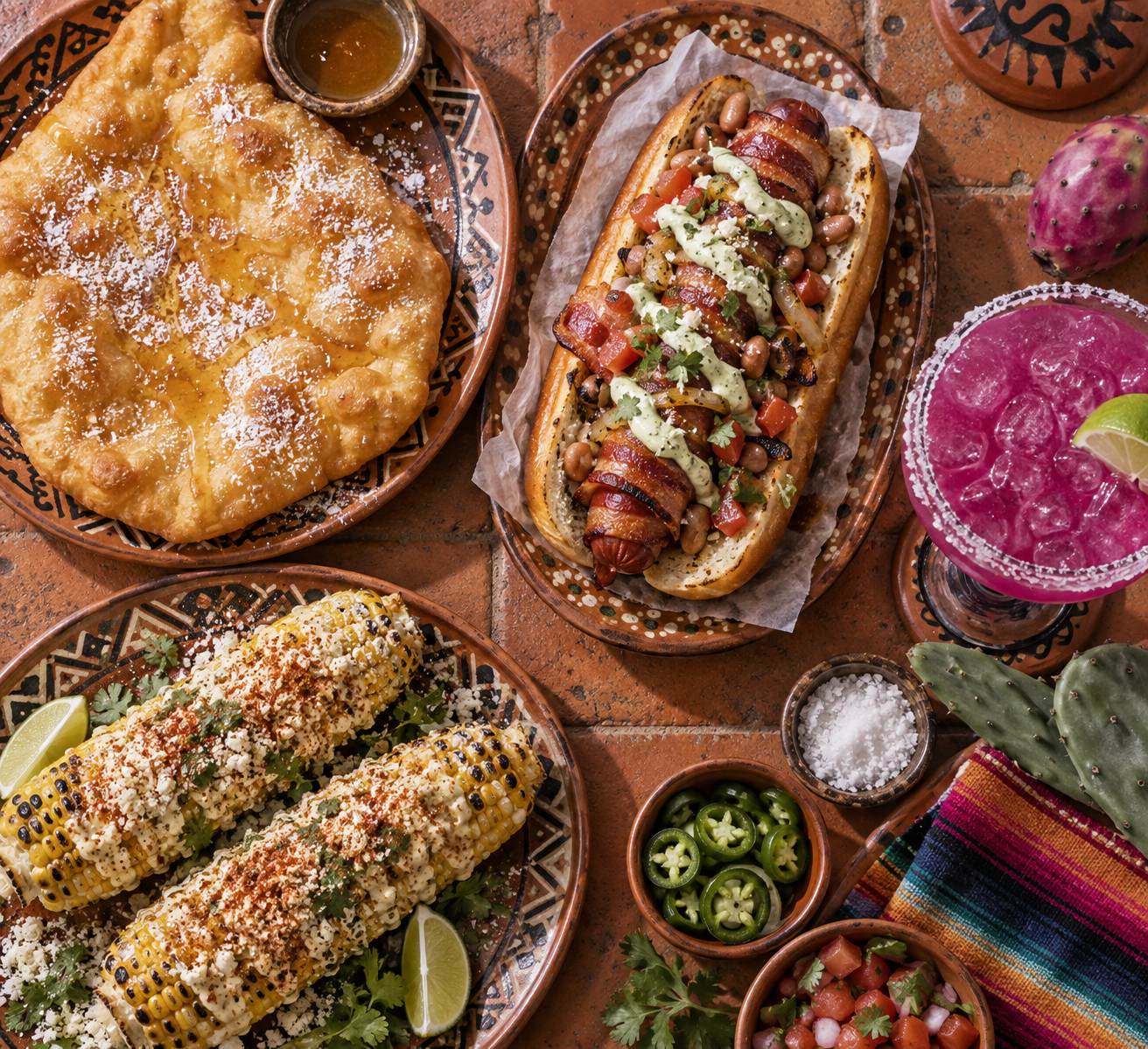
Traversing between Sedona and the Grand Canyon introduces travelers to these quintessential regional dishes:
- Authentic Navajo Fry Bread and Indian Tacos: Developed during the harrowing Long Walk of 1864 when the Navajo people were forced from their ancestral lands and survived on government rations of white flour, sugar, salt, and lard, fry bread has evolved into a beloved symbol of resilience and indigenous pride. Stretched thin and deep-fried in sizzling oil until golden and puffy, the bread is crispy on the edges with a tender, airy interior. Enjoyed sweet with desert wildflower honey and powdered sugar, or savory as an "Indian Taco" piled high with slow-simmered pinto beans, ground beef, melted cheddar cheese, crisp lettuce, and fresh green chile salsa.
- The Iconic Sonoran Hot Dog: Originating in Hermosillo, Sonora and perfected across the Arizona desert borderlands, this legendary street food features an all-beef frankfurter tightly wrapped in smoky bacon and grilled until crisp. Tucked into a split-top sweet bolillo roll, it is generously topped with warm pinto beans, grilled onions, diced fresh tomatoes, a ribbon of yellow mustard, creamy mayonnaise, and zesty jalapeño salsa verde.
- Charred Mexican Street Corn (Elote): Fresh sweet corn on the cob roasted over blazing open coals until lightly blistered and caramelized, slathered with lime-infused Mexican crema, dusted generously with salty crumbled cotija cheese, and sprinkled with smoked ancho chili powder.
- Prickly Pear Cactus Creations: The bulbous magenta fruit (tuna) of the native prickly pear cactus is harvested across the Sonoran desert each late summer. Yielding a vibrant fuchsia juice with flavor notes reminiscent of watermelon, raspberry, and bubblegum, local chefs and mixologists incorporate it into artisan glazes for smoked meats, salad vinaigrettes, and Sedona’s signature Prickly Pear Margarita served with a coarse sea-salt rim.
- Wood-Fired Southwestern Cedar Trout and Smoked Meats: Native rainbow and brown trout flash-roasted on aromatic cedar planks over mesquite fires, seasoned with ground Southwestern chilies, cumin, and citrus butter, representing the pinnacle of rustic canyon dining.
Enchanted Evenings at Tlaquepaque Arts & Shopping Village
As the desert sun slips behind the red rock spires and the temperature pleasantly cools, the historic Tlaquepaque Arts & Shopping Village in Sedona becomes an atmospheric haven of art, romance, and craftsmanship.
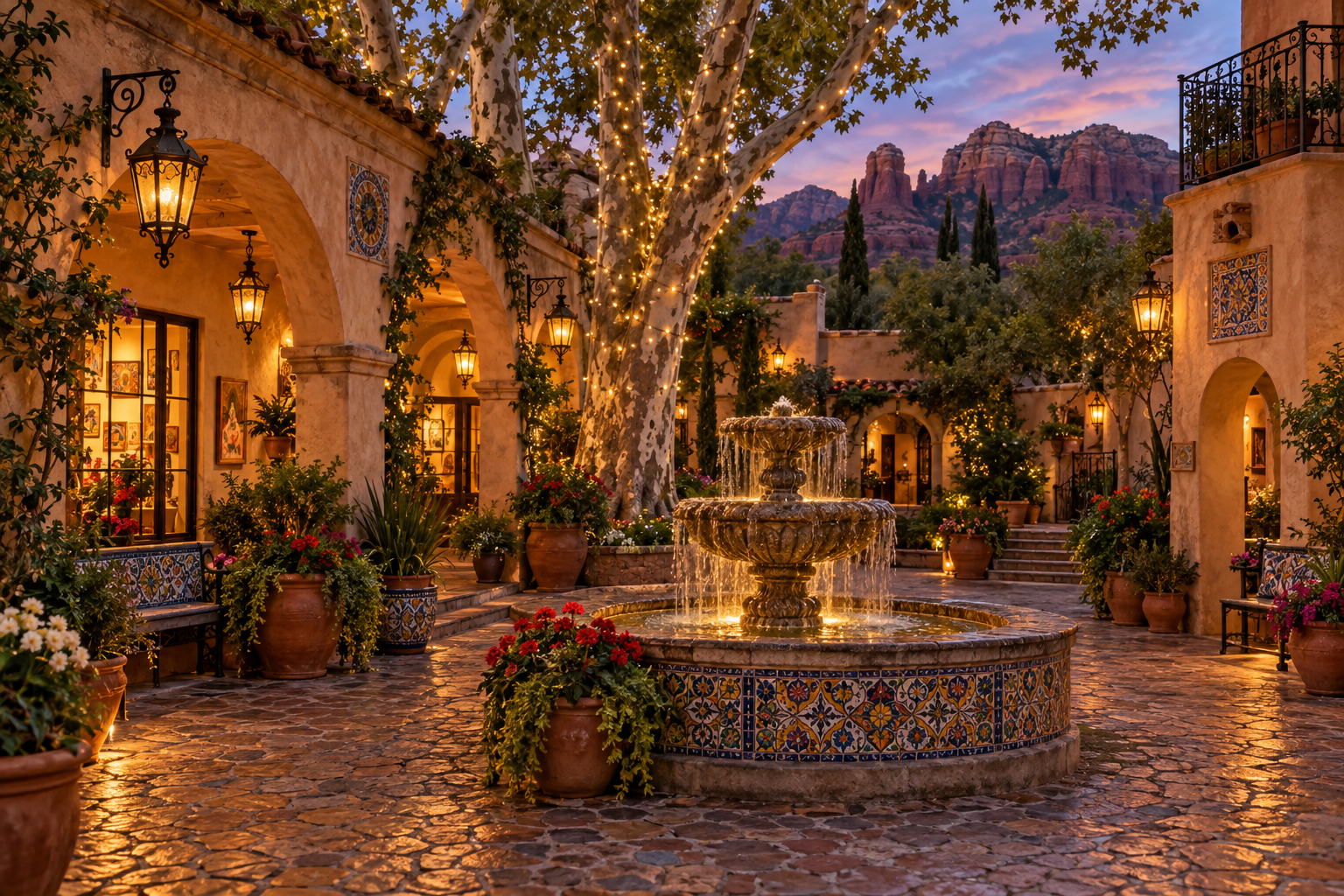
Conceived in the early 1970s and named after a historic suburb of Guadalajara, Mexico, Tlaquepaque was painstakingly constructed to resemble a timeless 18th-century Spanish colonial village:
- Stucco Arches and Cobblestone Plazas: Wandering through the maze of arched porticos, hand-carved wooden doors, and brick-lined passageways reveals hidden courtyards shaded by giant Arizona sycamore trees draped in delicate fairy lights.
- Artisan Galleries and Indigenous Craftsmanship: Tlaquepaque houses dozens of premier art galleries showcasing world-class bronze wildlife sculptures, vibrant Southwestern oil paintings, hand-thrown ceramics, and authentic Native American turquoise jewelry made by Navajo, Zuni, and Hopi silversmiths.
- Fountain Courtyards and Outdoor Dining: At the heart of the village, hand-painted Mexican Talavera tiles frame bubbling carved stone fountains where travelers sip locally roasted espresso or savor southwestern tapas beneath the rustling leaves.
Stargazing Under Certified Dark Skies
Both Sedona and Grand Canyon National Park are internationally recognized as certified Dark Sky Places by DarkSky International, maintaining rigorous lighting ordinances that minimize light pollution.
Thanks to the ultra-clean, dry desert air and high elevation exceeding four thousand to seven thousand feet above sea level, stepping outdoors on a moonless night reveals an astronomical spectacle of jaw-dropping clarity:
- The celestial ribbon of the Milky Way arcs brilliantly from horizon to horizon, visible with the naked eye in intricate detail.
- Distant nebulae, orbiting satellites, passing meteors, and constellations appear with razor-sharp definition against a velvety black canvas.
- Popular stargazing outposts like the Sedona Cultural Park trailhead, Two Trees Viewing Area, or Lipan Point at the Grand Canyon provide front-row seats to the cosmos.
Essential Practical Advice for Desert Travelers
Planning a seamless expedition to Sedona and the Grand Canyon requires mindful preparation to navigate desert terrain and shifting mountain weather:
- Optimal Seasons: Spring (March to May) brings comfortable hiking temperatures and blooming desert wildflowers, while autumn (late September to November) offers crisp mountain air and golden foliage along Oak Creek Canyon. Midsummer brings scorching midday heat in Sedona and afternoon monsoon thunderstorms, making early morning hikes essential.
- Passes and Parking Logistics: Trailheads throughout Sedona require a Red Rock Pass or an America the Beautiful Interagency Annual Pass, displayed clearly on your dashboard. Parking lots at popular trailheads like Cathedral Rock and Devil’s Bridge often fill before sunrise; utilizing the free Sedona Shuttle on peak weekends eliminates parking stress.
- Vehicle Selection: A standard rental car is completely sufficient for scenic paved drives along Highway 89A, Desert View Drive, and airport lookouts. However, if your itinerary includes rugged backcountry forest roads like Schnebly Hill Road or Diamondback Gulch, reserving a high-clearance 4WD vehicle or booking an open-air Pink Jeep Tour is strongly recommended.
- Hydration and Trail Safety: The arid desert air wicks away perspiration instantly, making dehydration deceptively rapid. Carry at least three liters of water per person per day, consume electrolyte-rich snacks, wear broad-brimmed hats and polarized sunglasses, and lace up hiking boots with sticky vibram rubber soles for gripping slick sandstone ledges.