
# Exploring the Historic Heart of Texas from the San Antonio River Walk to Austin Music and Smoked Brisket
There is a legendary, expansive soul to Texas that defies easy description. Far beyond the flat highway horizons and dusty frontier stereotypes, the central corridor of the Lone Star State reveals an enchanting landscape of crystal-clear spring-fed rivers, rolling limestone bluffs blanketed in wild mesquite and juniper, vibrant colonial history, and a rich, rebellious musical spirit.
Here, two distinct worlds lie merely seventy miles apart, connected by the scenic ridges of the Texas Hill Country. To the south rests San Antonio, a romantic 300-year-old Spanish colonial jewel where the gentle, winding river murmurs twenty feet below street level beneath massive bald cypress canopies. To the north thrives Austin, the live-music capital of the world, where neon signs glow across South Congress Avenue, acoustic guitars ring out from open-air honky-tonks, and pitmasters tend smoldering post-oak wood fires through the dead of night to produce the most tender, melt-in-your-mouth barbecue on Earth.
Traveling through Central Texas is an invitation to slow down and savor life. It is the sensory delight of stepping onto an arched stone footbridge as twilight turns the San Antonio River to liquid gold, listening to the resonant crackle of a vintage vinyl record spinning in a neon-lit Austin lounge, and sitting down at a butcher-paper-covered picnic table to pull apart a thick slice of smoked brisket with a glistening peppery bark that dissolves on the tongue like warm butter.
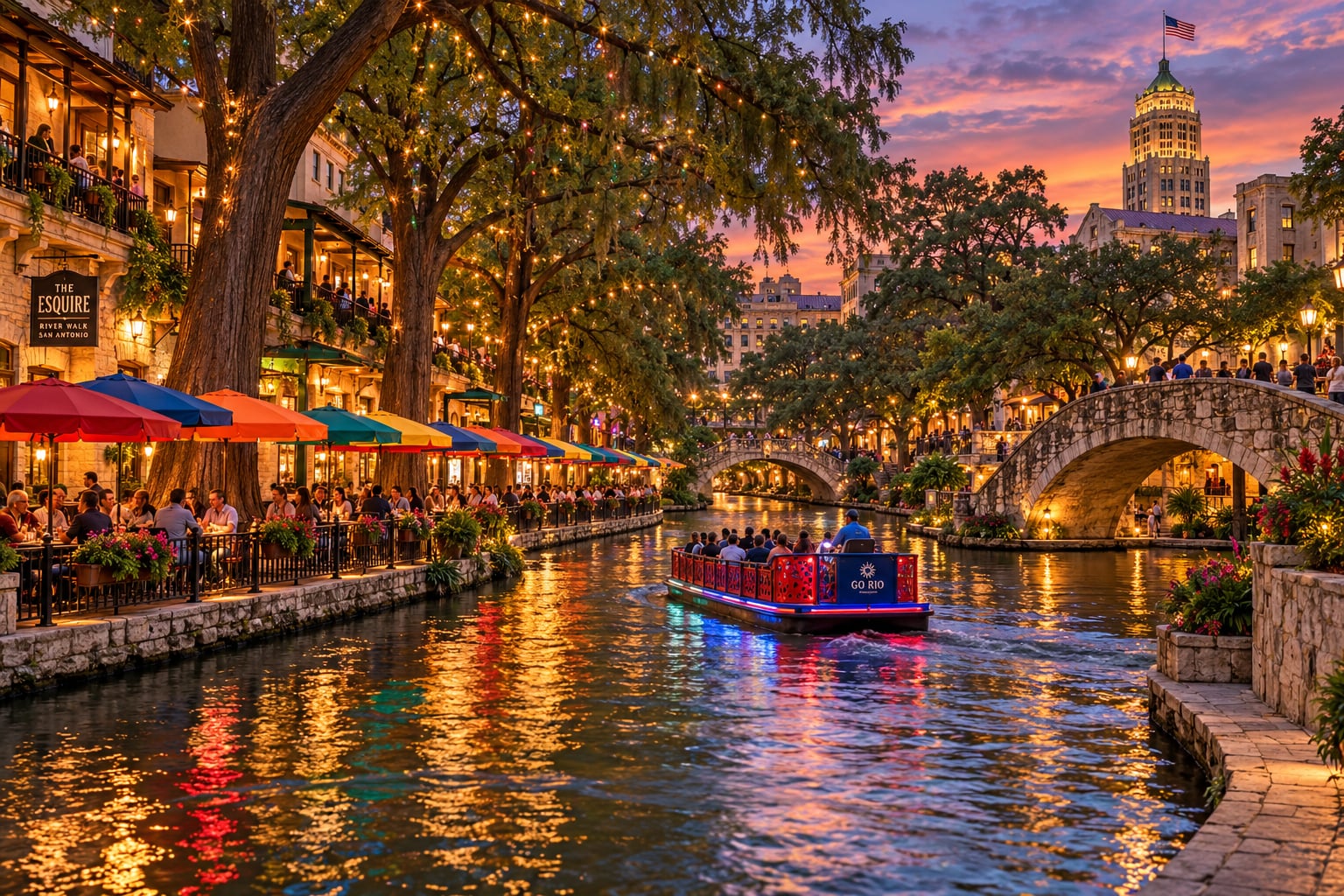
Strolling Beneath Giant Bald Cypress Trees Along the San Antonio River Walk
Tucked below the bustling city streets of downtown San Antonio, the San Antonio River Walk—known historically as Paseo del Río—is one of the most celebrated urban pedestrian sanctuaries in the world. Originally envisioned in 1929 by architect Robert Hugman to tame floodwaters while preserving natural beauty, this lush subterranean network of stone paths feels like an enchanted tropical oasis.
Gliding on Gentle Electric Barges Beneath Arched Stone Bridges and The Alamo
Wandering along the stone pathways that hug both banks of the emerald-green river reveals timeless architectural romance:
- Massive bald cypress trees, planted nearly a century ago, tower overhead with colossal gnarled roots dipping straight into the water, their feathery needle canopies filtering the warm Texas sunlight into a cool, emerald dappled shade. Arched limestone footbridges built by the Works Progress Administration in the 1930s arch gracefully over the water, connecting secluded stone terraces, weeping willow groves, and cascading fountains.
- Quiet, eco-friendly electric river barges glide smoothly through the water, offering open-air tours where travelers can sit back beneath the bridges and listen to stories of Spanish missionaries, indigenous Coahuiltecan communities, and early Tejano settlers who shaped this crossroads of cultures.
- Along the bustling central river bend, riverside patios brim with festive energy. Iconic establishments like Casa Rio—the first restaurant to open on the River Walk in 1946—feature clusters of bright yellow, orange, and turquoise patio umbrellas where patrons sip frozen prickly pear margaritas and listen to strolling mariachi musicians playing acoustic guitarróns and violins in the evening breeze.
- Just steps up a stone staircase from the river level stands The Alamo (Misión San Antonio de Valero), the 1718 Spanish mission church carved from pale yellow limestone. Surrounded by historic oak trees and quiet stone courtyards, standing before its iconic baroque facade evokes the legendary 1836 battle that cemented Texas folklore.
- Further south, the historic San Antonio Missions National Historical Park preserves four active 18th-century Spanish colonial missions connected by scenic hiking and cycling trails along the Mission Reach of the river, where colonial aqueducts, ancient stone carvings, and frescoed church walls remain remarkably intact.
Savoring the Sacred Craft of Central Texas Barbecue Smoked over Post Oak
If there is a sacred religion across the Texas plains, it is the craft of Central Texas pit barbecue. Brought to the region by German and Czech butcher immigrants in the mid-19th century who preserved unsold cuts of beef by smoking them over native hardwood, this regional culinary tradition has been perfected into a culinary art form recognized across the globe.
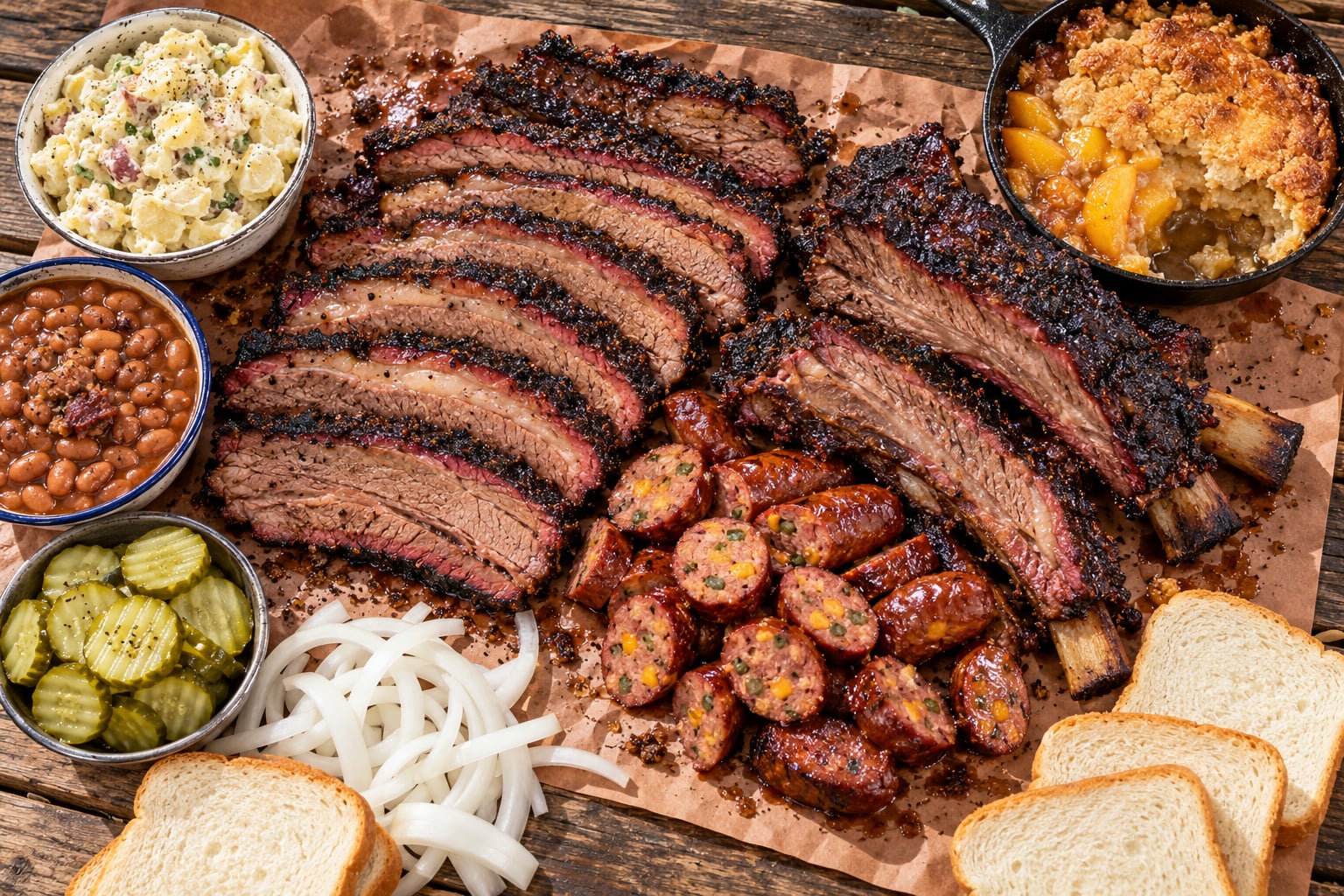
Giant Beef Ribs and Tender Peppery Brisket with House Made Peach Cobbler
To experience true Texas barbecue, you must leave forks and heavy sauces behind and feast on butcher paper:
- The undisputed king of the Texas pit is the slow-smoked beef brisket (packer cut). Seasoned purely with coarse kosher salt and cracked black Tellicherry pepper—known locally as the "Dalmatian rub"—the brisket is smoked over fragrant post oak wood fires for twelve to sixteen hours at low temperatures. The result is a masterpiece: a thick, crunchy, caramelized exterior bark that gives way to a vibrant pink smoke ring and impossibly juicy, marbled beef that sags under its own weight and melts instantaneously on the palate.
- Giant smoked beef plate ribs—affectionately called "dinosaur ribs"—are an awe-inspiring sight. Weighing over a pound per bone, these colossal ribs carry deep marbling that renders into rich, unctuous beef flavor with an intensely peppery, crispy crust.
- House-made beef and pork sausage links, stuffed into natural hog casings with coarse black pepper, fresh garlic, and melted jalapeño cheddar cheese, snap audibly when bitten, releasing a burst of spicy, savory juices.
- Barbecue is served by the half-pound straight from the carving block onto sheets of brown butcher paper. Accompaniments honor traditional butcher shop staples: crisp dill pickle chips, sliced raw sweet white onions, pickled jalapeños, and soft slices of white sandwich bread used to wipe up smoky rendered tallow.
- Classic side dishes include creamy mustard-spiced potato salad, slow-simmered pinto beans seasoned with brisket trimmings and cumin, and skillet-baked Hill Country peach cobbler served piping hot with melting scoops of sweet cream vanilla ice cream.
The Free Spirited Pulse of Live Music and Vintage Culture in Austin
Just an hour’s drive north along the edge of the Balcony Escarpment brings you to Austin, the eccentric and dynamic capital of Texas. Proudly carrying the official slogan "The Live Music Capital of the World," Austin pulsates with creative energy, outdoor recreation, and independent culture.
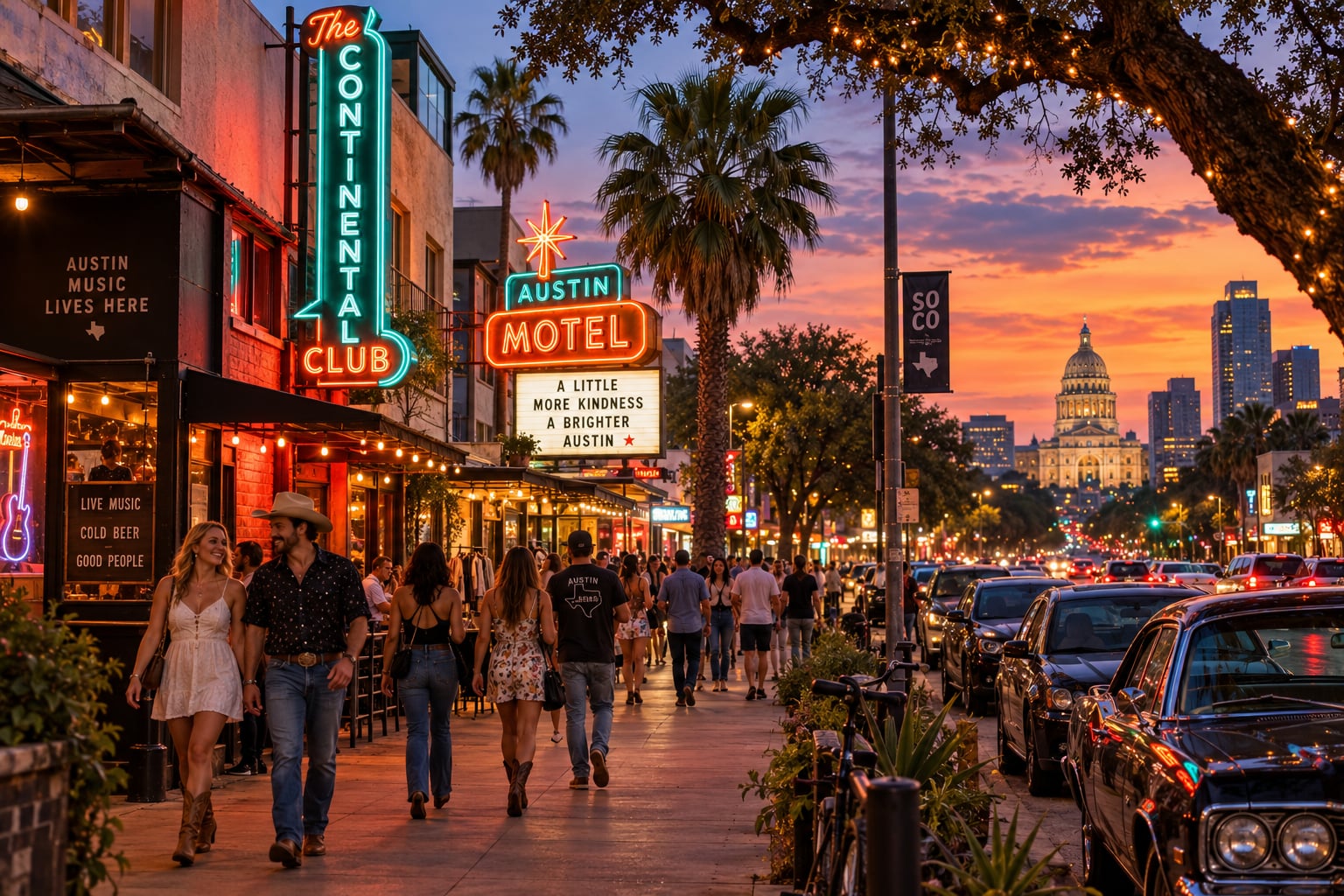
Electric Guitars on South Congress and Crisp Springs at Barton Creek
Experiencing the genuine spirit of Austin means immersing yourself in its historic thoroughfares and refreshing natural springs:
- South Congress Avenue (SoCo) forms the vibrant spine of local Austin culture. Flanked by majestic live oak trees and wide sidewalks, the street offers a stunning, uninterrupted view looking north toward the illuminated pink-granite dome of the Texas State Capitol. Vintage neon signs glow in turquoise and gold outside mid-century motels like the Austin Motel and historic venues like the Continental Club, which has hosted legendary blues, rockabilly, and country performers continuously since 1955.
- Boutique shops and independent record stores line the avenue, offering hand-tooled leather cowboy boots, vintage vinyl, and eclectic Texas folk art alongside artisan coffee roasters and open-air food truck parks.
- Tucked into the lush greenery of Zilker Park lies Barton Springs Pool, an iconic three-acre municipal swimming pool fed by natural underground limestone springs. Maintaining an invigorating water temperature of sixty-eight degrees Fahrenheit year-round, swimming in its crystal-clear turquoise waters beneath ancient pecan and cottonwood trees is the quintessential Austin ritual on warm sunny afternoons.
- In the evening, music spills out from dozens of neighborhood venues across the Red River Cultural District, East Austin, and historic Sixth Street. Whether listening to an upright bass thumping in a cozy underground jazz lounge or watching couples two-step across sawdust-strewn dance floors at the Broken Spoke, the air is alive with spontaneous rhythm.
- At twilight between March and November, hundreds of spectators gather along the Ann W. Richards Congress Avenue Bridge to witness North America’s largest urban bat colony—over 1.5 million Mexican free-tailed bats—emerge from under the bridge in swirling dark ribbons against the sunset sky to forage over Lady Bird Lake.
Golden Twilight Over Lake Austin from the Rocky Summit of Mount Bonnell
When the afternoon heat softens into twilight, heading into the western limestone hills of Austin provides the ultimate sunset sanctuary. Mount Bonnell, designated a historic landmark in 1836 and standing seven hundred and seventy-five feet above sea level, is the highest point within Austin city limits.
Panoramic Views Across the Rolling Limestone Bluffs of the Hill Country
Climbing the limestone stairs to the summit rewarded visitors with sweeping panoramas of Central Texas nature:
- A short ascent up ninety-nine stone steps carved into the hillside brings you to a flat limestone terrace shaded by twisted Texas live oaks and mountain junipers. From the stone pavilion at the top, the panoramic view stretches across the tranquil, winding waters of Lake Austin—a dammed portion of the Colorado River—where speedboats leave delicate white wakes across deep green water.
- Looking west, the rolling limestone hills of the Texas Hill Country unfold in layers of blue and violet ridges, glowing under the warm amber rays of the setting sun. Looking east, the modern glass towers of downtown Austin shimmer in the evening light.
- As twilight deepens, the sky transforms into dramatic dải colors of apricot, rose, and indigo, reflecting off the glassy river below while cool breezes rustle through the aromatic cedar trees, offering a tranquil conclusion to an exhilarating Texas day.
Practical Travel Insights for a Seamless Texas Hill Country Journey
Planning a road trip between San Antonio and Austin is straightforward and rewarding if you keep a few key tips in mind:
- The ideal time to visit Central Texas is during the shoulder seasons of autumn (October through November) and spring (March through May). Summers can be intensely hot with temperatures regularly exceeding ninety-five degrees Fahrenheit, while autumn brings mild sunny days, cool evenings, and ideal patio dining weather.
- Having a rental car is essential for fully experiencing the Texas Hill Country. While both downtown San Antonio and downtown Austin are very walkable, a car allows you to explore scenic backroads like Highway 281, historic German-settled towns like Fredericksburg with its peach orchards and wineries, and the legendary barbecue shrines of Lockhart and Luling.
- Be prepared for barbecue queues. World-renowned barbecue smokehouses often sell out of their daily meat supply by early afternoon; arriving by mid-morning on weekends ensures you won't miss out on prime cuts of brisket and beef ribs.
- Dress comfortably in casual, lightweight layers. Central Texas embraces an unpretentious, welcoming dress code where denim, comfortable walking boots, and breathable cotton shirts fit right in whether you are strolling the River Walk or attending a music festival.