
# Wandering Through the Historic Heart of Washington DC from the National Mall to Georgetown Cobblestones
There is a quiet, monumental grandeur to Washington DC that catches you by surprise the moment you step out onto its broad avenues. Built on a monumental scale designed by Pierre Charles L'Enfant to rival the majestic boulevards of Paris, the American capital is unlike any other metropolis on the continent. By law, no skyscraper is allowed to overshadow the dome of the United States Capitol, leaving the expansive sky wide open to bathe neo-classical marble columns, sprawling green lawns, and grand stone plazas in luminous daylight.
Visiting Washington DC is not about checking off distant government buildings from behind a tour bus window. It is about the physical sensation of walking across the soft gravel paths of the National Mall in crisp autumn air, watching fiery red oak leaves flutter across the marble steps of the Lincoln Memorial, losing yourself among ancient stone courtyards in Georgetown as vintage gas lamps flicker to life at dusk, and sitting down at a wooden harborside tavern to crack open steaming Maryland blue crabs dusted in savory Old Bay seasoning.
Standing in the Grand Open Spaces of the National Mall and Monument Grounds
Stretching over two miles from the United States Capitol in the east to the Lincoln Memorial overlooking the Potomac River in the west, the National Mall forms the ceremonial heart of the nation. It is an immense, open-air pedestrian sanctuary where history feels tangible at every step.
Strolling Past the Reflecting Pool and Marble Halls of Democracy
Exploring this historic expanse on foot reveals an awe-inspiring progression of monuments and sweeping landscapes:
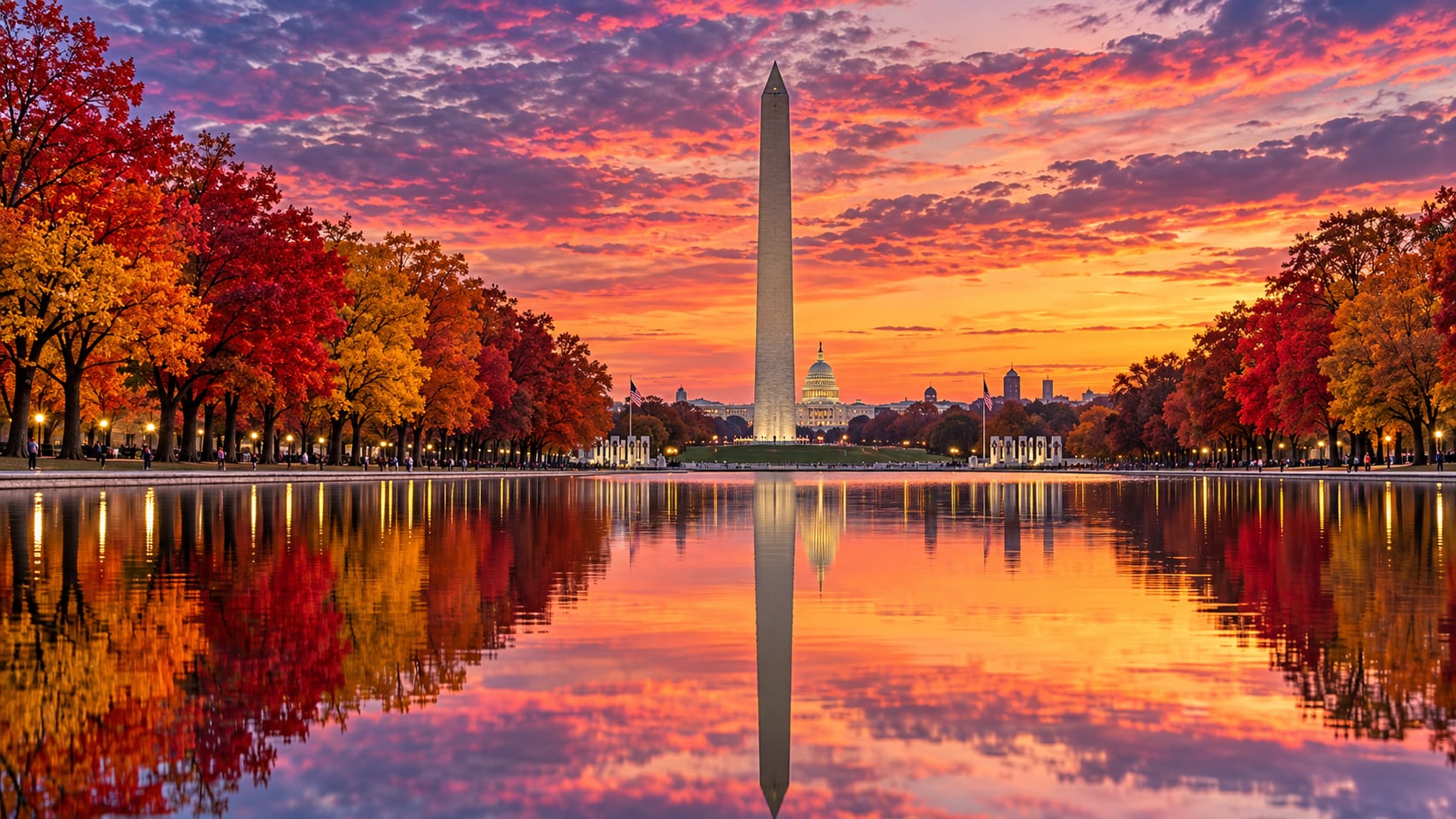
- The soaring obelisk of the Washington Monument stands at the geographical center of the capital. Rising five hundred and fifty-five feet into the sky, its marble and granite exterior shifts in color throughout the day, catching the rosy blush of early morning light and glowing brilliant pearl-white against the evening sky. Standing at its base beneath fifty encircling American flags, you can gaze eastward down the long lawn to the gleaming Capitol dome and westward toward the Lincoln Memorial.
- The Lincoln Memorial Reflecting Pool provides one of the most serene and iconic walking paths in the world. Flanked by double rows of majestic American elm and red oak trees whose branches turn blazing shades of crimson, amber, and gold each October, the still waters mirror the sky with crystalline perfection. Standing on the marble steps beneath Abraham Lincoln's contemplative gaze as sunset paints the water in shades of peach and lavender is a deeply moving experience.
- The Vietnam Veterans Memorial, designed by Maya Lin, offers a profoundly quiet and contemplative sanctuary cut into the sloping earth. The polished black gabbro granite wall, reflecting the surrounding trees and visitors while bearing more than fifty-eight thousand carved names, is one of the most powerful artistic tributes in the modern world.
- Near the southern tidal waters, the Thomas Jefferson Memorial sits beneath a majestic rotunda modeled after the Roman Pantheon, surrounded by hundreds of Yoshino cherry trees that create a sea of pink blossoms in spring and rustling golden canopies in autumn.
- Walking the grounds of the Franklin Delano Roosevelt Memorial leads you through four outdoor stone rooms carved from red South Dakota granite, filled with roaring waterfalls, bronze sculptures, and peaceful alcoves dedicated to perseverance through times of trial.
The Rich Flavors of the Mid Atlantic with Maryland Blue Crab and Capitol Delicacies
While Washington DC is globally famous for international diplomacy, its local culinary soul belongs to the Mid-Atlantic and Chesapeake Bay coastlines. Situated at the crossroads between northern culinary traditions and the rich coastal flavors of the American South, the capital offers a feast that is both deeply comforting and full of heritage.
From Shucked Chesapeake Oysters to Legendary U Street Half Smokes
To dine like a true Washingtonian, you must embrace the flavors of the bay and the historic neighborhood institutions:
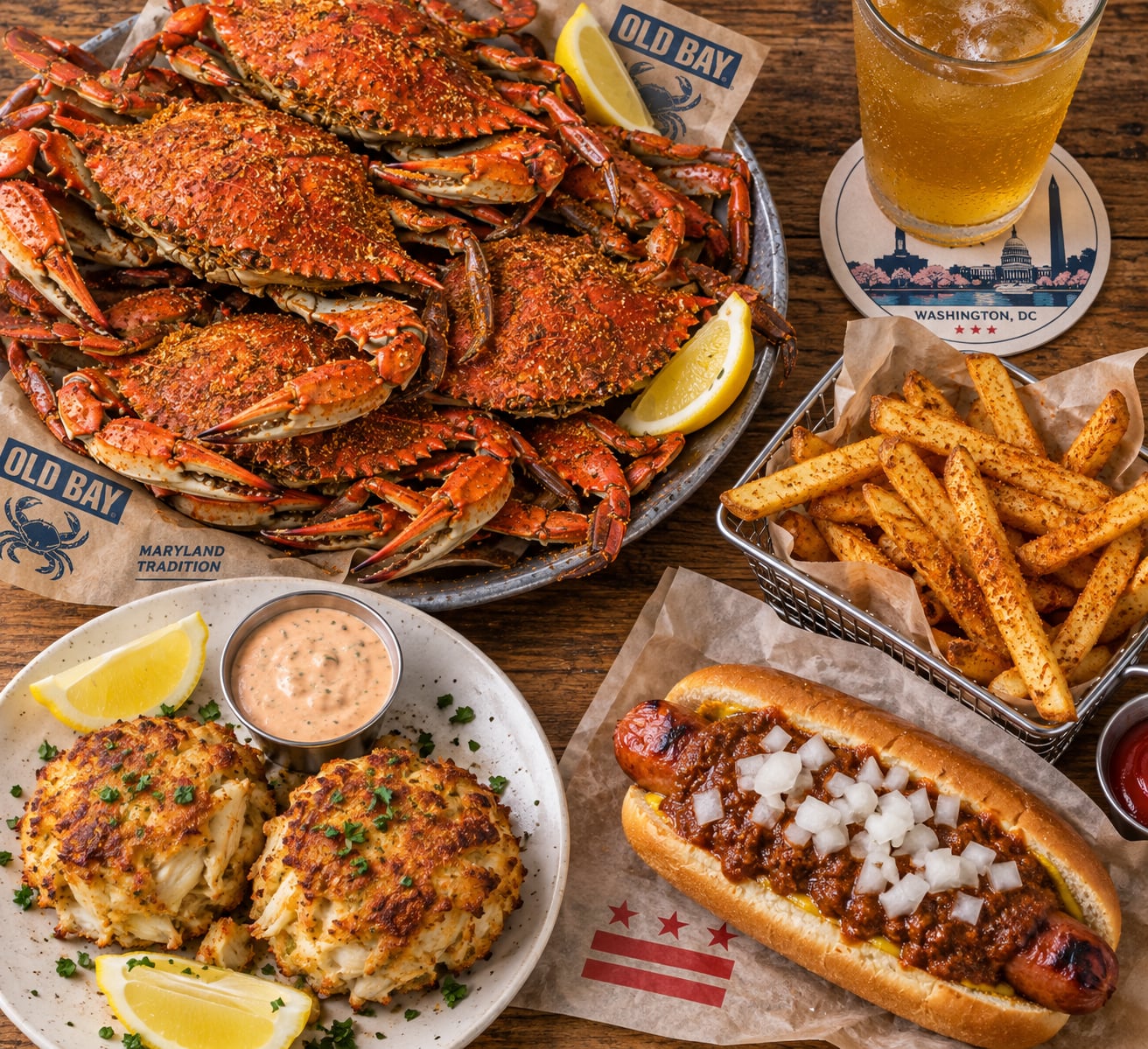
- The undisputed king of the regional table is the Maryland blue crab (Callinectes sapidus). Freshly harvested from the brackish waters of the nearby Chesapeake Bay, whole crabs are placed inside steaming wire baskets layered with coarse salt, dark beer, and thick coatings of aromatic Old Bay seasoning. Served communally on brown butcher paper with wooden mallets, cracking into sweet claw meat and rich lump crab meat is a joyful, hands-on feast that anchors local culture.
- Authentic Maryland Jumbo Lump Crab Cakes represent culinary luxury at its purest. Made almost entirely of enormous, pristine lumps of blue crab meat bound together with a mere teaspoon of mayonnaise, a whisper of Dijon mustard, and crushed saltine crackers, these cakes contain virtually zero filler. Pan-seared to a golden crisp or gently broiled, each forkful breaks apart into sweet, succulent crab meat that melts on the tongue, served alongside creamy remoulade and fresh lemon wedges.
- On historic U Street, Ben's Chili Bowl has been serving its legendary "Half-Smoke" since 1958. A beloved homegrown DC specialty, the half-smoke is a plump, coarse-ground sausage blend of half pork and half beef, seasoned with red pepper and smoked over hardwood. Split and grilled on a flat-top until the natural casing snaps crisply with every bite, it is tucked into a warm steamed bun, smothered in rich homemade spicy beef chili sauce, and topped with diced white onions and melted cheese.
- The historic Municipal Fish Market at The Wharf, operating continuously since 1805 as the oldest open-air fish market in the United States, is an essential stop. Here, barges floating right in the Washington Channel sell steamed spiced blue crabs by the dozen, fresh oysters shucked to order on crushed ice, and golden fried clam strips served in paper baskets with spicy cocktail sauce.
- For breakfast or afternoon tea, bakeries across the city serve freshly pressed hot apple cider from Virginia Blue Ridge orchards, warm spiced pumpkin pies, and flaky butter biscuits stuffed with thinly sliced country ham and apple butter.
Timeless Romance Along the Brick Sidewalks and Gaslit Alleys of Georgetown
Founded in 1751 as a bustling tobacco port along the Potomac River—predating the creation of the capital city itself—Georgetown is arguably the most romantic and atmospheric neighborhood in the United States. Its quiet, tree-lined residential streets feel worlds away from the marble monoliths of the National Mall.
Historic Federal Mansions and Peaceful Trails Beside the Canal Towpath
Wandering through Georgetown on an autumn afternoon reveals centuries of architectural heritage:
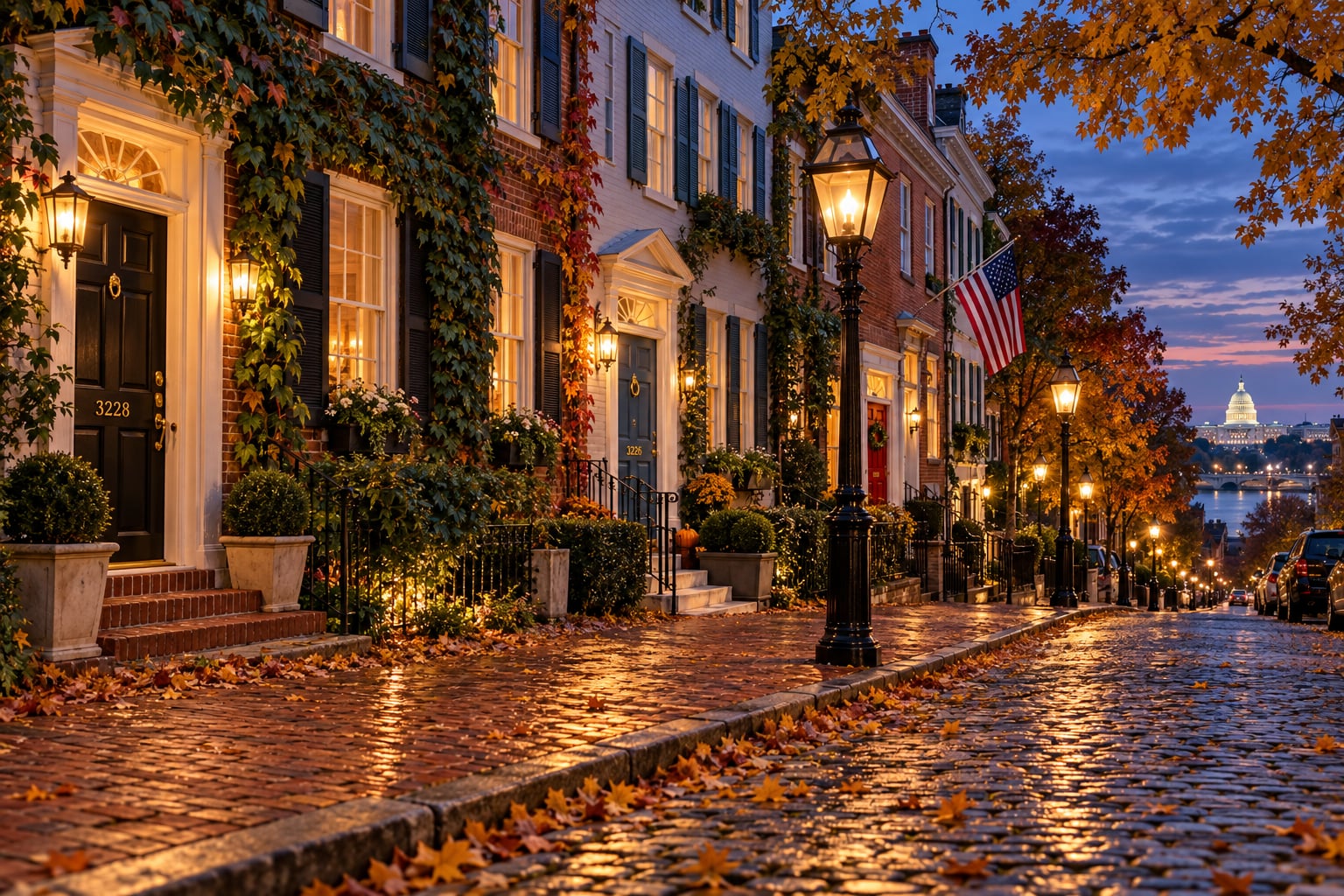
- The residential blocks along O Street, N Street, and Dumbarton Street feature some of the finest preserved Federal and Georgian-style brick townhomes in America. Built with hand-kilned red bricks, dark green wooden shutters, ornate brass door knockers, and iron flower boxes bursting with seasonal blooms, the streets are paved in authentic historic cobblestones that clatter softly underfoot.
- Original cast-iron gas street lamps line the brick sidewalks. As dusk settles over the neighborhood, their soft amber flames flicker to life, casting long romantic shadows across ancient brick facades and ivy-covered garden walls.
- The historic Chesapeake and Ohio (C&O) Canal runs through the lower heart of Georgetown. The gravel towpath, where mules once pulled timber and coal barges toward Cumberland, offers a tranquil nature escape beneath canopies of golden weeping willows and sycamores, complete with historic stone lift locks and wooden footbridges.
- Perched high on the crest of the neighborhood sits Dumbarton Oaks, a magnificent fifty-four-acre estate featuring terraced formal gardens, European-style hornbeam allées, stone swimming pools, and secret woodland walking trails that glow vibrant orange and crimson every autumn.
- M Street and Wisconsin Avenue form the bustling commercial arteries of the district, filled with independent bookstores, antique shops, cozy French bistros with candlelit windows, and beloved neighborhood sweet shops famous for red velvet and vanilla bean cupcakes.
World Class Treasures Inside the Smithsonian Halls and Hidden Neighborhood Parks
One of the greatest gifts Washington DC offers to curious travelers is its commitment to open knowledge. All Smithsonian Institution museums and the National Zoo are completely free to the public, making the city a treasure trove of culture and education.
Free Public Sanctuaries of Art History and Aviation Marvels
Stepping inside these hallowed institutions provides endless discovery:
- The National Air and Space Museum holds the original 1903 Wright Flyer that made humanity's first powered flight at Kitty Hawk, alongside Charles Lindbergh's Spirit of St. Louis and the Apollo 11 command module that carried astronauts back from the Moon.
- The National Museum of Natural History welcomes visitors with the magnificent eighty-ton African bush elephant in its grand central rotunda, the astonishing deep-blue Hope Diamond, and ancient fossil halls filled with towering skeletons of Tyrannosaurus rex and Triceratops.
- The National Gallery of Art, spanning its classical West Building and striking modern East Building designed by I.M. Pei, houses the only Leonardo da Vinci painting on display in the Americas (Ginevra de' Benci), alongside masterpieces by Rembrandt, Vermeer, Monet, and Van Gogh.
- The Library of Congress, located just behind the Capitol, is widely regarded as having the most magnificent interior in North America. Its Great Hall features soaring Italian marble arches, intricate ceiling frescoes, stained glass skylights, and a rare original Gutenberg Bible printed on vellum in 1455.
- Hidden just north of downtown, Meridian Hill Park (Malcolm X Park) offers a stunning European-style tiered cascade fountain inspired by Italian Renaissance villas, surrounded by manicured gravel terraces and peaceful shaded stone benches.
Twilight Along the Potomac River and Panoramic Views from the Waterfront
As day fades into evening, the scenic waterways that cradle Washington DC become the ultimate stage for sunset:
- The outdoor rooftop terrace of the John F. Kennedy Center for the Performing Arts provides an extraordinary panoramic vantage point. Encircling the entire grand auditorium building, the wide terrace looks out across the sweeping expanse of the Potomac River, Theodore Roosevelt Island, the Key Bridge in Georgetown, and the illuminated riverside monuments. Watching the river turn to liquid gold while classical music drifts from rehearsals inside is unforgettable.
- The Wharf district along the Southwest Waterfront buzzes with evening energy. Strolling the long timber piers, you can watch sailboats return to their slips, warm your hands beside roaring outdoor fire pits, and dine on fresh seafood with front-row views of the water.
- Taking a twilight stroll across the pedestrian walkway of Arlington Memorial Bridge lets you look back toward the Lincoln Memorial as its massive marble columns glow warm amber in the dark, framed by the velvet silhouette of the city skyline.
Practical Insights for Exploring the Capital on Foot and by Metro
Navigating Washington DC is remarkably pleasant and straightforward if you keep a few key strategies in mind:
- The Washington Metro system is clean, safe, efficient, and exceptionally user-friendly. Stations are recognizable by their distinctive brutalist coffered concrete vaults. Purchasing a SmarTrip card or loading it onto your smartphone wallet allows seamless travel throughout DC, Maryland, and Northern Virginia without the headache of parking.
- While the city is very walkable, distances on the National Mall are deceptively vast. Walking from the Capitol steps to the Lincoln Memorial is over two miles each way. Wearing sturdy, comfortable walking shoes is essential. You can also rent Capital Bikeshare bicycles or electric scooters to glide effortlessly between memorials.
- Autumn (late September through mid-November) and spring (April through May) offer the most pleasant weather of the year, with mild temperatures, low humidity, and breathtaking seasonal foliage.
- Many top attractions, including the Capitol Visitor Center, the National Museum of African American History and Culture, and the Washington Monument elevator tour, require advance timed-entry reservations online even though admission is free. Booking your tickets a few weeks in advance ensures smooth entry.