
# Walking Through the Towering Red Cliffs of Zion and Fairyland Hoodoos of Bryce Canyon in Autumn
Few places on earth humble the human spirit quite like the red rock country of Southern Utah when October arrives. In summer, the canyon floor radiates searing desert heat, but autumn transforms this ancient sandstone wonderland into something deeply transcendent. Crisp mountain breezes sweep down through the gorges, the Virgin River runs crystal clear over polished stones, and the towering cottonwood groves along the canyon floor ignite into ribbons of incandescent gold against two-thousand-foot vertical cliffs of vermilion, ochre, and deep crimson.
Just eighty miles northeast, the landscape shifts dramatically as you climb over four thousand feet onto the Paunsaugunt Plateau. Here, Bryce Canyon presents an entirely different realm of geological wonder, a vast natural amphitheater bristling with thousands of delicate limestone spires, labyrinths, and fin-like pillars known as hoodoos. Together, Zion and Bryce Canyon form one of the most breathtaking road journeys in North America, pairing the sheer vertical grandeur of deep carved canyons with the surreal, fairy-tale delicacy of high-altitude rock cathedrals.
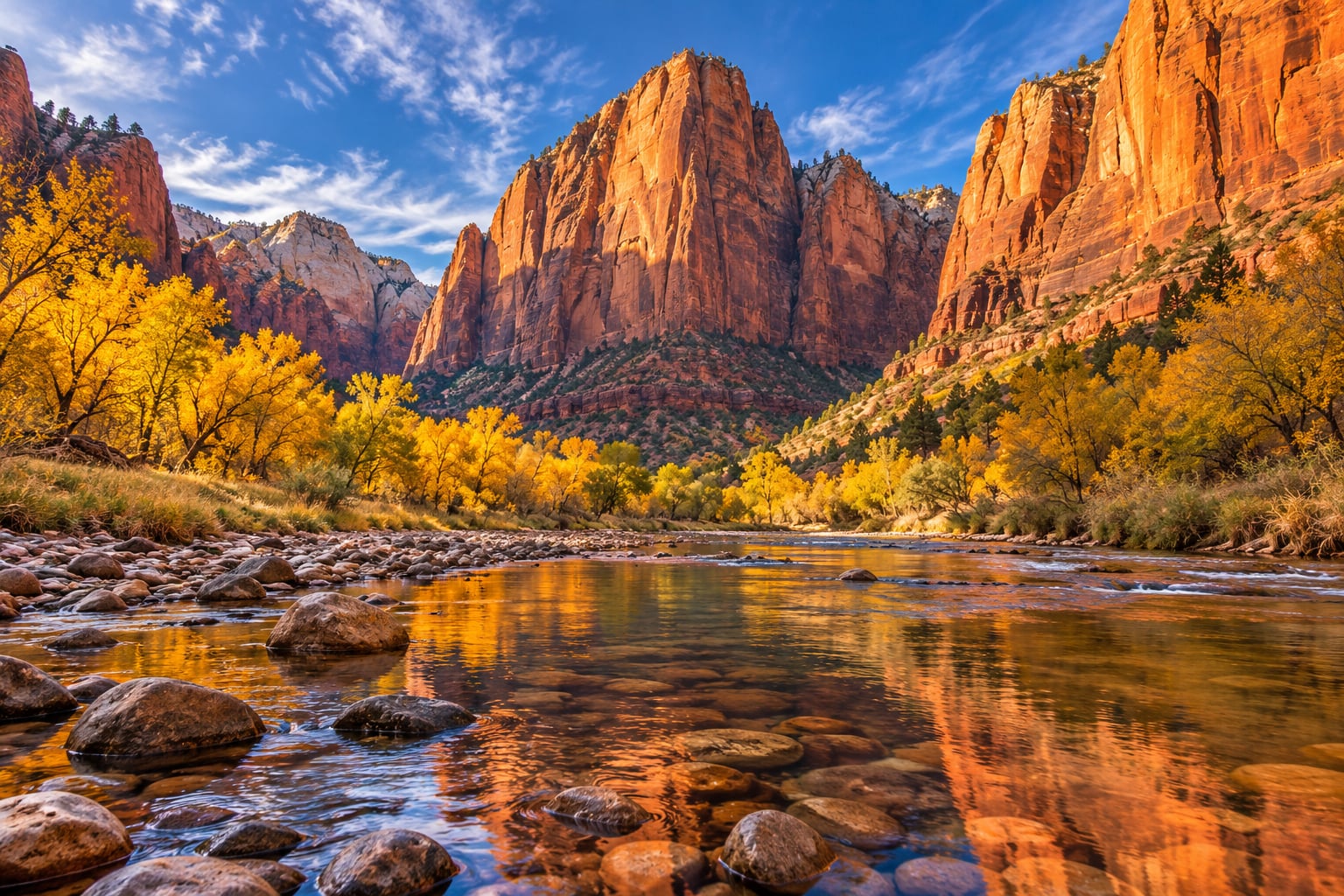
Standing in Awe Beneath the Two Thousand Foot Red Walls of Zion
Entering Zion Canyon feels less like visiting a park and more like stepping inside the nave of an immense natural cathedral. Unlike the Grand Canyon, where visitors gaze downward from the rim into the abyss, Zion envelops travelers from the valley floor looking straight up. Massive monoliths with evocative names like the Great White Throne, the Court of the Patriarchs, and Angels Landing rise thousands of feet above your head, their sheer faces sculpted by millions of years of water, wind, and seismic uplifting.
In the autumn season, the park reveals its finest personality. The Zion Canyon Scenic Drive is closed to private vehicle traffic for most of the year, meaning you travel along the canyon floor aboard zero-emission shuttle buses that glide quietly beneath the stone walls. As the morning sun creeps over the eastern rim, light hits the peaks first, turning pale Navajo sandstone into blazing torches of amber and rose gold while the canyon floor remains bathed in cool, quiet shadow.
Walking the paved Riverside Walk from the Temple of Sinawava at the very end of the shuttle line offers the perfect introduction to this landscape. The trail winds gently beside the Virgin River, shaded by weeping walls where hanging gardens of maidenhair ferns and wildflowers cling to seep springs in the sandstone. In autumn, the contrast is unforgettable: fiery yellow leaves drifting lazily through the crisp canyon air, contrasting against deep terracotta cliffs and sky of the purest sapphire blue.
Wading the Virgin River into the Towering Shadows of The Narrows
At the end of the Riverside Walk, the paved path simply dissolves into the river itself, marking the entrance to The Narrows, one of the most famous hikes on the planet. Here, the canyon walls constrict until they are barely twenty to thirty feet apart, soaring straight up toward a narrow sliver of sky hundreds of feet overhead. To venture deeper, you must step off dry ground and wade directly into the flowing waters of the Virgin River.
Hiking The Narrows in autumn requires preparation, but rewards you with absolute magic. By October, summer flash flood threats typically decline, and the river water clears from desert silt to translucent emerald. The water is undeniably brisk, requiring rented neoprene booties, thick neoprene socks, and a sturdy wooden hiking stick from outfitters in Springdale, but wading upstream through Wall Street—the narrowest and most awe-inspiring corridor—is an adventure unlike any other.
The sensory details here linger in memory for years:
- The steady rushing sound of water echoing against smooth, fluted stone walls polished by millennia of flash floods.
- Striated ribbons of color in the rock, where ancient sand dunes were compressed and mineral-tinted with iron and manganese into sweeping swirling patterns.
- Beams of midday sunlight breaking through the high canyon rim, illuminating pockets of mist and turning ripples on the river surface into liquid copper.
- The refreshing stillness of entering deeper bends where the sound of highway traffic does not exist, leaving only the rhythm of your boots stepping across cobblestones beneath the water.
Hikers who tackle this route do not need to walk the full sixteen miles of the canyon. Turning around after two or three miles delivers an unforgettable taste of raw wilderness before returning to dry land for a hot beverage.
Escaping the Canyon Crowds on the Canyon Overlook Trail and Pine Creek Canyon
While the main canyon floor draws the majority of visitors, some of Zion's most spectacular viewpoints sit east of the historic Zion-Mount Carmel Tunnel. Engineered in the 1920s through solid sandstone, this mile-long tunnel features grand cut-out windows framing vertiginous canyon views. As soon as you emerge from the eastern portal, you enter a starkly different landscape of slickrock plateaus, wind-sculpted stone chessboards, and pinyon-juniper woodlands.
Just outside the tunnel exit lies the trailhead for the Canyon Overlook Trail, an easy one-mile roundtrip scramble that packs an extraordinary visual punch:
- A protected path clinging to cliff edges, winding through alcoves with fossilized root systems and low-hanging stone ceilings.
- A sturdy footbridge crossing a sheer drop into Pine Creek Canyon, where canyoneers navigate deep slot chambers far below.
- An abrupt ending at a rocky promontory that looks straight out over the sweeping expanse of Zion Canyon, with the highway snaking through switchbacks below and the Towers of the Virgins anchoring the distant horizon.
Arriving at the overlook just before sunset is unforgettable. While the canyon floor sinks into early evening gloom, the high slickrock formations catch the last rays of red light, glowing with an intense, radiant warmth that seems almost supernatural.

Feasting on Navajo Tacos and Slow Smoked Southwest Campfire Cooking
After hours spent trekking through canyon rivers and ascending slickrock switchbacks, mountain appetite kicks in with ferocious intensity. The culinary scene surrounding Zion in Springdale and extending along Highway 89 toward Bryce Canyon reflects a delicious intersection of indigenous Southwest heritage, Mormon pioneer baking traditions, and contemporary wood-fired craft cooking.
Nothing satisfies after a cold-water river hike quite like authentic Navajo fry bread. Originating among the indigenous peoples of the Four Corners region, this pillowy, golden disc of fried dough serves as the hearty foundation for a mountain-sized Navajo taco. Crisp on the outside and tender within, the hot bread is piled high with:
- Slow-simmered pork carnitas or seasoned ground beef infused with roasted green chiles, cumin, and Mexican oregano.
- Creamy pinto beans simmered with smoked pork belly and garlic until velvety.
- Crisp shredded lettuce, ripe diced tomatoes, fresh cilantro, crumbled cotija cheese, and a dollop of cool sour cream.
- Fiery salsa verde made with charred tomatillos and roasted jalapeños to awaken the senses.
Beyond fry bread, the region excels in hearty campfire-inspired cooking. Roadside diners and rustic cedar lodge taverns serve steaming skillets of sweet honey butter cornbread baked fresh to order in seasoned cast iron, accompanied by fall-off-the-bone smoked pork ribs glazed in tart prickly pear barbecue sauce. Paired with a frosty glass of locally pressed sparkling apple cider from Southern Utah orchards, this rustic feast warms tired bones and sets the stage for tomorrow's alpine adventure.
Climbing to the Alpine Wonderworld of Bryce Canyon and Its Fairy Chimneys
Leaving Zion via the eastern plateau and driving north along scenic Highway 89, the elevation steadily climbs. You ascend from the warm, four-thousand-foot desert canyon of Springdale to the crisp, eight-thousand-foot alpine heights of Bryce Canyon National Park. The transition is striking: sagebrush valleys give way to dense forests of ponderosa pine, Douglas fir, and white fir, where mule deer graze peacefully along meadows dusted with morning frost.
Bryce Canyon is not actually a canyon in the traditional sense, but rather a series of gigantic natural amphitheatres carved into the eastern edge of the Paunsaugunt Plateau. When you first approach the rim at Sunrise Point or Sunset Point, the view simply takes your breath away. Spread out before you is an endless army of hoodoos—bizarre, slender stone spires sculpted by frost-wedging and rainwater from multi-colored Claron limestone.
The color spectrum here defies belief. Because different rock layers contain varying concentrations of iron oxides, the spires glow in alternating bands of pumpkin orange, pale rose, terracotta red, and porcelain white. In the clear autumn air, with zero humidity to soften the light, every ridge and pinnacle stands out in needle-sharp definition against the evergreen pine forests below.
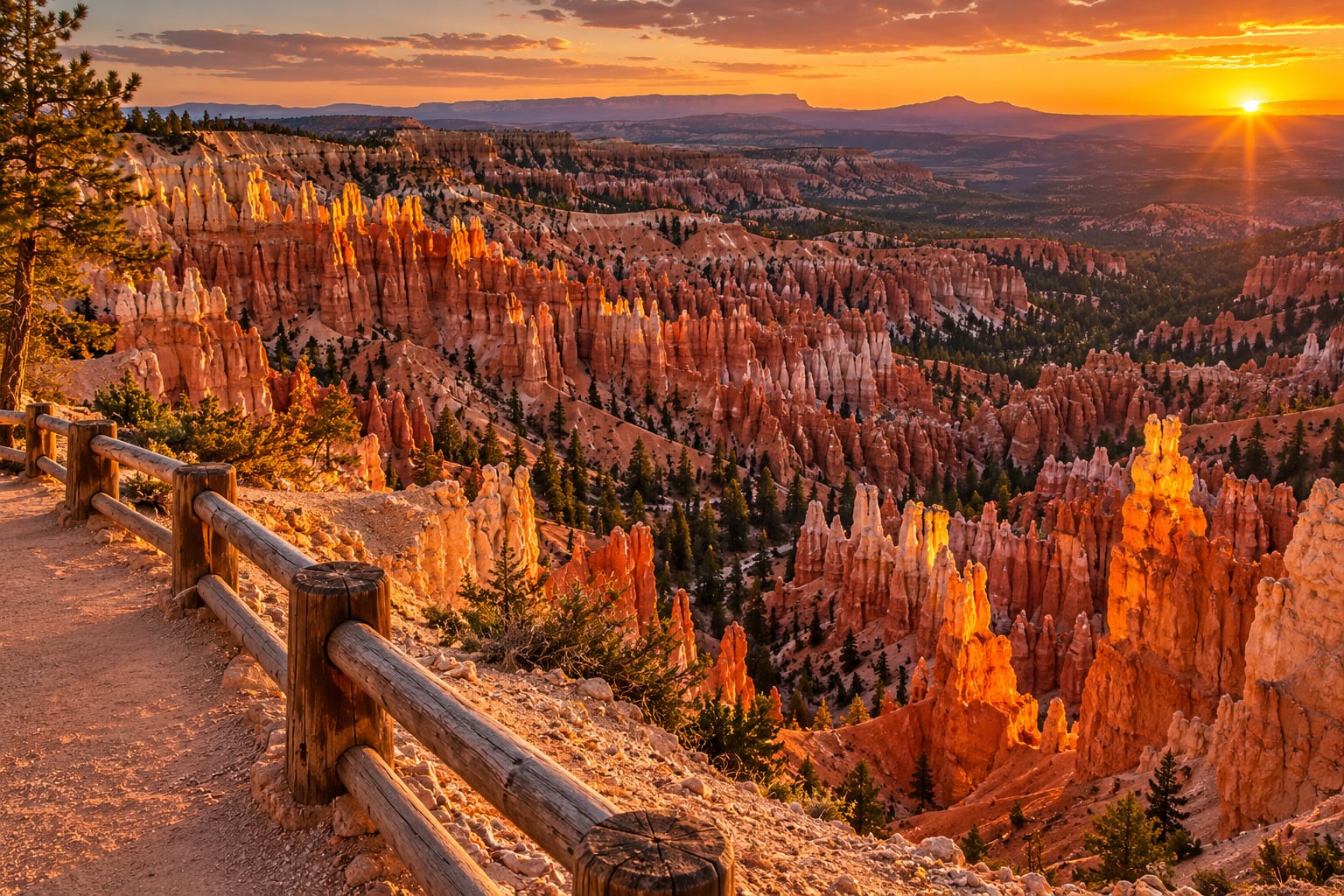
Descending the Queen Garden and Navajo Loop into Wall Street
Viewing Bryce Canyon from the rim provides an epic panoramic overview, but the true spirit of this park reveals itself only when you hike down between the spires. The classic route combines the Queen's Garden Trail with the Navajo Loop, creating an unforgettable three-mile circuit that drops hundreds of feet into the heart of the rock forest.
Beginning at Sunset Point, hikers descend into Wall Street, a dramatic slot canyon framed by towering perpendicular limestone walls so sheer they blot out the sun. Two ancient Douglas fir trees, hundreds of years old, reach straight toward the sky from the narrow canyon floor, their roots gripping deep into rocky crevices.
As you wander along the sun-dappled trail between the hoodoos, the formations take on whimsical, human-like personalities:
- Thors Hammer, a solitary spire capped with a colossal rectangular rock balancing precariously atop a slender pedestal.
- Two Bridges, where twin natural stone arches span a narrow gorge above the trail.
- Queen Victoria, an uncanny limestone formation that bears an unmistakable resemblance to the British monarch seated on a stone throne.
Walking at the base of the hoodoos provides an extraordinary sense of scale. Features that appeared diminutive from the rim tower sixty to a hundred feet above your head, their fluted surfaces textured with intricate ridges carved by water trickling over stone each spring.
Stargazing Under One of the Darkest Night Skies in North America
When the sun finally dips below the horizon in Southern Utah, a second, equally magnificent show begins overhead. Because Bryce Canyon sits at an elevation exceeding eight thousand feet and is separated by hundreds of miles of wilderness from major metropolitan light pollution, the park is designated as an International Dark Sky Park.
On crisp, moonless October nights, the atmosphere is so transparent that the night sky seems close enough to touch. As your eyes adjust to the darkness:
- The Milky Way appears not as a faint haze, but as a brilliant, silver-white river of starlight arching across the entire celestial dome from horizon to horizon.
- Thousands of distinct stars, distant nebulae, and shooting stars become clearly visible to the naked eye.
- The silent silhouettes of the stone hoodoos stand out against the cosmic background like ancient watchers guarding the rim of the earth.
Park rangers frequently host astronomy programs and dark-sky telescope sessions, allowing travelers to peer through high-powered optics at the rings of Saturn, the swirling arms of the Andromeda Galaxy, and glittering star clusters millions of light-years distant. It is a profoundly humbling experience that completes any journey into this geological wonderland.
Practical Advice for Navigating Utah Autumn Weather Permits and Shuttles
A journey through Zion and Bryce Canyon is an unforgettable adventure, but thoughtful advance preparation ensures everything runs smoothly:
- Shuttle system timing in Zion. During the autumn season, the Zion Canyon shuttle remains the mandatory method for accessing the scenic canyon drive. Shuttles run frequently and do not require advance reservations, but boarding queues at the visitor center can be long between nine in the morning and noon. Arrive at dawn to beat the crowds and enjoy the canyon in blissful morning quiet.
- Hiking gear for The Narrows. Do not attempt to hike The Narrows in cotton clothing or ordinary running shoes. The Virgin River is cold, and submerged boulders are slick. Rent a package from a Springdale outfitter containing neoprene wading socks, sticky-rubber canyoneering boots, and a sturdy wooden trekking pole.
- Elevation and temperature swings. Bryce Canyon sits several thousand feet higher than Zion. While Zion may enjoy pleasant seventy-degree weather in the afternoon, Bryce Canyon often drops below freezing at night and starts October mornings in the thirties. Dress in versatile moisture-wicking layers, including a fleece jacket, windproof shell, warm knit beanie, and gloves.
- Hydration and sun protection. Despite the cool autumn air, the desert environment rapidly dehydrates your body. Carry at least two liters of water per person, along with high-energy trail snacks, electrolyte powder, broad-spectrum sunscreen, and polarized sunglasses to cut through the intense high-altitude glare.
- Park passes and seasonal planning. If you plan to visit both parks, purchase the America the Beautiful annual interagency pass at your first park entrance. For eighty dollars, it covers entrance fees for both destinations and any other national parks you explore across the United States.